

A confrontation at a Jacksonville Beach skate park has led to the arrest of an off-duty sheriff’s officer after video surfaced showing a teenager being pulled from an electric bike and thrown to the ground. The incident, which occurred Saturday afternoon at Sunshine Park, has prompted a misdemeanor battery charge against 36-year-old Stephen Hicks, a five-year veteran of the Jacksonville Sheriff’s Office.
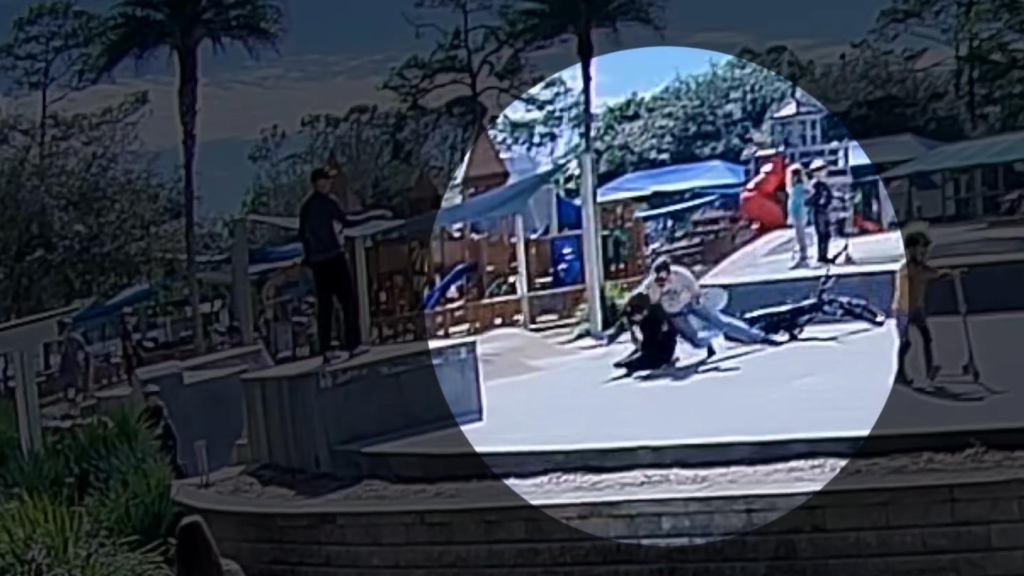
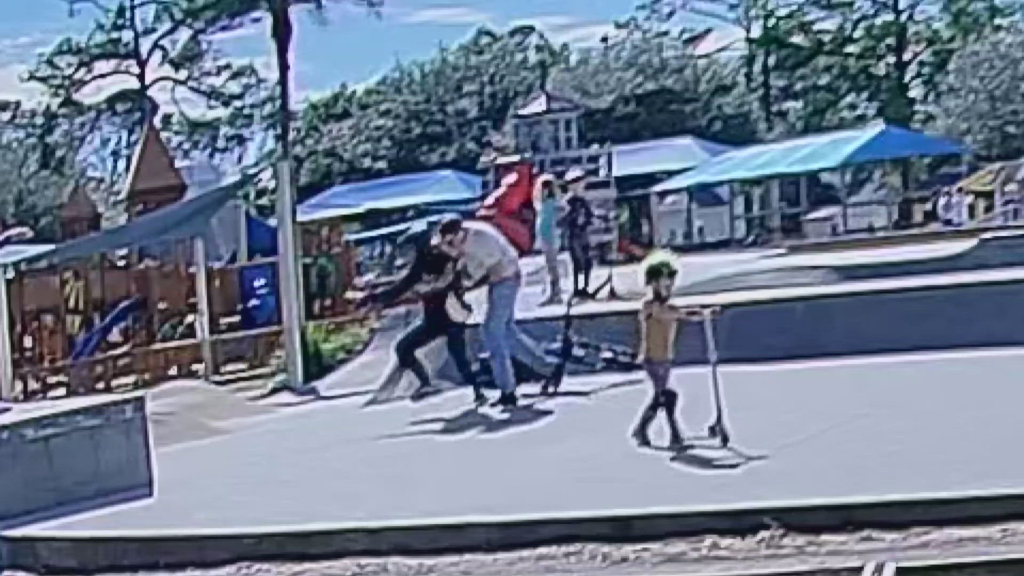
New footage obtained by First Coast News appears to capture the moment Hicks grabbed a teen by the shoulder, yanked him off an e-bike, and slammed him onto the pavement behind the skate park. The encounter unfolded amid ongoing tensions at the park over the use of motorized bikes in areas posted as off-limits, raising questions about enforcement, the conduct of off-duty officers, and the boundaries of intervention in public spaces frequented by minors.
According to investigators, police were dispatched to the park after receiving reports of teenagers riding e-bikes inside the skate park area despite posted signs prohibiting motorized bikes and scooters. One teen told officers that a man had pulled him off his bike and slammed him to the ground, causing minor injuries.
Witnesses reported that the man identified himself as an off-duty officer, displayed his badge, provided his name and badge number, and then left the scene. The Jacksonville Sheriff’s Office later confirmed that Hicks turned himself in to the Integrity Unit, was booked into the Duval County Jail, and was released on bond. The agency also stated that he has been reassigned pending the outcome of the case and that his most recent assignment was with the Hazardous Devices Unit.
The Incident at Sunshine Park and the Video Evidence
The video obtained by First Coast News has become central to public understanding of what happened at Sunshine Park. In the footage, Stephen Hicks is seen confronting a teenager behind the skate park area, where e-bikes had reportedly been ridden despite posted restrictions. Moments later, he appears to seize the teen by the shoulder, pull him off the bike, and throw him to the ground. The visual evidence has intensified scrutiny of the encounter, particularly because it involves an adult identifying himself as law enforcement and a minor engaged in a rule violation rather than a violent act.
Investigators say the call for service originated from complaints about e-bikes being used inside the skate park, an issue that has drawn increasing attention from parents and park-goers. Sunshine Park, like many skate parks, has signage prohibiting motorized bikes and scooters due to the risk they pose to younger children and others using traditional skate equipment. The teen involved told officers he suffered minor injuries as a result of the takedown.
While the reported injuries were not severe, the manner in which force was applied has become the focal point of the case. Witnesses at the park described a sequence in which Hicks asserted his authority after the confrontation. Several said he identified himself as an off-duty officer, showed his badge, and provided identifying information before departing.
Read : Teen Hiker Rescued from Heavy Storm in Northern California’s Bald Hills via Garmin SOS Activation
Those details were later confirmed by law enforcement officials as part of the investigation. The Jacksonville Sheriff’s Office determined there was sufficient cause to charge Hicks with misdemeanor battery, a decision that reflects the agency’s internal review process and the involvement of its Integrity Unit.
Read : Discovering Nature’s Giants: A Guide to the Largest Lakes Around the Globe
The presence of video has shaped public reaction. Unlike disputes that rely solely on competing accounts, the footage provides a concrete record that can be evaluated by investigators, prosecutors, and the court. It has also fueled broader debate about the role of video evidence in cases involving law enforcement, particularly when the officer is off duty and operating outside a formal enforcement context. The fact that the incident occurred in a space designed for youth recreation has further heightened concern.
Law Enforcement Response and Legal Proceedings
Following the incident, the Jacksonville Sheriff’s Office moved to address the allegations through its established accountability mechanisms. Hicks turned himself in and was booked into the Duval County Jail on a misdemeanor battery charge. He was later released on bond. JSO confirmed that he has been reassigned pending the outcome of the case, a step that places him away from his previous duties while the legal process unfolds.
The involvement of the Integrity Unit underscores the seriousness with which the agency is treating the matter. That unit is responsible for investigating allegations of misconduct involving personnel, particularly when questions arise about the use of force or violations of policy. While the criminal charge will be handled through the court system, the internal review may also examine whether Hicks’ actions complied with departmental standards governing off-duty conduct, identification as law enforcement, and appropriate responses to minor violations.
Hicks’ background has also drawn attention. At 36 years old, he is a five-year veteran of the Jacksonville Sheriff’s Office and was most recently assigned to the Hazardous Devices Unit. That assignment typically involves specialized training and responsibilities, which has led some observers to question how those skills and expectations translate to off-duty encounters in public recreational spaces. The sheriff’s office has not released further details about internal findings or potential disciplinary outcomes, noting that the case remains pending.
Legally, a misdemeanor battery charge hinges on whether the use of force was unlawful under the circumstances. Prosecutors will consider the video, witness statements, and the teen’s account of injuries. The defense may argue that Hicks was attempting to enforce park rules or ensure safety, while the prosecution will likely focus on proportionality and the absence of immediate danger justifying physical force. The outcome will depend on how the court weighs these factors, as well as any statutory considerations related to citizen’s arrests or off-duty law enforcement authority.
Community Reaction and Ongoing Concerns About E-Bikes
The incident has sparked a wide range of reactions among park users, parents, and community members. Thirteen-year-old Addie Martin, who regularly rides her e-bike at Sunshine Park, said she witnessed the confrontation and described it as frightening. She emphasized that many of the kids at the park are there simply to enjoy themselves. Her comments reflect a broader concern among young riders about safety and how conflicts are handled when adults intervene.
Parents who frequent the park have acknowledged that e-bikes present real challenges. Some describe the devices as fast and potentially dangerous when used in crowded areas with small children. Allen Warkentin, a regular at the park, characterized e-bikes as an epidemic at Sunshine Park, pointing to the risk they pose to younger kids on scooters. At the same time, he and others stressed that the officer’s actions went too far, drawing a clear line between enforcing rules and using physical force against a minor.
This dual perspective has shaped the community conversation. On one hand, there is widespread agreement that posted rules exist for a reason and that safety concerns are legitimate. On the other, there is discomfort with the idea that enforcement, particularly by an off-duty officer, escalated into a physical takedown. The incident has prompted calls for clearer guidelines on how park rules should be enforced and who should be responsible for doing so.
Sunshine Park has become a focal point for broader discussions about the rapid rise of e-bikes and how municipalities adapt to new forms of recreation. As e-bikes become more common among teenagers, parks and local governments are grappling with questions about designated areas, enforcement strategies, and education. The Jacksonville Beach incident illustrates how these unresolved issues can lead to confrontation, especially when expectations between adults and youth diverge.
For now, the case against Stephen Hicks proceeds through the legal system, while the community continues to weigh safety concerns against the conduct captured on video. The outcome will likely influence how similar situations are handled in the future, both by law enforcement and by those tasked with maintaining order in public recreational spaces.
References:
Mobile casino
References:
https://forum.issabel.org/u/porterhook78
References:
Games slots
References:
https://oiaedu.com/forums/users/quartzquiver7/
References:
When were steroids invented
References:
https://christophorus-sb.de/Aktuelles;focus=TKOMSI_com_cm4all_wdn_Flatpress_22854780&frame=TKOMSI_com_cm4all_wdn_Flatpress_22854780?x=entry:entry201030-095636;comments:1