
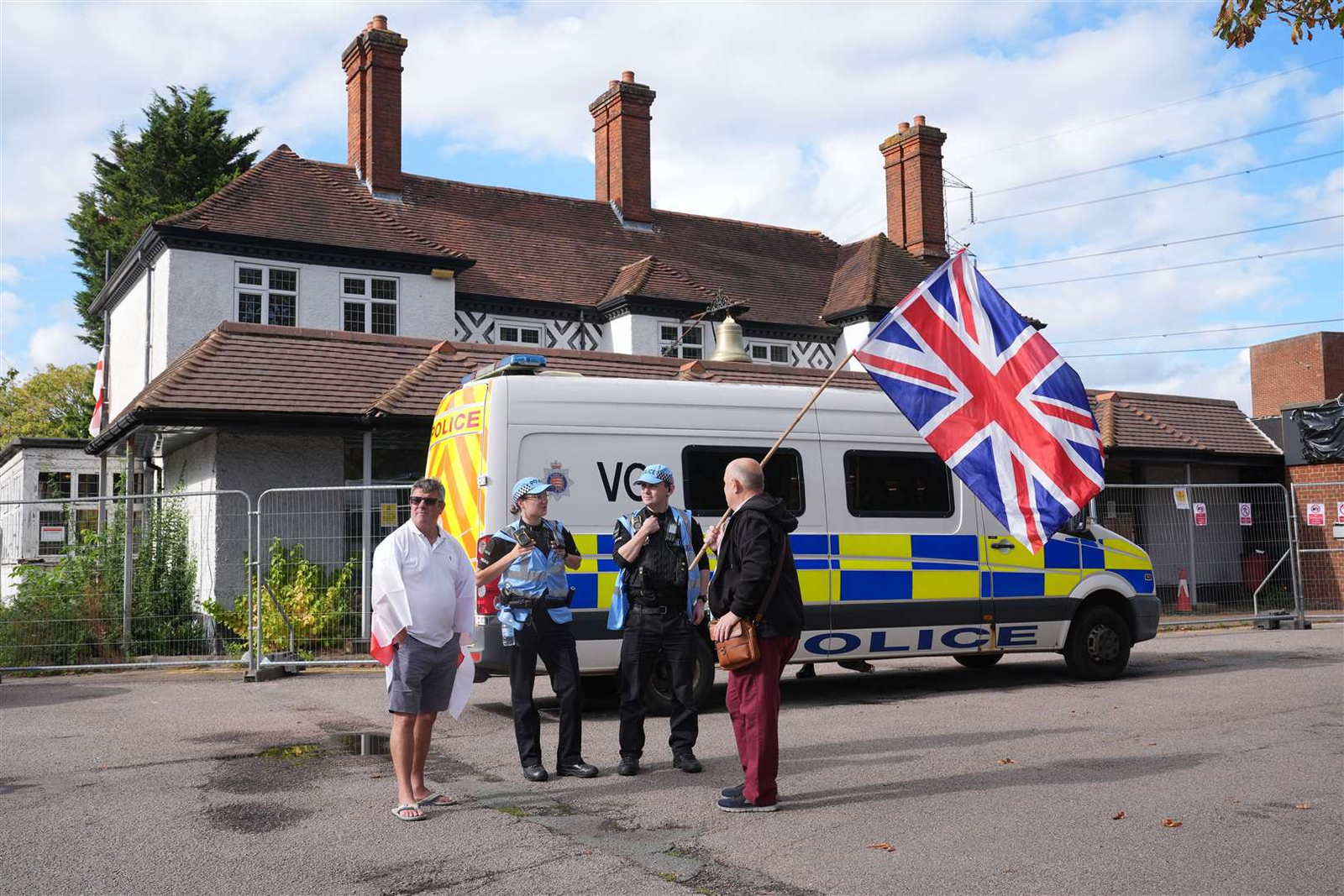
On Friday, August 29, 2025, a protest outside Bell Hotel in Epping, Essex, turned chaotic, resulting in the arrest of three men and injuries to two police officers. The demonstration was sparked by a Court of Appeal ruling that overturned a temporary injunction, allowing the hotel to continue housing 138 asylum seekers. The ruling reignited tensions in the community, which have been simmering since July due to ongoing protests and counter-protests over the use of the hotel as a residence for asylum seekers.
The Protest and Arrests
The protest outside Bell Hotel began on Friday evening, following the Court of Appeal’s decision to allow asylum seekers to remain at the hotel. The demonstration drew a mix of local residents and individuals from a separate protest in nearby Cheshunt, Hertfordshire. While most protesters expressed their views peacefully, a small group engaged in disruptive behavior, leading to a significant police response.
Essex Police reported that three men were arrested for separate offenses: one on suspicion of violent disorder, another for assaulting a police officer, and a third for drink-driving after allegedly driving a car on the wrong side of the road toward a police cordon. Two police officers sustained injuries during the unrest, though the injuries were described as non-serious.
Assistant Chief Constable Glen Pavelin, who oversaw the policing operation, emphasized that while the right to protest is a democratic principle, it does not extend to criminal acts. He noted that the majority of those present in Epping on Friday aimed to voice their concerns peacefully, but the actions of a few necessitated arrests. To manage the situation, Essex Police implemented a dispersal order around the Bell Hotel, which remained in place until 6 a.m. on Saturday, August 30, 2025. This order was designed to prevent further disorder and ensure public safety.
The protest saw demonstrators carrying England and Union Jack flags, with some chanting slogans and displaying banners. One protester, identified only as Carmen, wore a pink top with the message “Pink Ladies Say, The Only Way is Epping, Send Them Home.” She described the court’s ruling as “devastating” and warned that it could lead to civil unrest.
This is fantastic. @EssexPR is at the Bell Hotel protest in Epping.
— Lee Harris (@addicted2newz) August 8, 2025
No far-right.
No violence.
No masks.
Just HUNDREDS of concerned locals, families peacefully protesting.
They are NOT going to stop until that hotel is closed.
Good for them! 🔥pic.twitter.com/kDHnxe0O30
The charged atmosphere was further heightened by the presence of counter-protesters, including members of the group Stand Up To Racism, who had also gathered in Cheshunt earlier that day. While no arrests were reported in Cheshunt, small groups there engaged in disorderly behavior, clashing with police, though no formal complaints were filed by the public.
By Saturday, Essex Police confirmed that two of the three men arrested had been charged. Jimmy Hillard, 52, of Chequers Road, Loughton, was charged with assaulting an emergency worker, and Ross Ellis, 49, of Orchard Croft, Harlow, was charged with failing to provide a specimen. The third man, arrested on suspicion of violent disorder, remained in custody as investigations continued. Police maintained a visible presence in Epping throughout Saturday to enforce the dispersal order and prevent further incidents.
Background of the Bell Hotel Controversy
The Bell Hotel has been at the center of controversy in Epping since July 2025, when protests began following the arrest of an asylum seeker housed at the facility. Hadush Kebatu, a 38-year-old Ethiopian man, was charged with multiple offenses, including the alleged sexual assault of a 14-year-old girl.
Kebatu has denied the charges, and his trial is ongoing. The incident fueled local discontent, with some residents expressing concerns about safety and the appropriateness of using the hotel to accommodate asylum seekers. Since then, the Bell Hotel has been a focal point for weekly protests, drawing both local residents and external groups, including far-right activists and counter-protesters advocating for refugee rights.
Read : 22-Year-Old Channay Augustus Charged with Assaulting Security Guard at Britannia International Hotel
The legal battle over the hotel’s use intensified when Epping Forest District Council secured a temporary injunction from the High Court, which would have prohibited the accommodation of asylum seekers at the Bell Hotel beyond September 12, 2025. The council argued that the Home Office’s decision to house asylum seekers there posed risks to the community, particularly citing concerns about the proximity of the hotel to Epping St John’s, a local primary school.
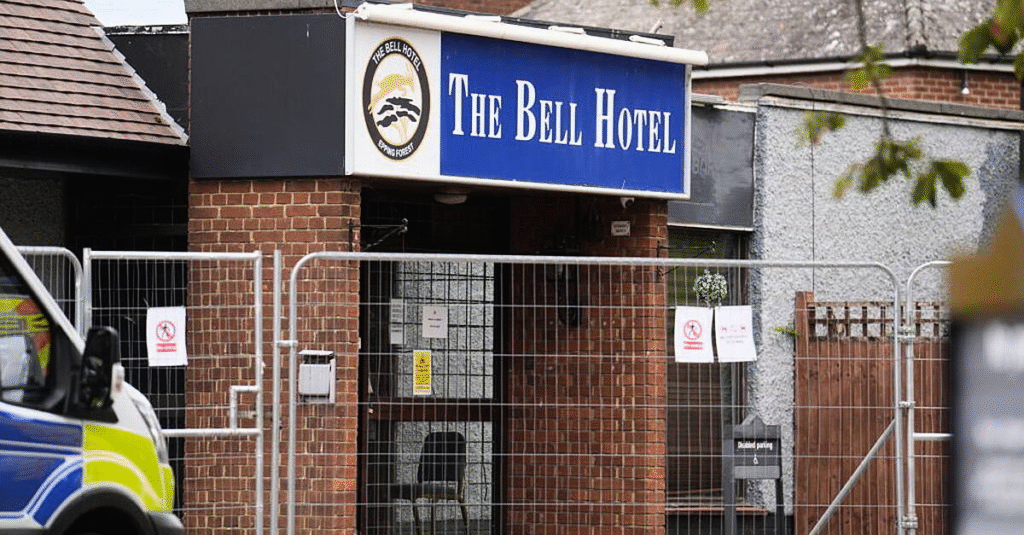
However, the Court of Appeal, led by Lord Justice Bean, overturned the injunction on August 29, 2025, deeming it “seriously flawed in principle.” The Home Office, represented by Edward Brown KC, argued that the hotel was part of “critical national infrastructure” and that housing asylum seekers was in the national interest. The court’s decision ensured that the 138 asylum seekers currently residing at the Bell Hotel would not be forced to leave by the September deadline.
However, Epping Forest District Council has not ruled out escalating the case to the Supreme Court, and at least 13 other councils are reportedly considering similar legal challenges against asylum hotels in their jurisdictions. The government has stated its intention to phase out the use of hotels for asylum seekers in an “orderly way” by the end of the current Parliament, but the immediate continuation of the Bell Hotel’s use has sparked frustration among some local residents.
Community Reactions and Broader Implications
The unrest in Epping reflects a broader divide in public sentiment regarding immigration and asylum policies in the UK. Residents like Stuart Hugh, a 36-year-old who lives near the Bell Hotel and has attended protests with his parents, expressed frustration with what he perceives as “uncontrolled illegal immigration.”
He condemned the violence that occurred during Friday’s protest, arguing that it detracts from the protesters’ message and risks portraying them as “thugs.” Similarly, Laura Fraye, whose mother lives in Epping, predicted that the court’s ruling would cause “a lot of upset” in the community. Her partner, Sarah, described the situation as “really upsetting,” while Mr. Turvey, another local, acknowledged the complexity of the issue, stating, “It’s not good – but I don’t know what the answer is.”
On the other hand, some residents and counter-protesters argue that the protests have been co-opted by far-right groups, misrepresenting the broader community’s views. Millie Smith, an Epping resident who attended a rally in early August, claimed that the presence of far-right protesters had led to “misinterpretation” of the demonstrations’ purpose.
The Home Office has emphasized its efforts to reform the asylum system, citing a “rapid increase in asylum decision-making” and the removal of over 24,000 individuals with no legal right to remain in the UK. Home Office Minister Dame Angela Eagle reiterated the government’s commitment to closing asylum hotels, but the immediate impact of the court ruling has left many in Epping feeling unheard.
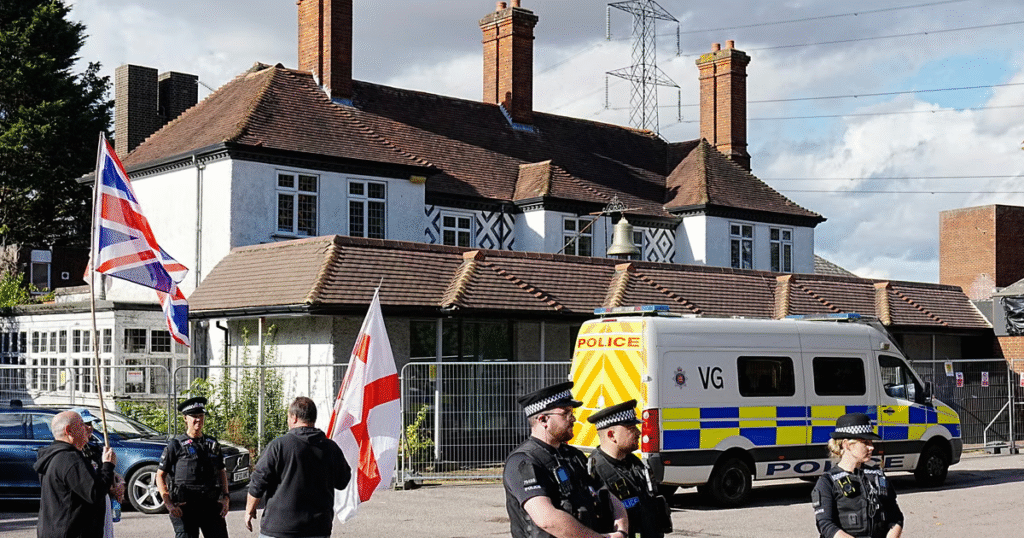
The protests have also raised concerns about community safety and cohesion. Lindsey Thompson, a 58-year-old resident, voiced fears for the safety of children at Epping St John’s, describing the situation as “terrifying.” Holly Whitbread, a Conservative councillor for Epping West, called the Court of Appeal’s decision “deeply disappointing” and a “betrayal” for many residents. She affirmed the council’s commitment to exploring all legal and diplomatic avenues to address the issue, signaling that the fight over the Bell Hotel is far from over.
The unrest has also drawn attention to the role of social media in amplifying tensions. Posts on X have highlighted the polarized nature of the debate, with some users praising the peaceful efforts of local protesters while others criticized police actions or the involvement of external groups like Stand Up To Racism and ANTIFA.
One post described a peaceful march that escalated when police blocked roads, leading to confrontations, while another accused authorities of facilitating counter-protesters to provoke trouble. These accounts, while not conclusive, underscore the challenge of managing public discourse in a highly charged environment.
The events in Epping highlight the complexities of balancing local concerns with national immigration policies. The protests, while rooted in genuine community anxieties, have at times spiraled into disorder, complicating efforts to find a resolution. The government’s victory in the Court of Appeal may have averted immediate disruption to its asylum housing strategy, but it has also galvanized opposition, both in Epping and potentially in other communities facing similar issues.
A full High Court hearing on the Bell Hotel’s use is scheduled for mid-October, which could further shape the trajectory of this ongoing saga. The protest outside the Bell Hotel in Epping on August 29, 2025, and the resulting arrests and injuries reflect deep-seated tensions over asylum policy and community safety.
While the majority of protesters sought to express their views peacefully, the actions of a few underscored the challenges of managing public demonstrations in a polarized climate. As Epping braces for continued debate and legal battles, the situation serves as a microcosm of broader national conversations about immigration, integration, and the role of local governance in addressing complex social issues.