
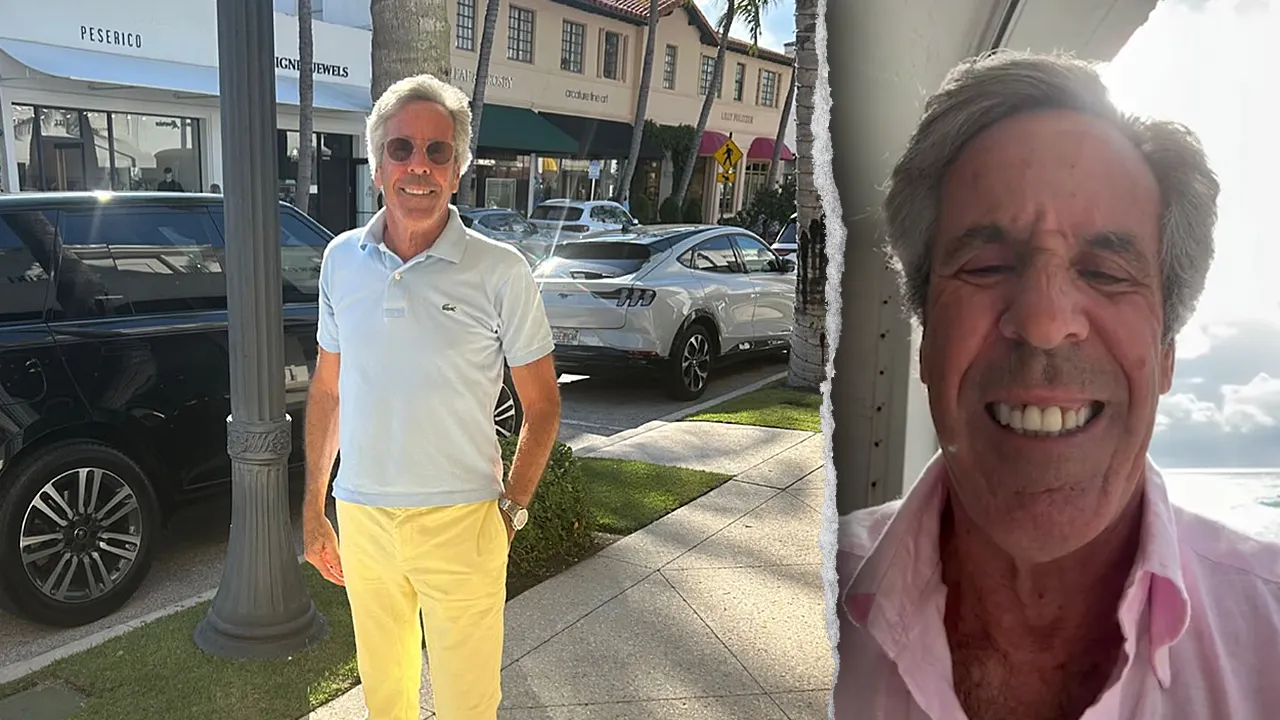
A seemingly ordinary moment on a South Florida highway unexpectedly turned into a viral internet sensation when a short video clip captured a man driving a convertible with the top down. Wearing sunglasses and a backward white baseball cap, the driver quickly drew attention online due to his striking resemblance to the late financier Jeffrey Epstein.
Within hours of being shared, the footage triggered widespread speculation, debate, and even conspiracy theories across social media platforms. Many users questioned whether the man could somehow be Epstein, despite official records confirming his death years earlier. As the clip continued to circulate, curiosity about the driver’s identity intensified, eventually leading to a public response from the man himself, who would soon be dubbed “Palm Beach Pete.”
The Viral Video That Sparked Speculation
The video that ignited the controversy was filmed from another moving vehicle, capturing a brief but clear glimpse of the driver. The angle, lighting, and the man’s facial features contributed to a resemblance that some viewers found uncanny. Social media users quickly began sharing the clip with captions that hinted at disbelief and intrigue, asking others to weigh in on who the driver looked like. In a digital environment where visual similarities often fuel speculation, the resemblance was enough to trigger widespread attention.
As the video gained traction, reactions ranged from humorous disbelief to more serious conspiracy-driven discussions. Some viewers insisted that the resemblance was too close to ignore, while others dismissed the idea outright, pointing to the widely documented circumstances surrounding Epstein’s death in 2019. Despite the lack of credible evidence supporting any alternative narrative, the clip continued to circulate rapidly, amplified by reposts, commentary, and algorithm-driven visibility.

The situation reflects a broader pattern in online culture, where brief and context-limited clips can quickly evolve into major talking points. Visual ambiguity, combined with public fascination around controversial figures, often creates an environment where speculation thrives. In this case, the viral nature of the video was less about verified information and more about perception, curiosity, and the speed at which content spreads online.
Palm Beach Pete Responds to the Claims
As the speculation intensified, the man at the center of the viral clip stepped forward to address the claims directly. Identifying himself as “Palm Beach Pete,” he firmly denied any connection to Epstein and expressed surprise at the sudden attention. According to his account, he had no idea he was being filmed at the time and only became aware of the situation once his phone began receiving an overwhelming number of messages.
Describing the experience, he explained that he had simply been driving along Interstate 95, going about his day as usual, when the video was recorded without his knowledge. The unexpected nature of the situation left him both amused and bewildered, as he found himself at the center of a viral moment he had not anticipated. His reaction highlighted the often unpredictable consequences of being captured in public footage that gains widespread attention online.
Read : Who Is David Rubenstein, Baltimore Orioles Owner Named in Jeffrey Epstein Files?
In interviews, Palm Beach Pete maintained a lighthearted tone while addressing the rumors, emphasizing that the situation was more surreal than concerning. He acknowledged the resemblance that sparked the speculation but made it clear that the claims had no basis in reality. His willingness to engage with the situation publicly helped to clarify the narrative, although it did not entirely stop the spread of the original clip or the discussions surrounding it.
Hello this Palm Beach Pete just wanted to thank everybody for the support and good vibes… I’m not Jeffrey Epstein pic.twitter.com/0sRXvSSAW1
— Palm Beach Pete (@not_jeffepstein) March 20, 2026
The incident also underscores how quickly individuals can become viral figures in the digital age, often without consent or prior public presence. A single moment, captured and shared widely, can transform an ordinary person into an internet talking point overnight. In Pete’s case, the sudden attention brought both recognition and the challenge of addressing misinformation circulating at scale.
Fact-Checks, Reality, and the Persistence of Online Myths
Despite the wave of speculation, official records and prior investigations leave little room for doubt regarding Epstein’s fate. Authorities confirmed his death in 2019, with findings concluding that he died by suicide while in custody. These conclusions have been widely reported and supported by multiple reviews, making any claims of his survival highly implausible.

Fact-checking organizations and media outlets quickly addressed the viral video, reiterating that the man in the clip was simply an unidentified driver who bore a resemblance to Epstein. Their assessments emphasized the absence of any credible evidence linking the two, reinforcing the importance of relying on verified information rather than visual similarities or viral narratives.
This is not the first time such claims have emerged. Similar incidents in the past have involved images or videos that were misinterpreted or manipulated, sometimes even involving digitally altered content. In one instance, a widely circulated image purportedly showing Epstein in another country was later identified as artificially generated, further illustrating how easily misinformation can spread when combined with public curiosity and technological tools.
The persistence of these narratives highlights a key aspect of modern information consumption: the tension between verified facts and viral speculation. Even when authoritative sources provide clear explanations, alternative theories can continue to circulate, driven by engagement and the human tendency to question official accounts. Social media platforms, while enabling rapid information sharing, also contribute to this dynamic by prioritizing content that generates strong reactions.
At the same time, the case of Palm Beach Pete serves as a reminder of the real-world impact such viral moments can have on individuals. While some may find humor in the situation, the sudden attention can be overwhelming, particularly when it involves association with a controversial figure. The experience underscores the importance of critical thinking and responsible sharing in an era where misinformation can spread as quickly as factual reporting.
Ultimately, the story of Palm Beach Pete is less about mystery and more about the mechanics of virality in the digital age. A brief video, a perceived resemblance, and the rapid amplification of social media combined to create a narrative that captured widespread attention. While the facts remain clear, the episode illustrates how easily speculation can take hold and how quickly ordinary moments can become extraordinary in the online world.