
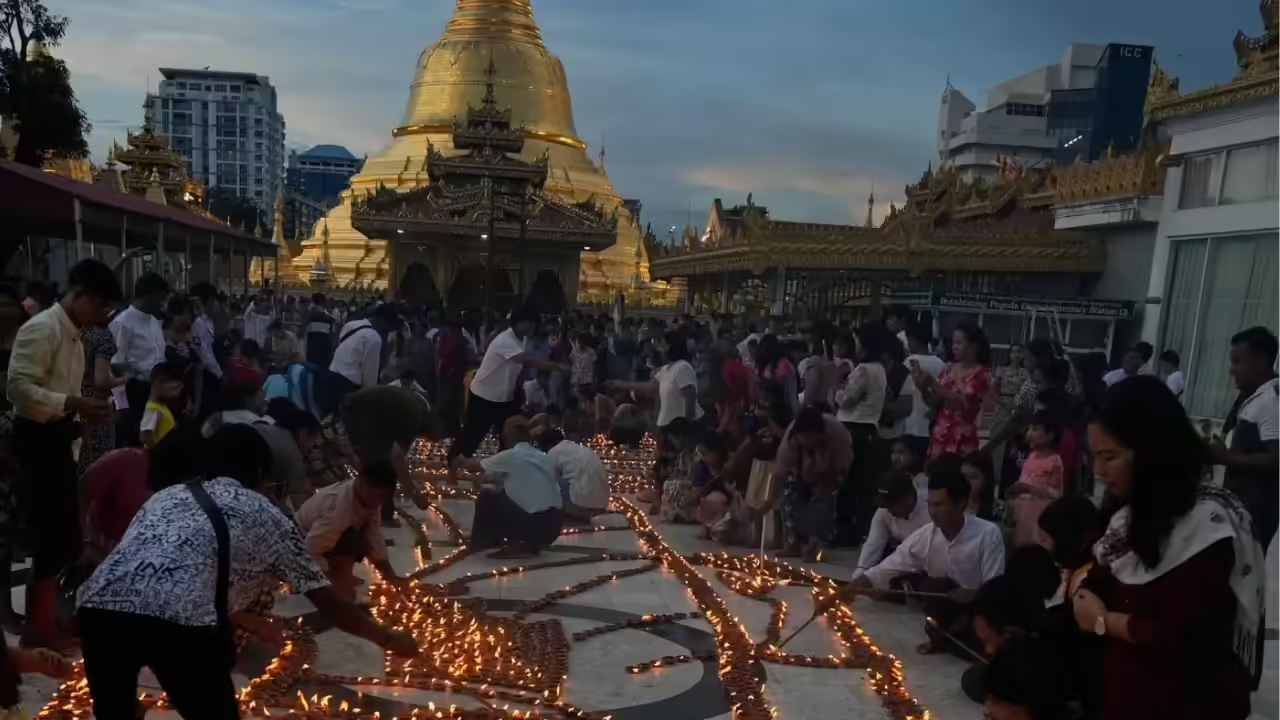
In a shocking escalation of its campaign against civilian dissent, Myanmar’s military junta launched a nighttime aerial assault on a peaceful gathering in Chaung-U Township, Sagaing Region, on October 6, 2025. The attack targeted participants in the Thadingyut Festival, a revered Buddhist full moon celebration, who were also holding a candlelight vigil to protest the regime’s policies. Motorized paragliders, or paramotors—lightweight aircraft equipped with small engines and capable of low-altitude flights—dropped at least two bombs directly into the crowd, resulting in a devastating loss of life.
Eyewitness accounts describe a scene of chaos as the distinctive chainsaw-like buzz of the approaching paramotors pierced the night air. Around 100 villagers had assembled for the event, which blended traditional festival observances with calls for the release of political prisoners, opposition to forced military conscription, and rejection of the junta’s planned December elections. The strike killed at least 24 people and injured 47 others, according to spokespeople from the exiled National Unity Government (NUG) and the anti-junta People’s Defence Force (PDF).
Other reports from local organizers and media outlets place the death toll higher, at over 40, including several children whose bodies were described as “completely torn apart” in the aftermath. This incident is not an isolated act but part of a broader pattern of aerial terror inflicted by the junta since its February 2021 coup. The United Nations has documented thousands of civilian casualties from such attacks, with paramotors emerging as a favored tool due to their affordability and ability to evade traditional air defenses. Amnesty International highlighted the assault as a “gruesome wake-up call,” noting that it occurred in an area where resistance groups are active, yet the targets were unarmed civilians honoring a national holiday.
Eyewitness Accounts and the Moment of Horror
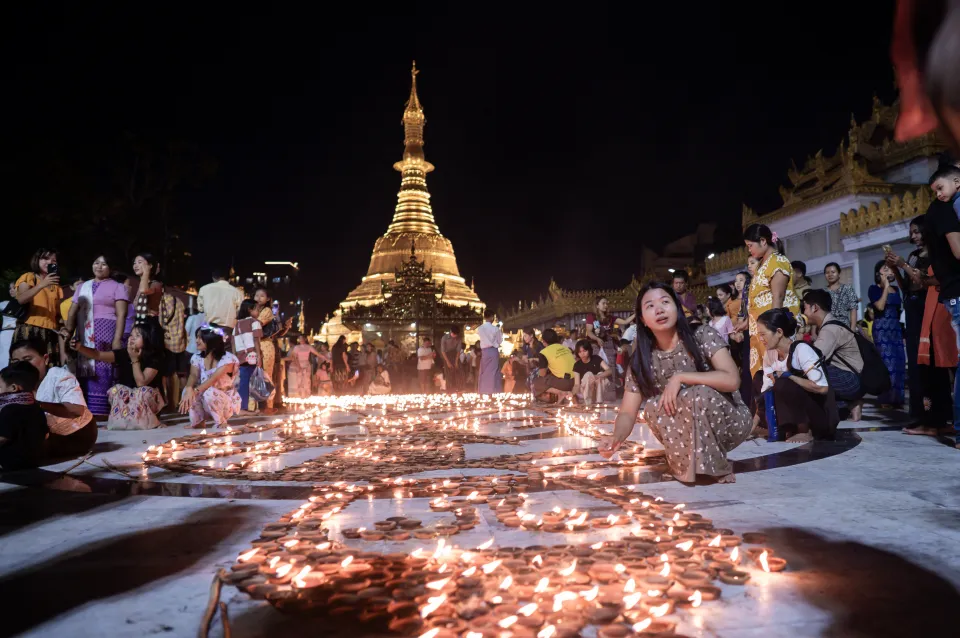
The Thadingyut Festival, also known as the Festival of Lights, marks the end of Buddhist Lent and is observed nationwide with candlelit processions and offerings to the Buddha. In Chaung-U Township, a rural area in Sagaing Region—one of the junta’s most contested fronts—the evening of October 6 began with quiet reverence. Families lit candles, children played under the full moon, and adults gathered to voice grievances against the regime that has plunged Myanmar into civil war.
At approximately 7:00 p.m., as the vigil transitioned into open protest, warnings circulated about a potential airborne threat. A local PDF official, speaking anonymously to BBC Burmese, recounted how organizers urged the crowd to disperse swiftly. “We received information about a possible attack and tried to wrap up the protest quickly,” he said. “But the paramotors arrived earlier than expected—within seven minutes.” Despite efforts to alert attendees, panic ensued as the first aircraft swooped low over the field.
A female organizer, who spoke to Agence France-Presse (AFP) on condition of anonymity for safety reasons, described the horror unfolding in real time. “The committee alerted people, and one-third of the crowd managed to flee,” she recalled. “But immediately, one motor-powered paraglider flew right over the crowd, dropping two bombs on the center of the gathering.” The explosions ripped through the assembly, scattering bodies and extinguishing the festival’s symbolic lights. “While I was saying to people ‘please don’t run,’ the paramotor dropped two bombs,” added a male witness, his voice breaking as he detailed the shrapnel that struck his knee amid screams of the dying.
🔴#Myanmar Army bombs a BUDDHIST festival– 24 killed and 47 injured
— Levina🇮🇳 (@LevinaNeythiri) October 8, 2025
At least 24 people have been killed and 47 others wounded after a motorised paraglider dropped explosives on a crowd gathered for a candlelight vigil in Chaung U, Myanmar.
After losing control of more than… pic.twitter.com/pt3XIdZUNF
Survivors reported a second paramotor strike around 11:00 p.m., which caused less damage but compounded the trauma. The blasts, likely from 120mm mortar rounds as noted by UN monitors, left the site littered with dismembered remains, making identification arduous in the darkness. “Children were completely torn apart,” the female organizer told AFP, her words echoing the indiscriminate brutality. Medical aid arrived sporadically, hampered by ongoing conflict, and the wounded were ferried to makeshift clinics where resources are scarce. Among the dead were infants and elders, turning a night of spiritual renewal into one of unimaginable grief.
Local resistance networks, including the PDF, confirmed the paramotors originated from the junta’s Monywa Northwestern Command, a base known for launching similar raids. These accounts align with video footage circulating among exile communities, showing smoldering craters and bloodied garments, though junta-controlled media has remained silent, as is standard in such cases.
The Rise of Paramotors: A Disturbing Tactic in Junta Warfare
The use of motorized paragliders represents a grim innovation in the junta’s arsenal, born from necessity amid international sanctions that have crippled its access to conventional aircraft. Since 2021, Myanmar’s military has faced fuel shortages, maintenance issues, and a dearth of helicopters, prompting a shift to cheaper, more agile alternatives like paramotors. These devices, typically used for recreational flying, can carry a single operator and payloads of up to 10 kilograms, including improvised explosives, at altitudes as low as 50 meters—making them nearly silent until the final moments and difficult to detect with radar.
Amnesty International’s Myanmar researcher, Joe Freeman, described this trend as “disturbing,” citing documentation of over a dozen paramotor attacks in Sagaing Region alone this year. “It continues to kill civilians on a daily basis, using methods such as motorized paragliders,” Freeman stated in a October 7 release. The UN human rights office has similarly warned that these runs often involve indiscriminate drops of mortar rounds in populated areas, violating international humanitarian law. In the Chaung-U incident, the paramotors’ low flight path ensured precision targeting of the vigil, exploiting the junta’s intelligence on resistance hotspots.
This tactic’s proliferation ties directly to the junta’s logistical woes. Western arms embargoes and supply chain disruptions have grounded much of the air force, forcing reliance on imported civilian gear modified for combat. BBC Burmese investigations reveal that paramotors, sourced from Southeast Asian markets, cost under $5,000 each—far below fighter jets—and require minimal training. Yet their effectiveness in terrorizing communities is profound: the chainsaw buzz has become a harbinger of death in rural Myanmar, prompting mass evacuations at the mere sound.
Experts estimate paramotors have contributed to at least 200 civilian deaths nationwide since mid-2024, with Sagaing bearing the brunt due to its role as a PDF stronghold. The NUG has called for targeted sanctions on paramotor suppliers, arguing that such low-tech weapons amplify the junta’s ability to sustain low-intensity warfare against a population that has largely rejected its rule.
International Condemnation and the Path to Accountability
The paramotor bombing has ignited swift global outrage, with human rights groups and exiled leaders demanding immediate intervention. Amnesty International urged ASEAN, convening later in October, to “increase pressure on the junta and revise an approach that has failed the Myanmar people for almost five years.” The organization’s call underscores the bloc’s tepid response since the coup, limited to non-interference principles that have allowed atrocities to fester.
The NUG, functioning as a shadow government, labeled the attack a “war crime” and appealed to the International Criminal Court for investigations, citing the systematic targeting of civilians. UN Special Rapporteur Tom Andrews echoed this, stating in a preliminary assessment that the strike exemplifies the junta’s “policy of collective punishment.” Western nations, including the US and UK, reiterated sanctions threats, while India and China—key junta backers—issued muted calls for restraint without concrete action.
Domestically, the assault has galvanized resistance. PDF units in Sagaing vowed intensified operations against Monywa bases, and underground networks reported heightened recruitment post-attack. The December elections, dismissed as a sham by observers, now face even broader boycott calls, with vigil participants’ chants for Aung San Suu Kyi’s release resonating anew.
As funerals proceed under curfew shadows, the Thadingyut tragedy exposes the junta’s fragility: a regime so desperate it bombs its own festivals to cling to power. Yet it also highlights civilian resilience—turning mourning into momentum for a democratic Myanmar. With over 6,000 killed and 3 million displaced since 2021, the international community must move beyond words. Urgent arms monitoring, humanitarian corridors, and diplomatic isolation could tip the scales, ensuring paramotors become relics of recreation, not repression.