
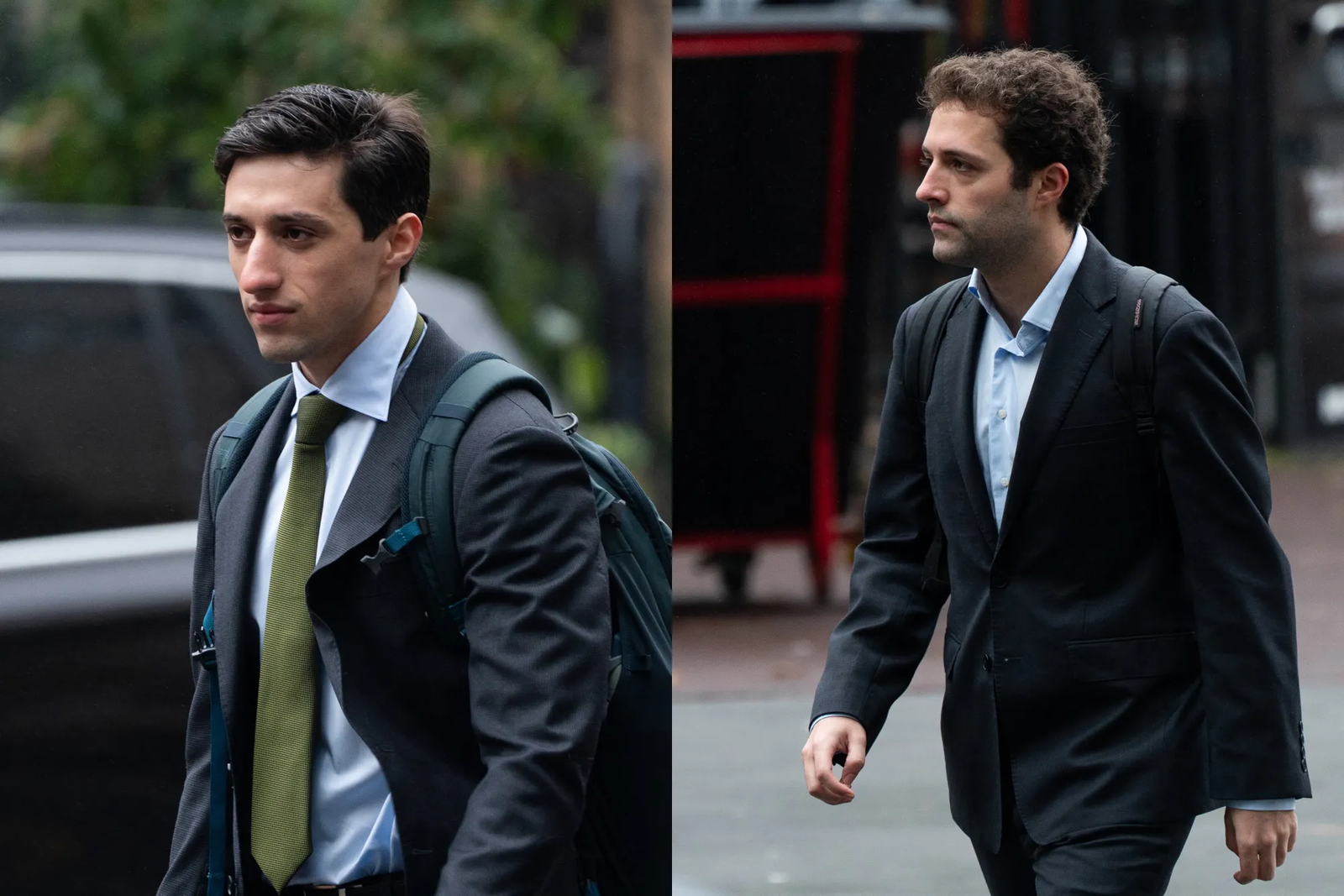
The high-stakes world of cryptocurrency has often blurred the line between innovation and illegality, and few cases illustrate this tension more vividly than that of Anton and James Peraire-Bueno. The two MIT-educated brothers stand accused of orchestrating a complex digital heist that allegedly netted them $25 million in Ethereum within seconds. Their trial, which opened on October 14 in Manhattan federal court, has drawn global attention for its implications on how law and technology intersect in an industry often defined by anonymity, speed, and minimal oversight. The case could become a landmark in determining where the boundaries of lawful trading end and fraud begins in decentralized finance (DeFi).
The Rise of the Peraire-Bueno Brothers: From MIT to the Digital Frontier
Anton Peraire-Bueno, 25, and his older brother, James, 29, both share an academic pedigree that many aspire to — degrees from the Massachusetts Institute of Technology (MIT), one of the world’s most prestigious institutions for mathematics, computer science, and engineering. During their years at MIT, the Peraire-Bueno Brothers developed deep technical expertise in cryptography, coding, and algorithmic systems — skills that would later prove both a strength and a potential source of legal peril.
Described by acquaintances as highly intelligent and intensely focused, the brothers reportedly immersed themselves in blockchain studies, fascinated by how decentralized networks could redefine finance. Their intellectual curiosity led them into Ethereum, a leading blockchain network that supports smart contracts and decentralized applications. Ethereum’s open architecture, which invites innovation, has also made it vulnerable to exploitation — and prosecutors now allege that the brothers used this very openness to their advantage.
According to the indictment, the Peraire-Bueno brothers spent three months meticulously planning a digital operation that prosecutors describe as a “first-of-its-kind” blockchain attack. Using their advanced understanding of how Ethereum transactions are verified, they allegedly identified and exploited a software vulnerability that enabled them to intercept and alter private trading transactions. Within a fleeting 12-second window — the typical time it takes for a block to be validated on Ethereum — they are accused of replacing legitimate trades with worthless crypto tokens, siphoning $25 million into their control.
Read : Woman Swallowed by 30-Foot Python in Indonesia: Husband Finds Her Legs Sticking Out of Its Mouth
Prosecutors claim that this was not a spontaneous act but a carefully engineered assault on the blockchain’s integrity. “Using the specialized skills developed during their education, as well as their expertise in cryptocurrency trading,” the brothers “exploited the very integrity of the Ethereum blockchain,” stated federal prosecutors in their 19-page indictment. They argue that this was no different from breaking into a financial exchange and rerouting funds to personal accounts — only this time, the crime occurred entirely within code.
The Case Against Them: Exploiting Ethereum’s Weaknesses or Committing Digital Fraud?
At the heart of the prosecution’s case lies a question that could define future legal interpretations of cryptocurrency crime: when does exploiting a system’s vulnerability become fraud? Prosecutors allege that Anton and James Peraire-Bueno crossed that line deliberately and with precision. They claim the brothers devised “bait transactions” to lure automated trading bots — algorithms that execute high-speed crypto trades — into revealing sensitive transactional data. Once the bots engaged with the bait, the brothers allegedly exploited a flaw in the transaction ordering system of Ethereum to access private transaction information, alter it, and redirect profits to their own accounts.
In effect, the prosecution contends that they replaced valid transactions from three separate victims with fake ones that transferred worthless tokens. The victims’ trading bots, unable to detect the manipulation in real time, finalized these altered transactions, resulting in an alleged $25 million loss. This rapid, 12-second manipulation — conducted without breaching any individual computer system — is being described by prosecutors as a “technological ambush” that undermined the core trust upon which blockchain operates.
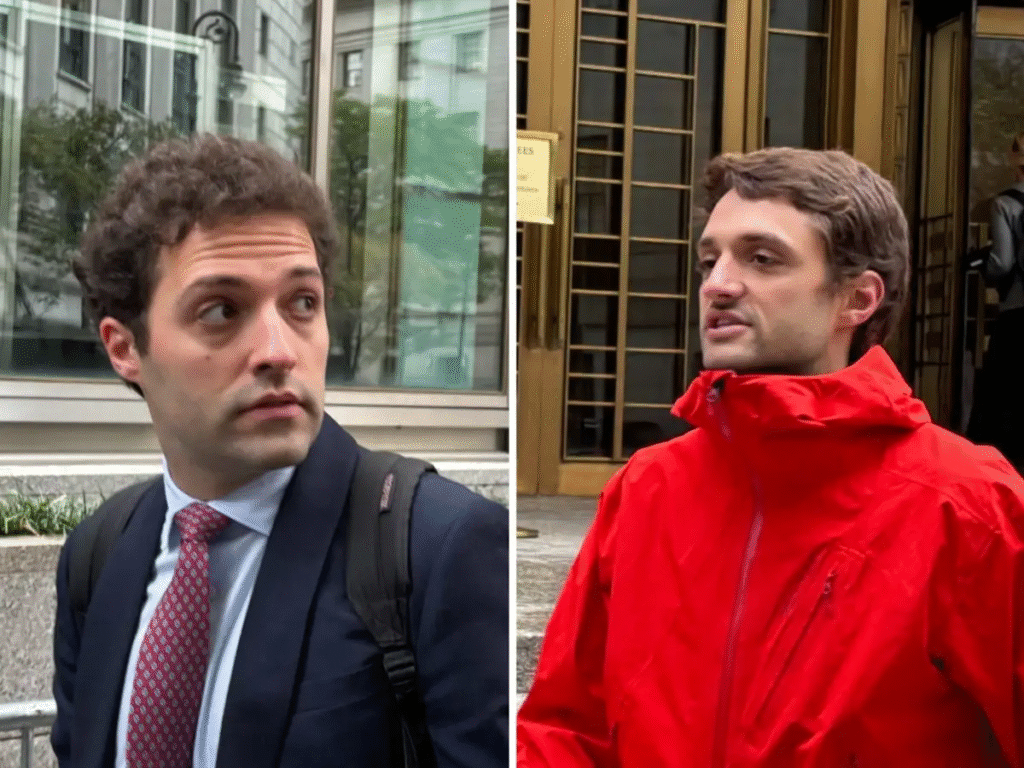
Adding to the case’s weight, prosecutors revealed that before the alleged heist, the brothers conducted online searches for phrases such as “how to wash crypto,” “top crypto lawyers,” “fraudulent Ethereum addresses database,” and “money laundering statute of limitations.” These digital traces, investigators argue, demonstrate forethought and awareness of the potential illegality of their actions.
In presenting their case, prosecutors have emphasized that the brothers’ actions went beyond the accepted norms of competitive trading. Unlike traditional arbitrage or strategic bot competition — where traders seek minor price differences — the brothers allegedly altered transactions in a manner that only the network’s creators or those with deep knowledge of its internal mechanisms could attempt. Federal prosecutors assert that this is not mere cleverness but calculated deceit designed to misappropriate digital assets.
If convicted, Anton and James face severe consequences. Each of the charges they are standing trial for — conspiracy to commit wire fraud, wire fraud itself, and money laundering — carries a potential sentence of up to 20 years in prison. The trial’s outcome could have far-reaching implications for how U.S. law enforcement agencies classify and prosecute future cases involving blockchain vulnerabilities and algorithmic trading manipulation.
The Brothers’ Defense: Outsmarting Predatory Bots or Exploiting the System?
The Peraire-Bueno brothers’ defense team has mounted a vigorous rebuttal, arguing that what prosecutors label as fraud was, in fact, an advanced form of legitimate trading strategy. Their attorneys assert that the brothers did not “steal” funds but simply outmaneuvered automated trading bots — systems that themselves often exploit minor inefficiencies to gain advantage over human traders. In the decentralized, fast-moving world of crypto, they claim, such tactics are not only common but also expected.
Defense attorney Patrick Looby, representing James Peraire-Bueno, told Business Insider that “there was nothing stolen and there was no theft, as that word would normally be used.” The defense contends that the transactions took place in an open, permissionless network — one where participants accept inherent risks, including the potential for loss due to strategic or algorithmic competition. They frame the brothers’ conduct as an example of using intellect and technical skill to exploit existing economic incentives, not to deceive or defraud.
This argument taps into a longstanding debate within cryptocurrency circles about the ethics of “on-chain” manipulation. In decentralized finance, many traders use bots that monitor pending transactions to gain profit — a practice known as “front-running.” The defense maintains that if automated bots can capitalize on others’ trades using code, then human traders who reverse-engineer and counter such bots are engaging in similar behavior. The difference, they argue, lies not in legality but in sophistication.

The broader crypto community has observed the case with divided opinions. Some industry insiders view the brothers’ alleged actions as a natural extension of blockchain’s open and competitive environment, where “code is law” and every participant accepts the consequences of its design flaws. Others, however, warn that justifying such behavior threatens the fundamental trust that underpins decentralized systems.
Beyond the legal arguments, the trial exposes the murky regulatory landscape of cryptocurrency. Unlike traditional financial markets governed by centralized authorities, digital currencies operate on distributed ledgers where enforcement and oversight are minimal. The lack of established legal definitions for concepts like “ownership” and “fraud” in decentralized networks makes the Peraire-Bueno case particularly significant. A conviction could set a precedent for how courts treat cases of digital asset manipulation, while an acquittal might embolden similar exploits under the guise of technological prowess.
As the defense team emphasizes, the case also raises philosophical questions about what constitutes fairness in algorithmic markets. If automated systems exploit traders every millisecond, is it truly unethical when humans learn to turn the tables? The brothers’ supporters suggest that they merely beat the system at its own game — albeit in a way that challenges conventional notions of legality.
The Larger Context: Cryptocurrency Regulation and the Future of Digital Finance
The trial of the Peraire-Bueno brothers is not unfolding in isolation. It comes at a time when regulators worldwide are grappling with how to govern the rapidly evolving crypto economy. According to a recent report by the United Nations Office on Drugs and Crime (UNODC), cryptocurrency exchanges have increasingly become key tools for organized crime networks to move and conceal illicit funds. The report underscores the growing complexity of tracing transactions across decentralized platforms, where anonymity and speed often outpace traditional enforcement mechanisms.
NDTV reported that cases like the Peraire-Bueno trial illustrate both the innovation and the danger inherent in digital finance. Blockchain technology, while revolutionary, operates on trust in algorithms rather than institutions. When individuals manipulate those algorithms — whether through technical skill or intentional deceit — it challenges the very foundation of decentralized systems. The question is not only whether the brothers broke the law but also whether the law itself is equipped to handle such technologically advanced disputes.
This trial also highlights the limitations of existing legal frameworks when applied to decentralized ecosystems. Unlike traditional financial fraud, where clear evidence of theft or deceit can be traced through regulated channels, blockchain manipulation often occurs within the rules of the system itself. Prosecutors must therefore prove not just that the Peraire-Bueno brothers profited, but that they did so through intentional deception rather than legitimate exploitation of available mechanisms.
For lawmakers and regulators, the case could serve as a catalyst to accelerate the development of more comprehensive crypto governance policies. Governments have long debated how to balance innovation with consumer protection in the digital asset space. The United States Securities and Exchange Commission (SEC) and other federal agencies have struggled to clearly define the boundaries of permissible conduct in decentralized markets. A high-profile verdict could influence future legislative and regulatory initiatives aimed at clarifying these boundaries.
The Peraire-Bueno trial has also revived discussions about the responsibility of blockchain developers and platforms in safeguarding users. Ethereum, like most public blockchains, is open source, meaning that anyone with sufficient skill can access its code and attempt to exploit its weaknesses. As blockchain networks expand into mainstream finance — from decentralized exchanges to tokenized assets — the security of these systems becomes paramount. The brothers’ alleged actions underscore how even small coding vulnerabilities can result in multi-million-dollar losses within seconds.
Whether the Peraire-Bueno brothers are ultimately convicted or acquitted, their trial symbolizes a turning point in the maturation of cryptocurrency markets. It compels both legal systems and the crypto community to confront questions about accountability, ethics, and innovation in a borderless digital economy. For now, the courtroom in Manhattan stands as the stage where the future of crypto legality may be rewritten — where the line between clever coding and criminal conduct will be tested as never before.