
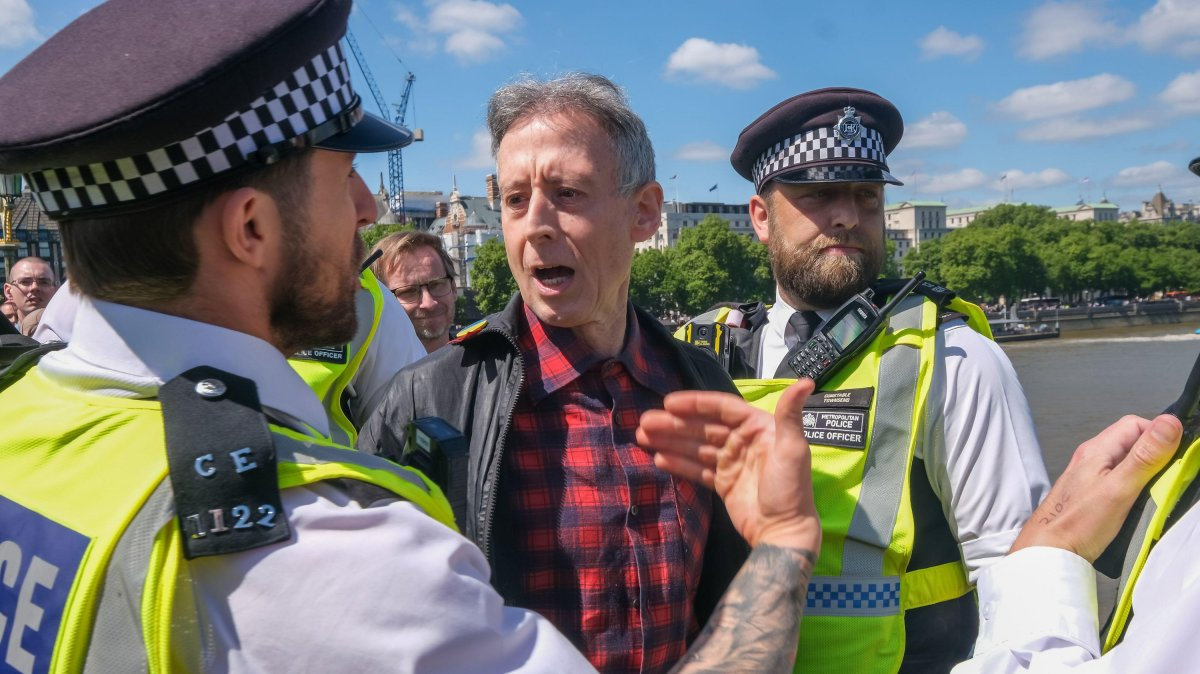
Peter Tatchell is one of the United Kingdom’s most recognisable political activists, known for more than five decades of high-profile campaigning on human rights, civil liberties, and equality. At 74, his arrest at a pro-Palestine march in London for holding a placard reading “Globalise the intifada: Non-violent resistance.
End Israel’s occupation of Gaza & West Bank” has once again placed him at the centre of a national debate about protest, free expression, and the limits of lawful dissent. The incident has drawn attention not only to the policing of pro-Palestine demonstrations but also to Tatchell’s long and often controversial history of challenging governments, institutions, and laws he believes infringe fundamental rights.
A Lifetime of Activism and Public Campaigning
Peter Tatchell first emerged as a prominent activist in the late 1960s and early 1970s, a period marked by intense political and social change in Britain. Over the decades, he has become best known as a leading figure in the struggle for LGBT+ rights, both in the UK and internationally. His activism has included campaigning against the criminalisation of homosexuality, challenging discriminatory age-of-consent laws, and confronting governments that persecute sexual minorities. Tatchell has repeatedly put himself at personal risk, staging protests in countries with poor human rights records and facing arrest, assault, or detention as a result.
Beyond LGBT+ issues, Tatchell has consistently framed his activism within a broader human rights philosophy. He has campaigned against torture, the death penalty, authoritarianism, and what he sees as abuses of power by states, regardless of political alignment. This wide-ranging approach has meant that he has sometimes found himself at odds with allies as well as opponents, particularly when his positions challenge prevailing narratives within political movements he otherwise supports.
Tatchell founded the Peter Tatchell Foundation to support and coordinate his campaigning work. The foundation focuses on human rights, free speech, and the protection of minorities, presenting itself as non-partisan and grounded in international human rights law. Throughout his career, Tatchell has emphasised the importance of peaceful protest and non-violent resistance, often drawing parallels between contemporary struggles and historical movements such as the campaign against apartheid in South Africa.
On Saturday's Palestine march I was arrested for this placard
— Peter Tatchell (@PeterTatchell) February 1, 2026
Instead of being taken to a London police station I was 'punished' with transportation to Surrey
I was detained 12 hours
Officers said I had to be held in cells to be interviewed
I was not interviewed for 8 hours! pic.twitter.com/dZTTdFvFw6
His methods have attracted both praise and criticism. Supporters see him as a principled campaigner willing to speak uncomfortable truths and accept personal consequences for his beliefs. Critics argue that his tactics can be provocative and that his messaging sometimes oversimplifies complex geopolitical conflicts. Nevertheless, Tatchell’s reputation as a persistent and fearless activist has remained intact, reinforced by repeated encounters with the criminal justice system that he characterises as attempts to silence dissent.
The Arrest at the Pro-Palestine March
Tatchell’s most recent arrest occurred during a Palestine solidarity march in London, where he carried a placard bearing the phrase “Globalise the intifada,” accompanied by clarifying text stating “Non-violent resistance. End Israel’s occupation of Gaza & West Bank.” According to Tatchell and his foundation, police officers told him that the word “intifada” was unlawful in the current context. He was arrested on suspicion of a public order offence and taken to Sutton police station in south London.
The Metropolitan Police later confirmed that a 74-year-old man had been arrested for carrying a sign including the words “globalise the intifada” and stated that there were multiple arrests connected to the protest. The force has previously indicated that chants or slogans using the phrase could lead to arrest, arguing that the “context has changed” following a recent terror attack in Sydney. This position reflects heightened sensitivity around language associated with political violence, particularly amid ongoing conflict in Gaza and the West Bank.
Read : Fremont High School Student Hit by SUV During Anti-ICE Protest
Tatchell has strongly disputed the police interpretation. In a statement, he argued that “intifada” is an Arabic term meaning uprising, rebellion, or resistance and does not inherently imply violence or antisemitism. He stated that his intention was to advocate non-violent resistance, specifically through tactics such as boycott, sanctions, and divestment, which he likened to strategies used during the global anti-apartheid movement.
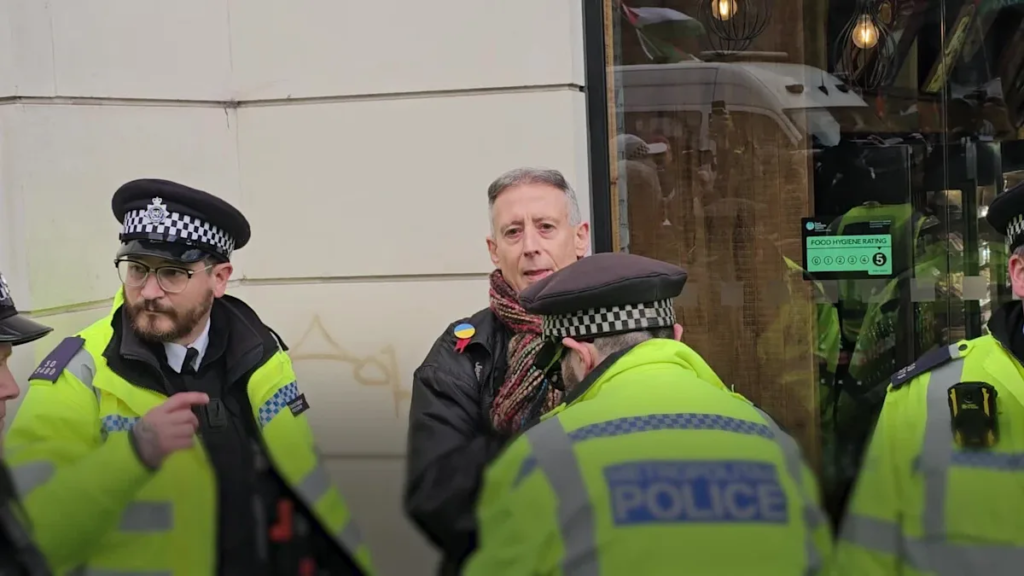
From his perspective, “globalise the intifada” meant encouraging an international campaign of peaceful pressure against what he described as Israel’s occupation and war crimes, not endorsing attacks on civilians or Jewish people. He described his arrest as an “attack on free speech” and part of a “dangerous trend” toward the criminalisation of peaceful protest.
Tatchell also noted that several other individuals had been charged in recent months for expressing support for what authorities interpreted as an intifada, suggesting that the policing of language at demonstrations has become increasingly restrictive. The case has intensified debate about where the line should be drawn between preventing hate speech or incitement and protecting political expression.
Free Speech, Antisemitism, and a History of Confrontation with Police
Tatchell’s response to his arrest has been shaped by his longstanding involvement in debates around free speech and antisemitism. He has repeatedly emphasised that his criticism is directed at the policies and actions of the Israeli state, not at Jewish people or Judaism. In his statement, he stressed his history of opposing antisemitism, including participation in the March Against Antisemitism alongside Jewish leaders shortly after the 7 October massacre.
Read : Who Is Don Lemon, Former CNN Anchor Arrested Over Anti-ICE Church Protest in Minnesota?
He argues that conflating criticism of Israel with hatred of Jews undermines genuine efforts to combat antisemitism and restricts legitimate political discourse. This is not the first time Tatchell has been arrested over protest placards relating to Israel and Palestine. In May of the previous year, he was detained for holding a sign that read: “Stop Israel genocide! Stop Hamas executions! Odai Al-Rubai, aged 22, executed by Hamas! RIP!”
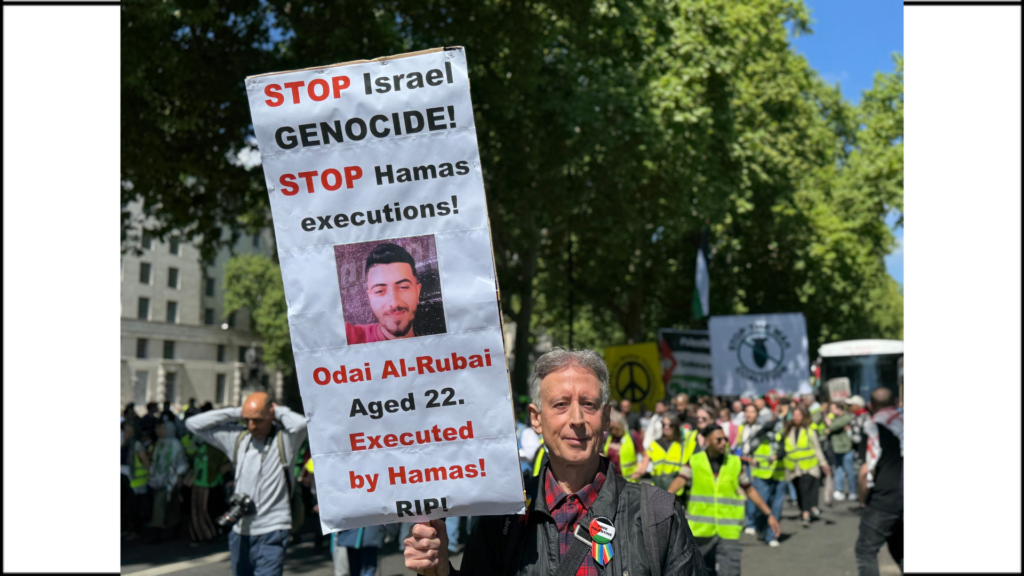
He was arrested on suspicion of a racially and religiously aggravated offence, a move he later challenged. According to Tatchell, police subsequently admitted that the arrest was wrongful, and he is pursuing legal action and awaiting a settlement. He has cited this experience as evidence of overreach by authorities and a misunderstanding of political speech.
These repeated encounters with police have reinforced Tatchell’s narrative that peaceful protesters are increasingly vulnerable to arrest based on the perceived offensiveness or ambiguity of slogans, rather than clear evidence of incitement or hatred. Supporters argue that his arrests illustrate a chilling effect on protest, where individuals may self-censor out of fear of legal consequences. Critics, including some community groups, contend that certain phrases carry connotations that can reasonably cause distress or fear, particularly during periods of heightened tension and violence.
The broader controversy surrounding Tatchell’s arrest reflects deeper divisions within British society about how protests related to Israel and Palestine should be policed. Authorities face pressure to prevent hate speech and maintain public order, while activists warn that expansive interpretations of public order laws risk eroding the right to protest. Tatchell’s case has become emblematic of this tension, precisely because of his long record of peaceful activism and his insistence on non-violent methods.
As his legal situation unfolds, Peter Tatchell remains a figure who provokes strong reactions across the political spectrum. To supporters, he represents a consistent and principled defender of human rights who is willing to challenge state power and accept personal cost. To critics, his language choices and comparisons risk inflaming already fraught debates. What is clear is that his arrest has once again brought questions of free speech, protest policing, and the interpretation of political language into sharp public focus, ensuring that his role as a controversial yet influential campaigner continues well into his eighth decade.
It’s great to see someone explain this so clearly.
I wasn’t expecting to learn so much from this post!
I enjoyed your perspective on this topic. Looking forward to more content.
You made some excellent points here. Well done!