
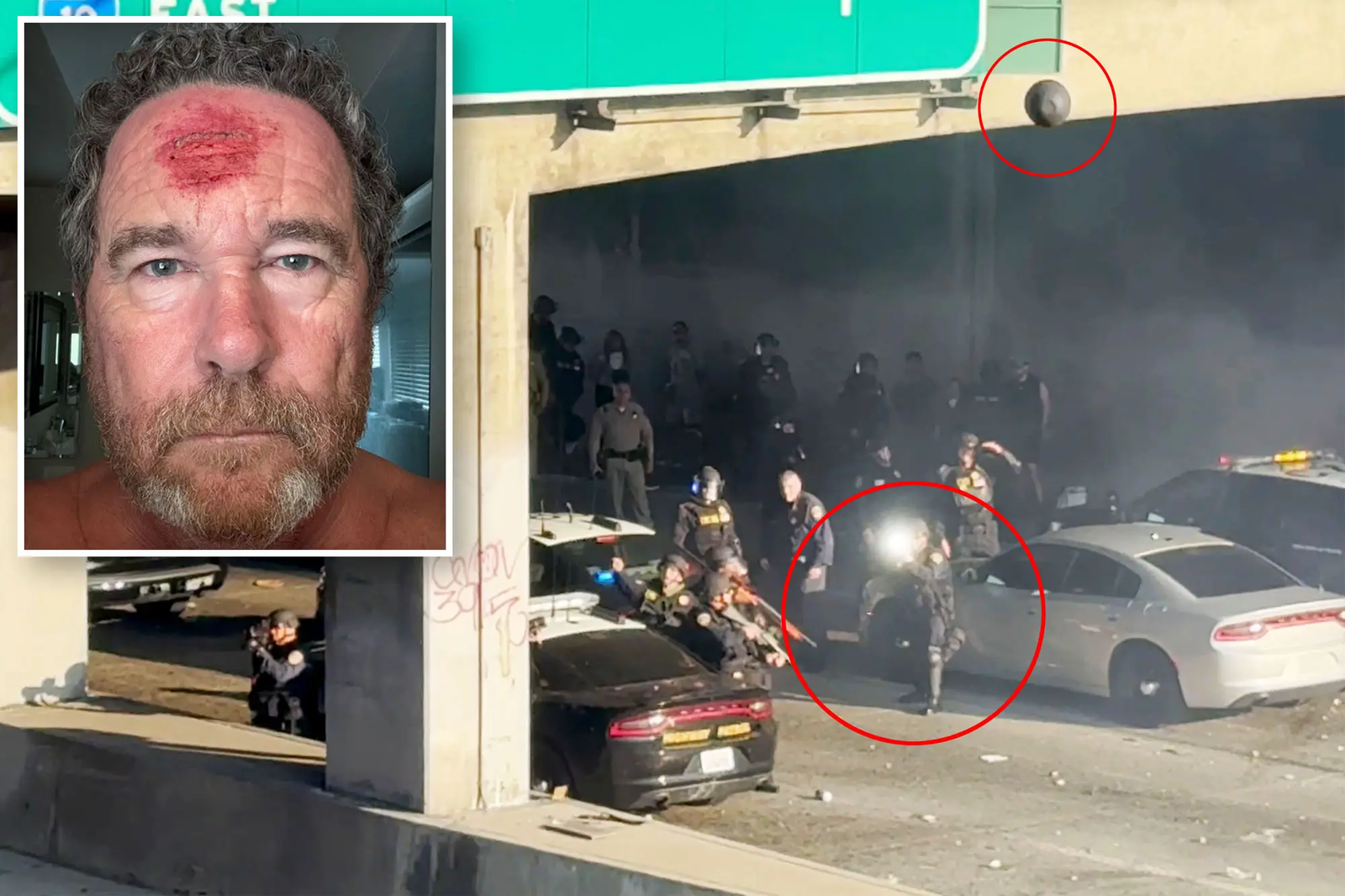
The volatile protests that erupted across Los Angeles this past Sunday in response to actions by Immigration and Customs Enforcement (ICE) took a dangerous turn when New York Post photographer Toby Canham was shot in the head with a rubber bullet by California Highway Patrol (CHP).
The shocking incident was caught on camera by Canham himself and has raised serious concerns about the use of force by law enforcement, especially toward members of the press clearly identified and uninvolved in the clashes. Canham, a 59-year-old veteran photographer and British Army veteran based in Los Angeles, was filming from an elevated platform just off the 101 Freeway when a CHP officer fired at him from approximately 100 yards away.
Despite being clearly identifiable with a press pass and not being surrounded by protesters, Canham became a target in what he described as a completely unjustified attack. The rubber bullet struck him in the forehead, leaving him with a massive bruise and symptoms of whiplash, requiring hospital care.
Caught on Camera: The Harrowing Moment of Impact
The entire moment was captured by Toby Canham himself on video as he documented the ongoing chaos between police and demonstrators. In the footage, the veteran photographer can be heard yelling, “F–k, f–k, I just got shot in the head!” just moments after the impact. His camera shook violently before the image went unstable, marking the split-second violence that disrupted his assignment and left him injured.
Canham had been filming from a vantage point overlooking the freeway, a position that was isolated from the crowd. According to his own account, no one was standing near him, making him an “easy target” in the event. Seconds before the rubber bullet hit him, a flashbang exploded a few feet from where he was standing, tearing holes in his pants and sending shrapnel flying. Shortly after, a protester hurled a water bottle filled with an unknown liquid toward authorities, and Canham began filming the scene to capture the escalation—just 20 seconds later, he was shot.
🇺🇸🪖❌📸 New York Post photojournalist Toby Canham was shot in the head with a rubber bullet by police while covering anti-ICE protests in Downtown Los Angeles on Sunday.#US #PressFreedom #AlKashf pic.twitter.com/BqqcNd8mkY
— Al-kashf | الكشف (@alkashfmedia) June 12, 2025
The video and aftermath captured on camera are deeply unsettling, not just for the violence but for what it implies: a journalist, wearing press credentials and not interfering, was struck by a projectile aimed at his head by law enforcement. The physical consequences included a large forehead bruise and whiplash, but the psychological toll and threat to journalistic freedom are just as concerning.
Protests Erupt Into Chaos and Violence
The protest that led to the incident was one of many demonstrations across the country, sparked by anger at ICE actions against undocumented immigrants. In Los Angeles, the situation reached a boiling point as thousands of protesters took to the streets, even managing to block sections of the major 101 Freeway in downtown LA.
Law enforcement, including California Highway Patrol and local police, responded to the unrest with what has been described as heavy-handed tactics. Protesters lit self-driving vehicles on fire and engaged in clashes with authorities. In turn, officers used flashbang grenades, tear gas, and rubber bullets to disperse the crowds. Amidst this chaos, Canham was attempting to do his job—document the escalating conflict—when he was struck.
Read : Los Angeles Streets Turn Into Battlegrounds as Anti-ICE Protests Turn Violent: Watch
Rioters had been seen throwing rocks, bottles, and other objects at law enforcement. While some level of response was expected, the targeting of a credentialed journalist on an elevated platform raises difficult questions. The violence toward the press in such scenarios not only hampers public awareness but also threatens the integrity of media freedom in tense political climates.

Los Angeles has become one of the many epicenters of civil unrest in recent months. The tension between immigration enforcement and activists has triggered scenes of civil disobedience, with some protests devolving into full-blown riots. The protest on Sunday marked a new level of volatility, prompting a militarized response from both state and federal forces.
Response, Repercussions, and Calls for Accountability
The response from officials following the incident has been troubling in its silence. Neither the Los Angeles Police Department nor the California Highway Patrol offered immediate comment. The Governor’s office declined to speak on the matter, instead redirecting inquiries to law enforcement agencies on the ground. Even the Los Angeles Mayor’s office failed to return emails seeking comment.
This lack of accountability only fuels concerns about unchecked power and the absence of consequences for unnecessary force. For Canham, the incident could have resulted in far more serious injuries. “I could have lost an eye or some teeth,” he said, visibly angry at the recklessness of the officer’s action. “There was no justification for even aiming the rifle at me and pulling the trigger.”
The situation mirrors another incident the same day, where an Australian reporter was also shot with a rubber bullet while reporting live from the protests. This pattern of aggression toward members of the media sends a troubling message about the space journalists occupy in times of civil unrest.

In response to the ongoing turmoil, U.S. Defense Secretary Pete Hegseth deployed an additional 700 Marines to back up the 300 National Guard troops already assisting local authorities. The military reinforcement highlights just how dangerous and unpredictable the protests have become, but also how high the stakes are for those documenting them.
Toby Canham spent the following day in the hospital, receiving treatment for his injuries. He is expected to recover physically, but the larger conversation about press freedom and police accountability continues to grow. News organizations, civil liberties groups, and press associations have begun voicing strong concerns about the rising number of journalists injured while covering protests.
Even in hostile environments, press members are protected under both domestic and international laws. They serve the vital role of bearing witness and informing the public, especially during moments of upheaval. Attacking them—whether intentional or negligent—is not only dangerous but undermines democratic transparency.
The events of that night in Los Angeles have sparked outrage among advocates and journalists alike. Social media is rife with discussions on press safety and the blurry line between crowd control and state violence. Video evidence like Canham’s will play a key role in determining whether these actions were accidental or part of a larger, more disturbing trend.
In a time when journalists are increasingly on the frontlines, their safety must be taken seriously. Whether through stricter oversight of law enforcement or legal reforms to protect the media, action must follow incidents like the one involving Toby Canham.
For now, the disturbing footage remains a grim reminder of how volatile the situation has become in cities across America—and how even those who report the truth can find themselves in the crossfire.