
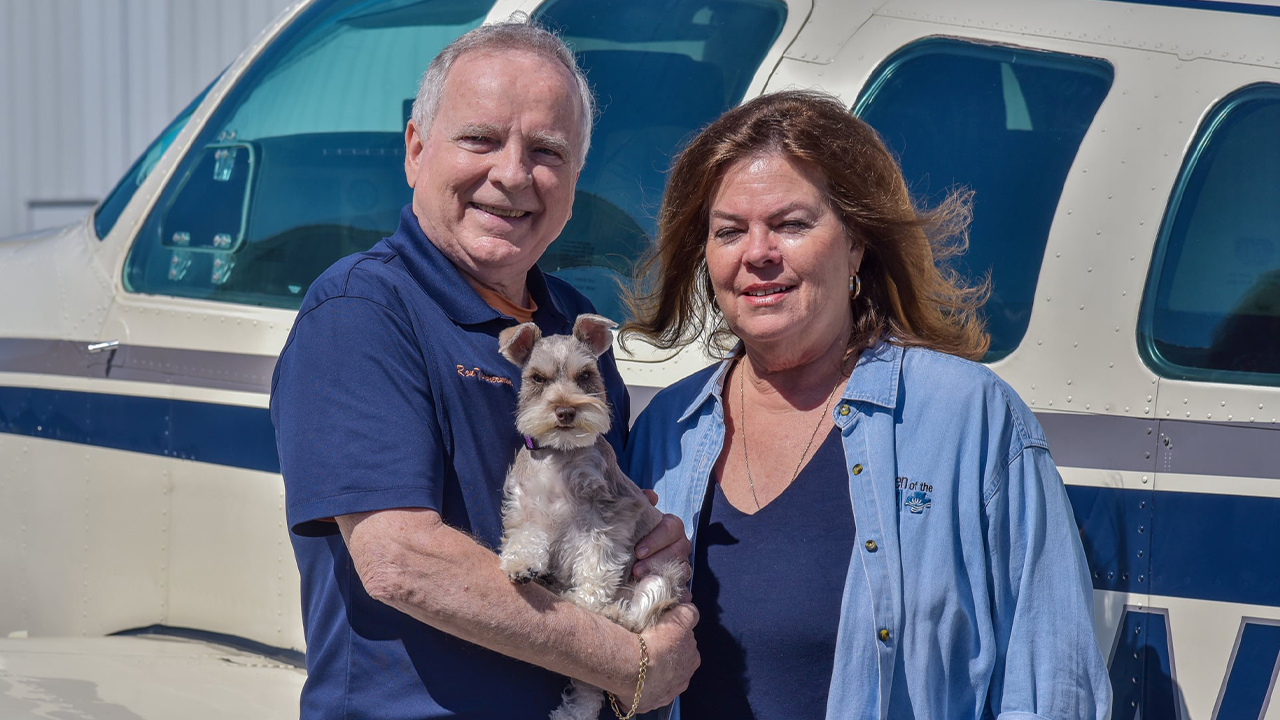
The quiet routine of a Texas neighborhood was violently interrupted when a small aircraft suddenly fell from the sky, claiming the lives of a Florida pilot and his wife while leaving behind a single unlikely survivor — their pet dog. What began as a routine flight ended in a devastating crash that shocked residents, drew emergency crews to the scene, and left aviation investigators searching for answers. The tragedy has since drawn attention not only because of the lives lost, but also because of the dramatic circumstances leading up to the accident and the remarkable survival of the couple’s companion animal.
The victims, identified as aviation business owners who had built their lives around flight, were traveling aboard a Beechcraft A36 when the aircraft went down near a residential area in Texas. Reports indicate the couple attempted to land after encountering a serious mechanical problem that impaired visibility. Their efforts were unsuccessful, and the aircraft ultimately struck a power line before crashing into the ground. Despite the severity of the wreckage, one life remained — their small lapdog, found alive amid the destruction.
Authorities continue to examine what happened in the aircraft’s final moments, while friends, neighbors, and the aviation community process the sudden loss of two individuals whose lives were closely tied to the skies. The crash has left behind a mix of grief, unanswered questions, and a story of survival that has captured public attention.
The Final Flight and Sudden Emergency
According to reports from the New York Post, the aircraft carrying Ron Timmermans and Barbara Timmermans departed on what appeared to be a routine flight before encountering unexpected trouble in the air. The couple, who operated an aviation business in Florida, had extensive experience with aircraft operations, making the events that unfolded all the more alarming.
The plane went down near Brownsboro at approximately 5:30 pm on a Wednesday evening. Witness accounts and early reports indicate the situation deteriorated quickly after the pilots reported an emergency. Authorities later stated that oil had spread across the windshield, severely obstructing forward visibility — a dangerous situation that can make safe navigation and landing extremely difficult.
With their view compromised, the couple reportedly radioed for assistance and attempted an emergency landing. Information cited by Fox Business suggested that the visibility issue played a critical role in the crash sequence. As the aircraft descended at low altitude, it struck a power line, destabilizing the plane further and eliminating any remaining chance of a controlled landing.
Read : Pilot Donald Fossum and Wilderness Seaplanes Sue Each Other Over Bella Bella Crash
Moments later, the aircraft crashed near residential homes, sending shockwaves — both literal and emotional — through the neighborhood. The violent impact left the nose embedded in the ground while the tail rose sharply upward, a stark visual of the force involved. Residents described hearing a loud, jarring sound that immediately drew them outdoors. Many initially struggled to understand what had happened, only gradually realizing that a plane had fallen into their community.
Read : 10 Countries That Are Least Prepared for Artificial Intelligence
For people accustomed to quiet streets and predictable surroundings, the sudden disaster created confusion and fear within seconds. The sequence of events — emergency radio call, obstructed visibility, power line collision, and final impact — is now central to the investigation, as authorities attempt to determine precisely how the mechanical failure progressed and whether any additional factors contributed.
A Neighborhood Witnesses Tragedy and Rescue
For residents living nearby, the crash unfolded as a moment of chaos followed by stunned silence. The sound of breaking metal and impact echoed through the area, prompting neighbors to rush outside in search of the source. What they encountered was a devastating scene — wreckage scattered, the aircraft damaged beyond recognition, and emergency responders arriving quickly.
Among those who witnessed the aftermath was local resident Mary Ann Shoulders, who described the frightening noise that first alerted her to the disaster. She recalled hearing what sounded like metal tearing apart, followed by the sight of the plane lodged in the ground. At first, she and others did not know who had been aboard or whether anyone had survived.
Emergency personnel worked swiftly, but the two occupants of the aircraft were declared dead at the scene. The scale of the destruction left little doubt about the severity of the impact. For those who gathered nearby, the realization that lives had been lost added a heavy emotional weight to the already shocking event.

Amid the devastation, however, an unexpected discovery shifted the emotional tone of the scene. The couple’s small lapdog — which had been traveling with them — was found alive inside the wreckage. Neighbors carefully retrieved the animal and moved it to safety. The dog did not appear to be seriously injured, a fact that astonished both witnesses and responders. In a crash that had destroyed an aircraft and claimed two lives, the survival of such a vulnerable passenger seemed almost impossible.
Residents took responsibility for the animal’s immediate care, ensuring it was protected and comforted. For many who witnessed the aftermath, the dog’s survival became a rare moment of relief within an otherwise tragic situation. The contrast between loss and survival left a deep impression on the community. While emergency workers secured the site and investigators began their work, neighbors continued processing what they had seen — a catastrophic crash followed by the quiet rescue of a single surviving companion.
Investigation and Aviation Community Response
In the days following the crash, federal investigators began examining every available piece of evidence to reconstruct the aircraft’s final moments. The National Transportation Safety Board quickly launched a formal investigation, focusing on mechanical systems, flight data, and communications leading up to the emergency.
Officials collected several onboard devices that may contain critical information about the aircraft’s speed, altitude, and performance prior to impact. These data sources are essential in determining how rapidly the situation developed and whether the pilots had any viable options for recovery.

The wreckage itself was carefully transported from the crash site to a secure facility for detailed examination. Specialists will inspect structural components, engine systems, and cockpit instruments to identify mechanical failures or contributing factors. Investigators will also analyze maintenance records, pilot communications, and environmental conditions present at the time of the flight. Each element plays a role in building a complete picture of what occurred.
Within the aviation community, news of the crash has been met with grief and reflection. Ron Timmermans was widely known not only as a pilot but also as a flight instructor dedicated to teaching others. Colleagues described him as someone deeply committed to aviation safety and education, making the circumstances of the accident particularly difficult for those who knew him.
Friends and professional associates have expressed shock at the loss, remembering both Ron and Barbara as individuals whose lives were closely intertwined with aviation. Their business activities, instructional work, and shared passion for flight formed a significant part of their identity. As the investigation continues, attention remains focused on the mechanical issue that reportedly triggered the emergency — oil covering the windshield. Understanding how and why that condition developed may provide insights relevant to aircraft maintenance, operational procedures, and safety awareness.
The outcome of the investigation will likely take months, as aviation accident analysis requires meticulous review and verification. Until then, the crash stands as both a personal tragedy for those who knew the victims and a technical case study for investigators seeking answers. The loss of two experienced aviation professionals, the shock felt by an entire neighborhood, and the unexpected survival of a small companion animal together form a story that continues to resonate as authorities work to understand exactly what happened in the sky above Texas.