
In a chilling reminder of the dangers that can unfold within moments, a skydiving Plane With 15 on Board Goes Off Runway and crashed into the woods shortly after takeoff in southern New Jersey.
On Wednesday evening, the peaceful air around Cross Keys Airport turned tense when the single-engine Cessna 208B radioed that it was experiencing engine trouble, ultimately leading to a failed emergency landing attempt and a crash that sent all on board to local hospitals.
Miraculously, no fatalities have been reported, though the injuries range from minor to critical. The crash has triggered federal investigations and raised serious questions about aviation safety, aircraft maintenance, and emergency protocols in skydiving operations.
Skydiving Plane With 15 on Board Goes Off Runway
The incident occurred around 5:30 p.m. at Cross Keys Airport, located roughly 21 miles southeast of Philadelphia. The plane, owned by ARNE Aviation of Virginia and leased to Skydive Cross Keys, had just taken off when the pilot radioed in to report engine trouble.
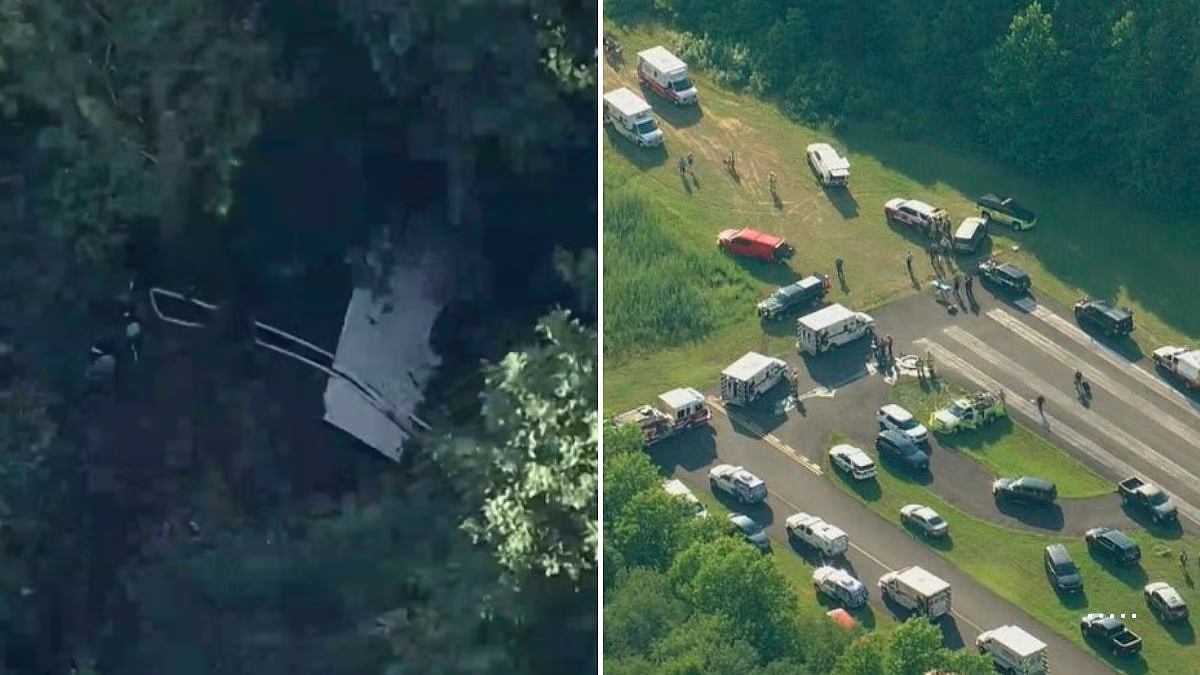
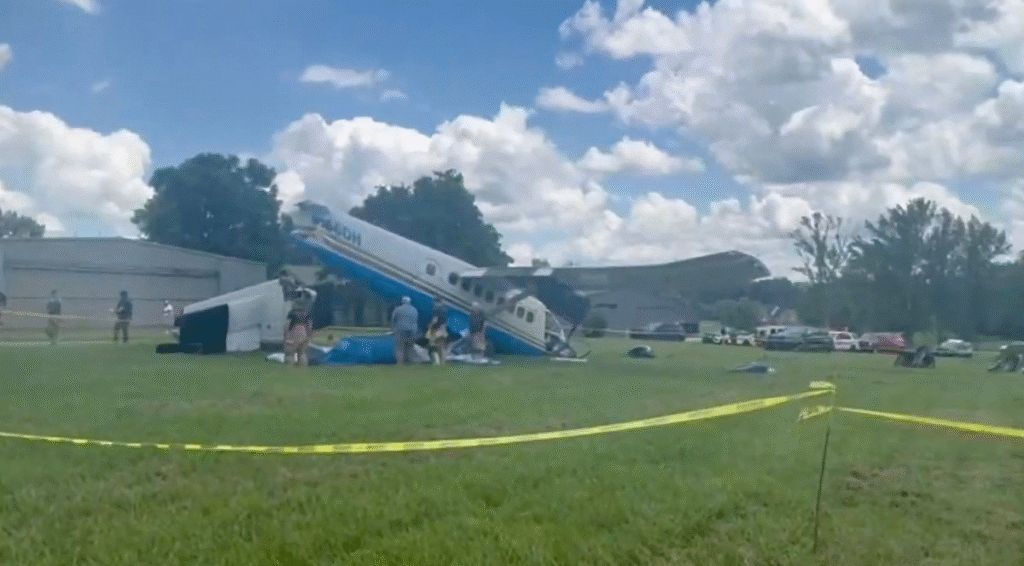
According to Andrew Halter from Gloucester County Emergency Management, the pilot attempted to circle back and make an emergency landing. Unfortunately, that attempt was unsuccessful. The aircraft went off the runway and crashed into the nearby wooded area, splitting into pieces and scattering debris across the crash site.
Eyewitnesses described a surreal scene as sirens blared and emergency responders rushed to the area. Fire trucks, ambulances, and rescue teams swarmed the site. Aerial images showed the plane wreckage nestled amid the trees, with visibly damaged wings and fuselage.
Read : Family Sues Tesla After 47-Year-Old Man Burns to Death in Newly Purchased Cybertruck After Crash
The crash site was littered with debris, and responders worked quickly to assess and stabilize the victims. Some of the passengers were reportedly covered in jet fuel and had to be decontaminated before they could be safely transported to nearby hospitals.
A federal investigation is underway after a skydiving plane carrying 15 people crashed in New Jersey on Wednesday. @morganorwood has the latest. pic.twitter.com/ySR2nys97p
— Good Morning America (@GMA) July 3, 2025
The fact that all 15 passengers survived the crash is nothing short of miraculous. “Just the fact that we have 15 people that are still with us here today, some with minor injuries, I think is fantastic and remarkable,” Halter said during a news conference. It’s a testament to the quick thinking of emergency crews and perhaps the structural integrity of the aircraft that no lives were lost in such a dangerous and chaotic event.
Emergency Response and Medical Efforts
Once the call for help went out, a coordinated response was swiftly launched by various emergency services. EMS teams, trauma specialists, and fire departments arrived at the scene to rescue and treat the injured. Some of the passengers had sustained critical injuries, while others suffered minor scrapes and bruises. All required evaluation and treatment, with some having been exposed to hazardous jet fuel.
Three individuals were immediately taken to Cooper University Hospital’s trauma center in Camden, New Jersey, for critical care. Eight others with moderate injuries were treated in the hospital’s emergency department. Four additional patients were in stable condition, awaiting further evaluation.
Wendy A. Marano, a spokesperson for the hospital, confirmed that medical personnel from the trauma and EMS departments were also deployed to the crash site to provide on-the-spot treatment and assist in the triage and transportation process.
The medical teams worked against the clock to ensure that no secondary complications arose from injuries, fuel exposure, or shock. While the full extent of each passenger’s injuries has not been disclosed, authorities have confirmed that all individuals are expected to survive. Families and loved ones of those on board have been notified, and counseling services are being provided to help them cope with the traumatic event.
Investigation and Questions for the Future
As the immediate aftermath settles, attention now turns to the investigation and the broader implications of the crash. The National Transportation Safety Board (NTSB) announced via social media that it has launched a full investigation into the incident. Key areas of focus will include the mechanical integrity of the aircraft, the circumstances surrounding the reported engine failure, and the emergency procedures followed by both the crew and ground personnel.
The aircraft in question, a Cessna 208B, is a popular model for skydiving operations due to its reliability and capacity. However, engine failures in such aircraft are rare and usually point to serious mechanical or operational oversights. The ownership and leasing arrangement between ARNE Aviation and Skydive Cross Keys will likely come under scrutiny as investigators try to determine who was responsible for maintenance and safety checks.
When contacted for comment, ARNE Aviation’s office manager, Tracey Sackett, asked reporters to call back the next day, indicating that the company is not yet ready to address the incident publicly. Skydive Cross Keys, the local skydiving company leasing the plane, did not immediately respond to inquiries either. A person who answered the phone at Cross Keys Airport referred all questions to Skydive Cross Keys.
New Jersey Governor Phil Murphy acknowledged the crash in a statement posted on X (formerly Twitter), noting that he had been briefed on the incident and confirmed that there had been “no fatalities at this time.” His message echoed the sense of relief felt across the state, especially in a scenario that could have easily ended in far greater tragedy.
While the crash investigation continues, aviation experts and enthusiasts are once again calling for stricter oversight and more robust safety protocols in adventure sports aviation. Skydiving, though relatively safe compared to other extreme sports, relies heavily on the aircraft used and the professionalism of the crew. Any lapse in maintenance, training, or emergency preparedness can quickly escalate into a life-threatening disaster.
The community around Cross Keys Airport is now grappling with the shock of the incident. Many residents had witnessed the plane take off countless times without incident and were stunned to see such a dramatic turn of events. Local officials have praised the bravery and coordination of first responders, who managed to extract all victims safely despite the dangerous terrain and presence of jet fuel.
As more details emerge, the incident will likely serve as a case study for aviation safety experts and regulatory bodies. It underscores the importance of rigorous aircraft inspections, emergency training for pilots, and swift coordination between airport personnel and emergency services. Most importantly, it serves as a powerful reminder of how quickly things can go wrong — and how critical it is to be prepared when they do.
In the days ahead, the Federal Aviation Administration (FAA) and the NTSB will work closely to piece together the moments leading up to the crash. Black box data, radio communications, and witness statements will be analyzed thoroughly to understand the sequence of events. While the final report may take months, the initial findings could lead to changes in policy or procedure, particularly for aircraft used in skydiving and recreational aviation.
For now, the focus remains on the recovery of those injured, the emotional healing of the survivors, and the lessons that can be learned from this terrifying incident. The fact that all 15 individuals survived — some walking away with only minor injuries — is a testament to the resilience of the human spirit and the life-saving capabilities of well-coordinated emergency response systems.