
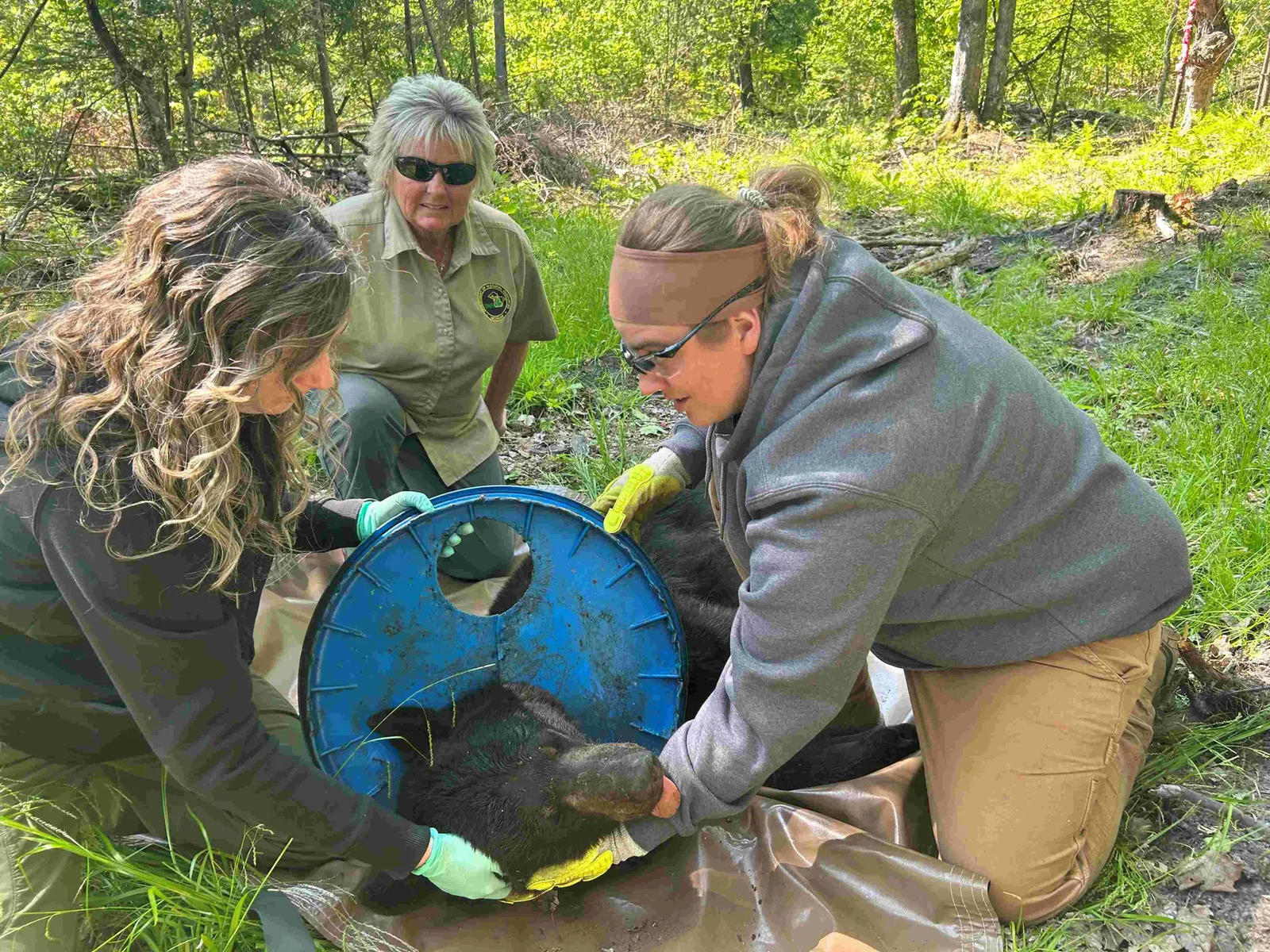
Once upon a time in the lush, shadowy woods of Michigan, a black bear cub began his life unaware that a simple, discarded object would become a symbol of human carelessness and wildlife resilience. For two long years, this young bear roamed the forests with his head stuck inside a plastic lid—an unintended collar that grew increasingly tight as he matured. Though he lived through seasonal changes and eluded capture time and again, his strange burden became both a survival challenge and a mystery for conservationists.
The bear’s ordeal first came to the attention of Michigan wildlife officials in 2023. At the time, trail cameras caught a glimpse of a cub with an odd blue ring encircling its neck. Upon closer inspection, it was revealed that the object was a plastic lid, about five inches in diameter—likely from a 55-gallon drum, commonly used by hunters.
This plastic ring, though light and seemingly harmless at first glance, had become a literal chokehold on the bear’s neck. The young bear was still small then, but as he grew, so did the severity of his condition. The plastic did not stretch or break; instead, it tightened mercilessly with each passing month.
What began as a minor inconvenience became a serious health risk. Yet, this resilient animal adapted, roaming the forests in search of food and avoiding humans, unaware of the growing concern for his wellbeing. Every new sighting prompted conservation teams to spring into action, but the bear would disappear before they could catch him. Despite the high-tech surveillance and tracking techniques, he remained elusive, like a ghost in the forest.
The Hidden Dangers of Human Waste in the Wild
The plight of this bear highlights a larger, more troubling issue—how human waste and negligence continue to pose threats to wildlife across the country. In this case, the plastic lid that became the bear’s collar likely originated from a baiting container used by hunters. These containers, designed to lure bears, are supposed to follow specific regulations in Michigan.
Under state law, baiting containers must have openings that are either less than one inch or more than 22 inches in diameter to avoid trapping wildlife. The blue plastic lid had a five-inch opening—an unfortunate size that proved to be just right for a curious cub to slip his head through, but far too small for him to remove it afterward.
According to Cody Norton, a specialist in bears, furbearers, and small game with the Michigan Department of Natural Resources (DNR), these kinds of accidents are entirely preventable. He emphasized that the size of the container opening is far more critical than the size of the container itself when it comes to wildlife safety.
A black bear who got its head stuck in a plastic lid and wore it around his neck for two years is now free after wildlife biologists in Montmorency County removed it from the animal, according to the Michigan DNR.https://t.co/abbvYkZLdZ pic.twitter.com/Hn1TvHhhkf
— UpNorthLive News (@upnorthlive) June 18, 2025
Across the United States, similar incidents have occurred in recent years. In Florida, Wisconsin, and Tennessee, bears have been found with their heads stuck in oversized cheese ball jars—a plastic hazard born of convenience and disregard. Fortunately, each of these bears was rescued in time. But not all animals are so lucky. In Colorado, an elk famously carried a tire around his neck for two years before wildlife officers managed to remove it—at the cost of sawing off his antlers.
These stories serve as a sobering reminder of the damage that even everyday trash can do when left in natural environments. What might seem like harmless refuse to a human can become a death trap for an animal. As humans continue to expand into wild spaces, the overlap between our world and that of animals like the Michigan bear becomes increasingly dangerous.
A Long-Awaited Rescue in the Northern Michigan Wilderness
For nearly two years, the bear with the plastic collar lived a life of silent suffering. He was spotted intermittently via trail cameras, which only added to the urgency and frustration of wildlife teams. They knew he was out there—growing, enduring, and surviving—but each time help was within reach, the bear vanished into the dense underbrush of Michigan’s northern lower peninsula.
Then, in May of this year, came the breakthrough. The bear was sighted in Montmorency County, prompting a coordinated response from the Michigan DNR. Setting up traps and surveillance in the area, officials patiently waited. Finally, earlier this month, they succeeded in capturing him. Now approximately two years old and weighing 110 pounds, the bear was sedated safely. The plastic collar that had constricted him for so long was carefully removed.

Images released by the Michigan Department of Natural Resources showed the bear lying sedated on a tarp, his fur matted around the neck, bearing clear signs of the long-term pressure and friction from the plastic lid. Wildlife technician Angela Kujawa, one of the rescuers on the scene, took the opportunity to gather vital data from the animal—measurements, health assessments, and identifiers that would aid future research and monitoring efforts.
Though the bear showed signs of his ordeal, he was otherwise in surprisingly good health. After the team ensured he had no severe wounds or infections, he was allowed to wake up and return to the wild. This time, he walked away free of the plastic ring that had defined nearly his entire life up until that moment.
A Hopeful Future for Wildlife Conservation
The story of the Michigan bear ends with hope—a rare and precious outcome in the world of human-wildlife conflict. His journey from a helpless cub caught in the grip of a plastic lid to a free-roaming adult once again is a testament to both the resilience of wild animals and the tireless efforts of conservationists. But his experience should not be viewed in isolation.
As more people spend time in nature—whether for recreation, hunting, or other purposes—the responsibility to preserve the integrity of these ecosystems becomes more urgent. Items like plastic lids, jars, and containers may seem insignificant when discarded, but in the natural world, they become deadly hazards. Education, regulation, and personal accountability must all work in tandem to reduce these threats.

One solution lies in stricter enforcement of baiting container laws and more widespread public awareness campaigns. When hunters or hikers understand the consequences of using improperly sized containers or leaving garbage behind, they’re more likely to adopt safer practices. Organizations can also play a crucial role by promoting wildlife-safe products and organizing clean-up initiatives in frequently trafficked natural areas.
Another part of the solution is improving the technological and strategic approaches to wildlife tracking and rescue. While this bear was eventually freed, his capture took two years and multiple failed attempts. Investing in better surveillance tools, GPS tagging, and community reporting networks could greatly enhance response times and rescue outcomes in the future.
The bear now continues his journey, older and wiser, and most importantly—free. His neck may bear the scars of his ordeal, but those marks also symbolize survival and the compassion of those who worked tirelessly to help him. His story reminds us all that wildlife is fragile, and even the smallest of human actions—tossing a jar or leaving out a lid—can ripple into years of suffering for an animal. But with awareness and effort, we can ensure that fewer bears and other creatures endure the same fate.
In a world increasingly shaped by human influence, tales like this one serve as both a caution and an inspiration. If a plastic lid can nearly cost a bear his life, then it’s our responsibility to ensure that the next generation of wild animals can roam freely—without the burden of our waste on their backs or around their necks.