
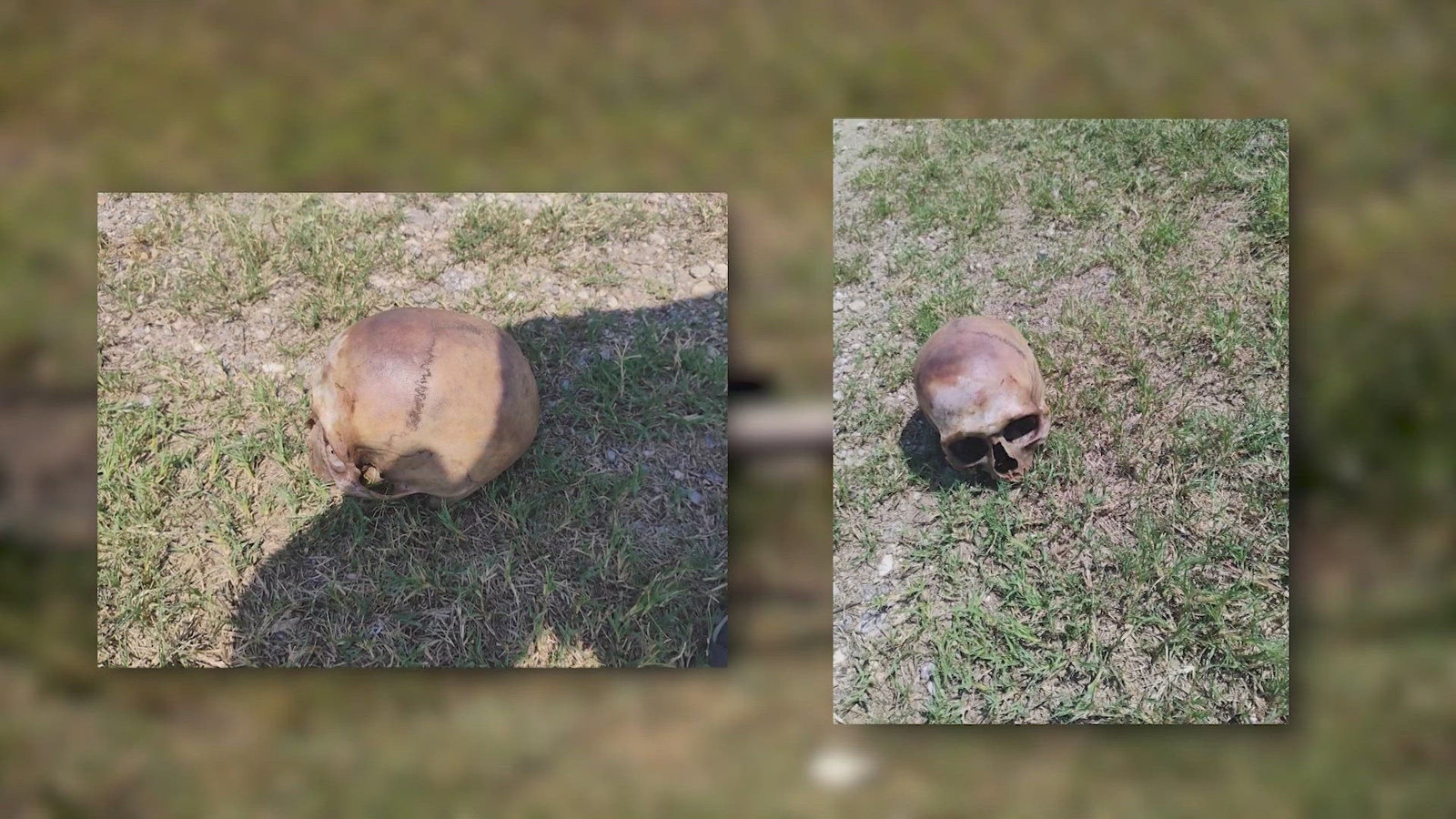
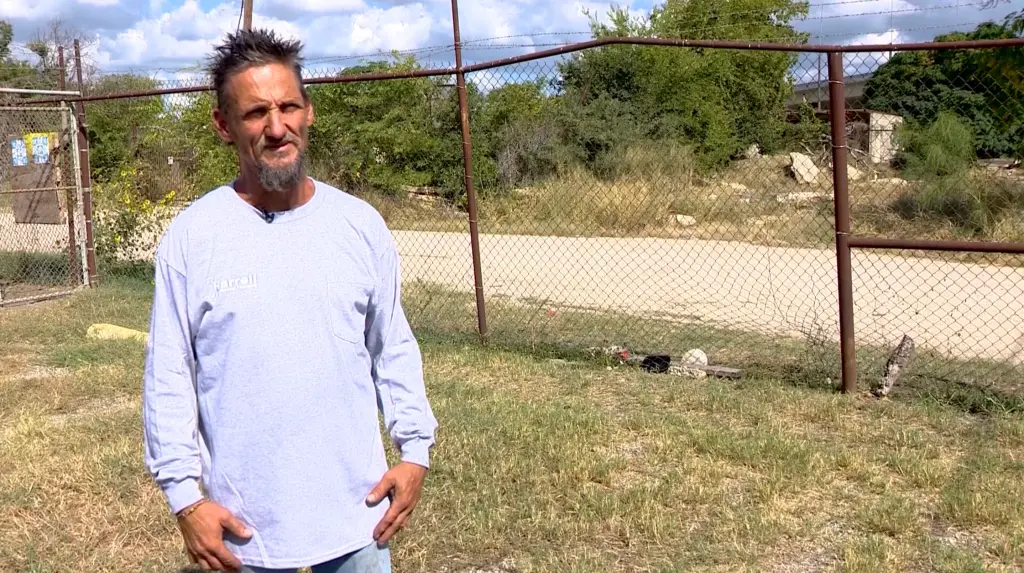
In the sweltering heat of a San Antonio afternoon, what began as a routine lawn-mowing task for a local plumber turned into a scene straight out of a crime thriller. On September 15, 2025, Walter Stephens, a dedicated employee at Harrell Commercial Plumbing, stumbled upon a grim discovery that has left the community reeling and authorities scrambling for answers. While trimming the grass along the fence line near the business on North San Jacinto Street, Stephens spotted what he initially mistook for an innocuous piece of debris—a dried-up cantaloupe, perhaps, weathered by the relentless Texas sun.
But as he reached down to pick it up, the object revealed itself in horrifying clarity: a decomposed human skull, bleached and barren, with no trace of flesh or hair remaining. The incident unfolded around 1:30 p.m., a time when the plumbing company’s operations were humming along as usual. Harrell Commercial Plumbing, a fixture in the northwest San Antonio area, sits adjacent to Martinez Creek Park, a spot known for its green spaces and occasional gatherings of the unhoused.
Stephens, who has worked for the company for years, was simply maintaining the property’s exterior when the unexpected find halted him in his tracks. “I saw what looked like a dried cantaloupe or something,” Stephens later recounted to local reporters, his voice steady but laced with the unmistakable tremor of disbelief. The skull, sun-bleached and eerily lightweight, felt almost otherworldly in his hands—a sensation he described as carrying an inexplicable energy, peaceful rather than malevolent, like releasing a long-trapped spirit.
Shaken but composed, Stephens didn’t hesitate. He carried the skull inside the office, alerting his superiors immediately. Brad Harrell, the company’s vice president and co-owner, was among the first to see it. “You don’t think you’re going to see a human skull, ever really,” Harrell said, echoing the sentiments of anyone thrust into such a surreal moment. With no skin or tissue attached, the remains clearly indicated a lengthy period of decomposition, yet neither man could recall seeing anything amiss earlier that day.
Read : Unhinged! 64-Year-Old Woman with Pistol Sits in Lawn Chair for 5 Hours on I-45
Harrell wasted no time in dialing 911, summoning the San Antonio Police Department (SAPD) to the scene. Within minutes, officers and park police arrived, cordoning off the area as the gravity of the situation sank in. As the initial shock rippled through the plumbing crew, the responding authorities confirmed the worst: the object was indeed human remains. A preliminary sweep of the lawn yielded more chilling evidence—a detached jawbone, scattered fragments of bone, and other small body parts partially buried in the overgrown grass.
Read : Watch Video: Joe Biden Wanders Off Before G7 Summit, PM Meloni Guides Him Back
The site, near several bowls left out for feeding stray dogs, added another layer of intrigue. Was this the work of local wildlife, or something more deliberate? The police established a perimeter, calling in forensic teams to meticulously comb the grounds. The discovery wasn’t just a random oddity; it pointed to a larger puzzle, one that demanded swift and thorough investigation. By evening, the once-quiet lawn had transformed into a hive of activity, with yellow tape fluttering in the breeze and investigators donning gloves to unearth every clue.
The Victim: Unraveling the Identity of Austin Thomas Wyrosdick
In the days following the macabre find, the Bexar County Medical Examiner’s Office worked tirelessly to identify the remains, piecing together a story from fragments of bone and dental records. On September 26, 2025—just eleven days after the discovery—the office released a name that brought a human face to the horror: Austin Thomas Wyrosdick, a 30-year-old San Antonio resident whose life had ended under circumstances as mysterious as his remains’ final resting spot.
Wyrosdick, described by those who knew him as a kind-hearted soul battling personal demons, had been reported missing months earlier, though exact details of his disappearance remain closely guarded by investigators. The identification process was no small feat. Forensic anthropologists examined the skull’s structure, noting its adult male characteristics, while DNA sampling and comparisons to missing persons databases accelerated the breakthrough. Wyrosdick’s dental records proved a match, confirming the remains as his beyond doubt.
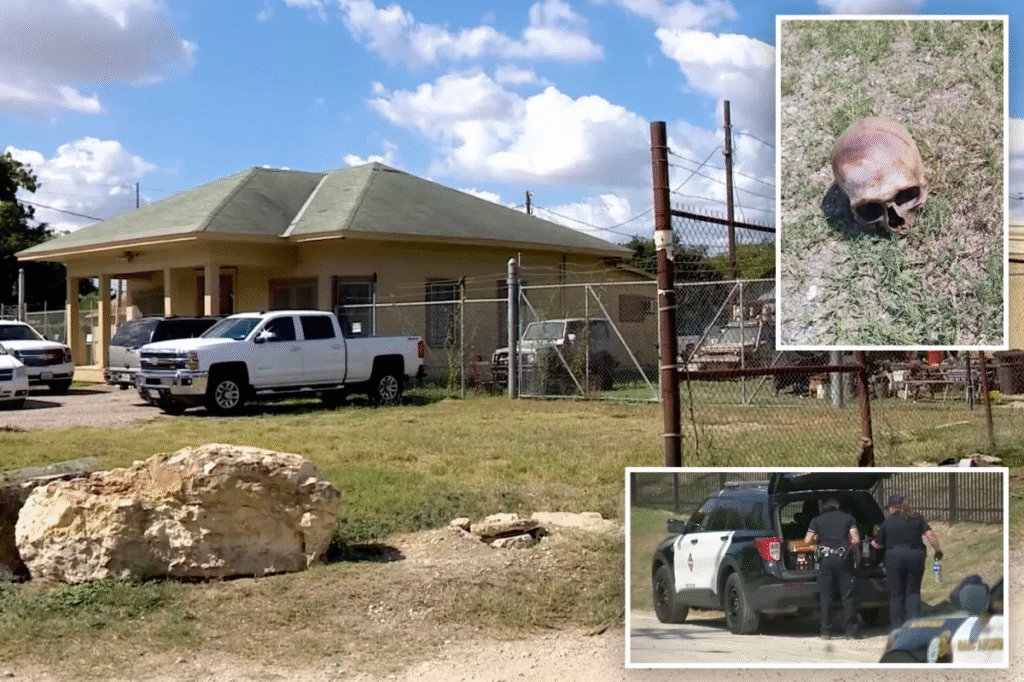
At 30 years old, he was in the prime of life, yet the decomposition suggested his death had occurred well before the skull surfaced on the plumbing company’s lawn. The medical examiner’s report, preliminary as it was, classified the cause and manner of death as pending further analysis—toxicology tests, bone fragmentation studies, and scene reconstruction all pending to shed light on how Wyrosdick met his end. Friends and family, reached by local news outlets, painted a portrait of a man who frequented the parks and creekside areas near the discovery site. Wyrosdick had ties to the unhoused community in San Antonio, often seeking solace in Martinez Creek Park, just steps from Harrell Commercial Plumbing.
“Austin was the type to help anyone, even when he was down on his luck,” one acquaintance shared anonymously, highlighting the irony of his remains being found in such a communal space. The proximity to stray dog feeding stations fueled speculation: Had animals disturbed a shallow grave, dragging the skull from its original burial site? Or was this a deliberate dumping ground, chosen for its obscurity amid the urban greenery?
As the victim’s identity emerged, so did the human toll of the story. Wyrosdick’s family issued a brief statement through authorities, expressing grief and gratitude for the quick identification. “We’re heartbroken, but thankful to bring Austin home,” they said, underscoring the closure that even tragic news can provide. For the San Antonio community, the revelation transformed an abstract horror into a tangible loss—a reminder that behind every set of remains is a life interrupted, full of untold stories waiting to be honored.
Theories and Speculation: How Did the Remains End Up Here?
With the victim identified, attention swiftly turned to the million-dollar question: How did Austin Thomas Wyrosdick’s skull journey from his final moments to a patch of grass in a bustling commercial district? Walter Stephens and Brad Harrell, the unwitting discoverers, offered their grounded theories based on daily familiarity with the property. Both men traverse the lawn frequently—Stephens for maintenance, Harrell for oversight—and insist the skull wasn’t present earlier on September 15. “It had to have been moved there recently,” Harrell posited, suggesting either a person or an animal as the culprit.
Stephens echoed this, noting the site’s adjacency to dog-feeding bowls: “Maybe a stray picked it up from somewhere else and dropped it here.” This animal-displacement hypothesis isn’t far-fetched in San Antonio’s ecosystem, where raccoons, coyotes, and feral dogs roam freely, scavenging in parks and creeks. Martinez Creek, teeming with wildlife, could have served as a conduit, with currents or creatures ferrying remains downstream.
Forensic experts, consulted in the early stages, supported the idea of post-mortem disturbance; the lack of attached tissue and the scattered nature of the bones pointed to environmental exposure rather than a fresh crime scene. Yet, skeptics in the community whispered darker possibilities: Was this the remnants of foul play, a body dumped in the creek and washed ashore? Or an unsolved hit-and-run, with the skull kicked aside like roadside litter? Local authorities have remained tight-lipped, classifying the case as an active investigation.
SAPD homicide detectives joined the fray, canvassing nearby homeless encampments and reviewing surveillance from adjacent businesses. No cameras captured the lawn directly, but footage from North San Jacinto Street showed increased foot traffic in the weeks prior—unhoused individuals, joggers, and dog walkers passing through without incident. Toxicology results, expected to reveal any substances in Wyrosdick’s system, could point to accidental overdose or self-harm, common tragedies in the area’s vulnerable populations. If drugs were involved, the creek might have become an impromptu disposal site, with decomposition accelerating in the humid climate.
Speculation aside, the plumbing company’s role added an unintended twist. Harrell Commercial Plumbing, known for its community involvement, now grapples with the stigma of a death site on its doorstep. Co-owner Jennifer Harrell-Smith emphasized the business’s innocence: “We’re just a family-run operation trying to do right by our city.” Theories abound online and in local diners, from serial predator whispers to tragic mishaps, but experts urge caution. “Without evidence, it’s all conjecture,” a Bexar County spokesperson noted. As the investigation deepens, the focus remains on facts: the skull’s mobility, the creek’s flow, and the quiet desperation that led Wyrosdick to that fateful stretch of green.
Community Impact and Ongoing Investigation: Ripples in San Antonio
The discovery has sent ripples across San Antonio, a city already grappling with homelessness, urban decay, and the invisible scars of loss. Martinez Creek Park, once a serene escape for picnickers and pet owners, now bears the weight of whispered warnings—parents steering clear, runners opting for busier paths. The unhoused community, hit hardest, fears heightened scrutiny; outreach workers report a spike in relocations, with many echoing Wyrosdick’s own struggles. “This isn’t just about one man—it’s about all of us out here, unseen until something like this happens,” one resident told reporters, capturing the raw vulnerability exposed by the find.
Harrell Commercial Plumbing has rallied, installing better lighting and fencing while counseling its staff through the trauma. Stephens, the accidental hero, has found an odd silver lining: “It’s sad, but it was good I found him.” His words resonate, a testament to the quiet closure provided by chance. The company, in a show of solidarity, donated to local shelters, channeling grief into goodwill. City officials, meanwhile, pledged increased patrols and mental health resources, addressing root causes like addiction that may have ensnared Wyrosdick.
As of September 29, 2025, the Bexar County Medical Examiner’s Office awaits final autopsy results, with SAPD vowing transparency. Interviews continue, from park regulars to Wyrosdick’s inner circle, piecing together his last days. Whether accident, animal, or atrocity, the truth promises to heal—or haunt—San Antonio further. For now, the lawn lies dormant, a silent witness to life’s fragility, urging us all to look closer at the overlooked corners of our world.