
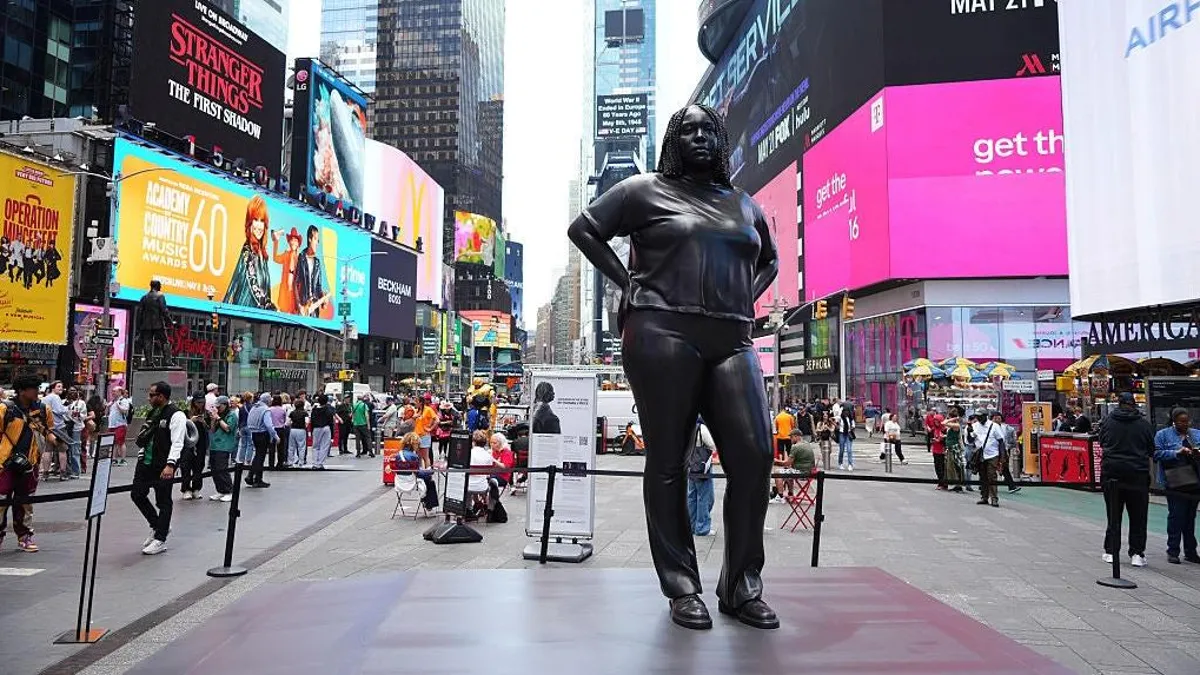
The heart of Midtown Manhattan has long been home to towering billboards, glitzy advertisements, and the pulsing rhythm of New York City life. But recently, something else has claimed space among the urban clutter of Times Square—a 12-foot bronze Black woman Statue, standing tall with braided hair, plain clothing, and hands confidently placed on her hips.
Titled Grounded in the Stars, the sculpture by British artist Thomas J. Price has quickly become the subject of heated public discourse, not for its artistic merit, but for the cultural and political waves it has stirred.
The statue was intended as a reflection on representation, identity, and the importance of everyday people in the fabric of society. Price, known for his work that elevates ordinary Black figures into monumental forms, conceived the piece as a counterpoint to the dominant visual narrative in public art—typically white, male, and heroic.
Yet, while many have praised the sculpture’s humanizing and inclusive intent, others—especially from right-wing online spaces—have lashed out with ridicule, derision, and outright racism.
The resulting clash has laid bare America’s deep divisions over race, beauty standards, public space, and what kinds of bodies deserve celebration in the public eye.
A New Face in Public Art
Thomas J. Price has long focused his artistic practice on reshaping how we view everyday individuals, particularly those from underrepresented communities. With Grounded in the Stars, his vision was to elevate a figure that reflects the real people who walk among us—those not typically immortalized in bronze. The statue depicts a fictional Black woman, unadorned, grounded, and powerful in her quiet stance. She wears a plain T-shirt and pants, her hair braided, her posture self-assured.
Price stated that his aim was to “instigate meaningful connections” and allow for “deeper reflection around the human condition and greater cultural diversity.” He hoped viewers would see not only the figure itself but also what it represents—the countless lives and stories that rarely make it into grand monuments or historical tributes.
In a space like Times Square, where commercialism and sensationalism often overshadow authenticity, the statue provides a striking contrast. Unlike the grandiosity of traditional heroic monuments, Price’s work is subtle, familiar, and rooted in the everyday. It challenges viewers to consider whose image is elevated in public consciousness and why.
Read : Statue of Millicent Fawcett Defaced as Trans Rights Protesters March on London
The Times Square Arts organization echoed this sentiment, noting that the figure’s “familiar qualities” are intended to resonate with ordinary people, giving visibility to those typically unseen in public art. In that sense, the statue is both inclusive and radical—an invitation to imagine a broader, more representative future for public monuments.
Backlash and Online Vitriol
Despite its intended message of inclusivity and empowerment, Grounded in the Stars has become a lightning rod for controversy, particularly among right-wing commentators and social media users. Almost immediately after its installation, the Black woman Statue was met with mockery and scorn online, especially targeting the woman’s appearance.
Critics derided the statue as a “DEI project,” a dismissive shorthand for diversity, equity, and inclusion initiatives they view as forced or politically motivated. One user on X (formerly Twitter) sarcastically asked if the statue was meant to challenge preconceived notions, suggesting instead that it reinforced them. Others mocked the figure’s weight, likening her to memes or using deeply racist and fatphobic language.
They tear down statues of American heroes and replace them with statues of random obese black women. That’s because the Left has no historical heroes. Everyone who was born before approximately 2005 is inherently problematic.
— Matt Walsh (@MattWalshBlog) May 7, 2025
pic.twitter.com/ypjxG1p2ZU
One particularly inflammatory post from a right-wing account claimed that “fat Black women have somehow elevated themselves to the top of the pyramid,” a comment that received thousands of likes and shares. Other posts questioned the legitimacy of the art, asking if the woman was “famous” or simply the result of “wokeness gone mad.”
On Facebook, the comments turned even more vulgar and offensive. Some users suggested knocking the statue over, likening it to “cow tipping,” while others made derogatory comments about food stamps, poor dietary habits, or customer service stereotypes. These comments were not just disrespectful—they were steeped in long-standing racist and sexist tropes meant to dehumanize and demean.
Rather than fostering reflection and dialogue, these responses illustrate a disturbing level of intolerance and resistance to any shift away from traditional, Eurocentric representations in art. The backlash suggests that for some, simply seeing a large statue of a Black woman—especially one not idealized or sexualized—is too much to tolerate.
A Mirror for Society’s Values
While the vitriol has been disheartening, the controversy also reveals a deeper truth about the current cultural climate. Public art, especially when it confronts societal norms, often serves as a mirror—showing us not just what we value, but also what we fear, reject, or ridicule.
Grounded in the Stars was never meant to be universally adored. Its power lies in its simplicity and the space it claims in one of the world’s busiest, most commercialized locations. It’s a bold statement in a landscape typically dominated by glossy advertisements and sanitized ideals. The very fact that this artwork has provoked such strong reactions proves its relevance.
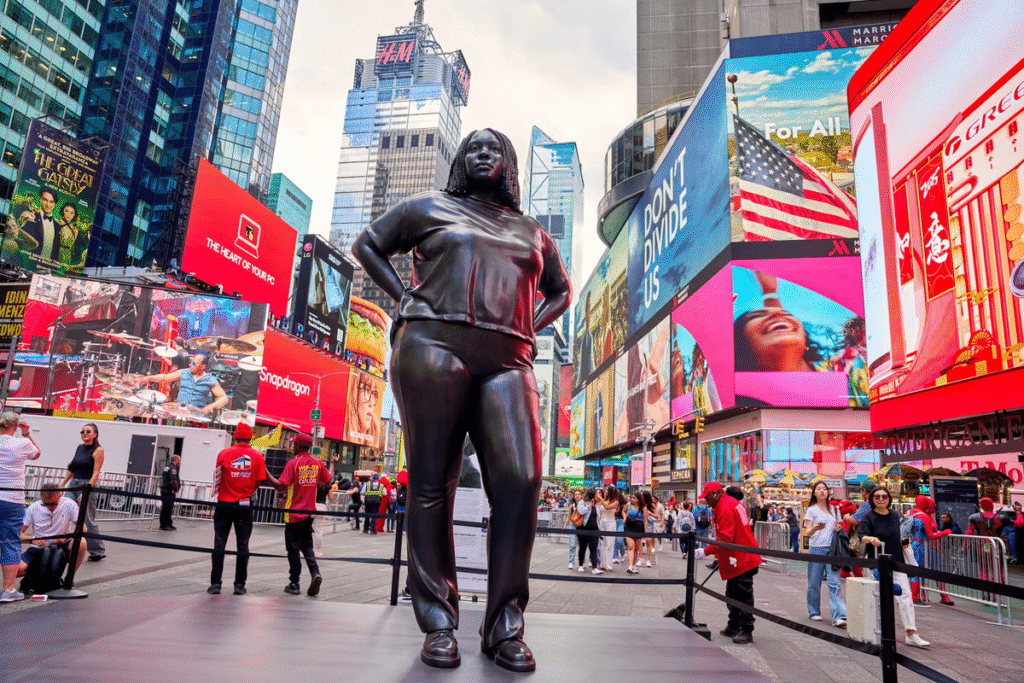
For supporters of the statue, the backlash underscores exactly why such a piece is necessary. When a realistic depiction of a Black woman is so offensive to some that it sparks national outrage, it signals how far society still has to go in accepting different forms of beauty, power, and presence. In this context, Price’s work becomes not just art, but activism—quietly yet boldly pushing back against centuries of exclusion and erasure.
Moreover, the statue invites critical conversations about who gets to occupy public space. Historically, statues have been tools of power—erected to honor war heroes, political leaders, or mythologized figures, most of whom are white and male. Changing that narrative is not just a matter of fairness; it’s about reshaping our collective memory and expanding our cultural imagination.
As Grounded in the Stars stands firm in Times Square through June 17, it does more than occupy physical space. It claims emotional, cultural, and psychological ground in a society still reckoning with the legacies of racism, sexism, and exclusion. The strong reactions—both positive and negative—show that public art continues to be a powerful battleground for societal values and identity politics.
Thomas J. Price’s statue is not just a depiction of a woman—it’s a monument to the everyday, a tribute to visibility, and a confrontation with uncomfortable truths. In an era where inclusivity is often politicized and even vilified, this statue remains a symbol of resistance, dignity, and a future in which everyone sees themselves reflected in the stories we choose to tell.