
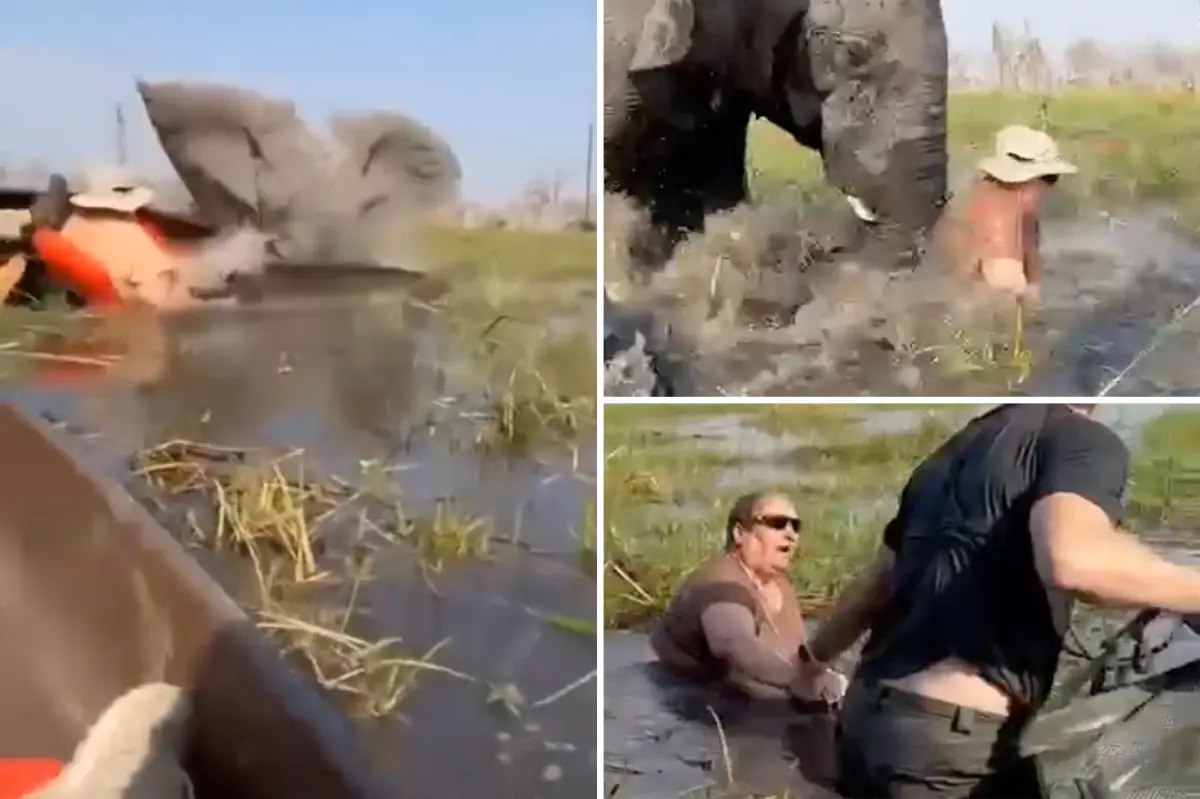
In a harrowing incident that underscores the raw power of wildlife in one of Africa’s most pristine ecosystems, a bull elephant charged a group of tourists on a safari canoe tour in Botswana’s Okavango Delta, flipping their vessels and briefly trapping one woman underwater. The attack, which occurred on Saturday, September 27, 2025, was triggered by the group’s proximity to a mother elephant and her two calves. Miraculously, the four tourists—two couples from the United Kingdom and the United States—emerged unscathed, though their expensive equipment was ruined and the waters’ dangers amplified the terror. The event, captured on video and rapidly circulating online, has reignited debates on safe distances during wildlife encounters.
The Okavango Delta, a UNESCO World Heritage site renowned for its labyrinth of waterways and abundant megafauna, attracts thousands of visitors annually. This clash highlights the delicate balance between tourism and conservation, where human curiosity can provoke defensive responses from animals protecting their young. Officials from Botswana’s Department of Wildlife and National Parks confirmed the incident but reported no human fatalities or severe injuries. The episode serves as a stark reminder of the risks inherent in eco-tourism, even under guided supervision.
The Incident Unfolds in the Delta’s Shallow Waters
The attack took place during a routine mokoro excursion—a traditional dugout canoe tour poled by local guides through the delta’s shallow, reed-fringed channels. The group, consisting of British couple Mark and Sarah Thompson and American couple John and Emily Davis, had set out from a remote lodge near the Moremi Game Reserve. Their guides, experienced in navigating the 15,000-square-kilometer inland delta, aimed to provide close-up views of the region’s iconic wildlife, including elephants that roam freely in herds.
As the canoes glided silently through the papyrus marshes around midday, the tourists spotted a female elephant with two young calves grazing on the water’s edge. The mother, estimated to be in her late 20s and weighing several tons, stood protectively near her offspring, who appeared to be under two years old. According to preliminary reports from the guides, the current and wind caused the canoes to drift approximately 20 meters closer than the recommended 50-meter buffer zone. This intrusion, though unintentional, was perceived as a threat by the herd.
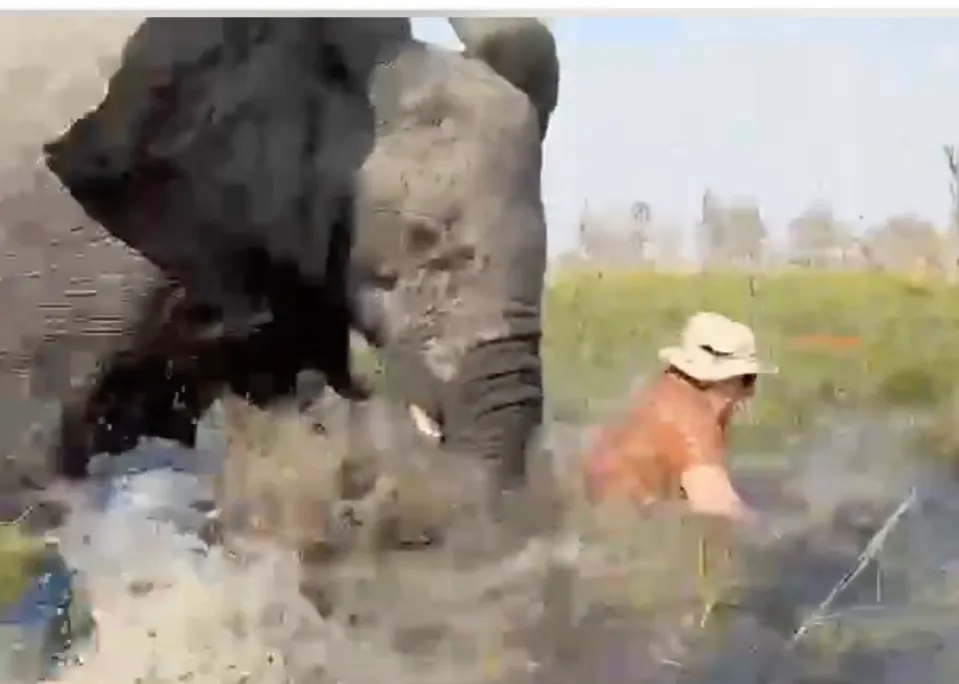
In a sudden burst of speed, a large bull elephant—likely a sentinel protecting the family group—emerged from the dense reeds and charged directly at the vessels. Eyewitness accounts describe the scene as chaotic: the bull’s massive frame, towering over 10 feet at the shoulder, barreled through the shallow water, creating waves that destabilized the lightweight mokoros. With a powerful sweep of its tusks and trunk, the elephant struck the first canoe, capsizing it instantly and hurling Mark Thompson and his guide into the murky, chest-deep water.
British & US tourists cheat death in miraculous escape from elephant reminding them whose turf it is
— RT (@RT_com) September 29, 2025
A furious elephant, angered by tourists getting too close to calves, charged & tipped canoes into crocodile-infested waters
Lucky they left Botswana with only wounded egos pic.twitter.com/4h1jwZhdv7
The second canoe, carrying Sarah Thompson, John Davis, and Emily Davis, met a similar fate moments later. The bull, undeterred, pursued the floundering group, its trumpeting echoes carrying across the floodplain. Video footage obtained from a surviving camera shows the elephant’s trunk coiling around Emily Davis’s leg as she struggled to surface. For approximately 10 seconds, the bull held her submerged, its foot pressing down in an apparent effort to neutralize the perceived danger to the calves, who had scattered into the shallows behind their mother.
The water, teeming with Nile crocodiles and hippos—both notorious for territorial aggression—added an extra layer of peril. Guides later recounted shouting warnings and attempting to pole away, but the elephant’s momentum was unstoppable. The bull released Emily after losing grip in the sediment-churned murk, allowing her to gasp for air and swim toward a nearby sandbank. The entire assault lasted less than two minutes, but in that span, both canoes splintered, rendering them unusable.
Read : Cringe! Spanish Tourist Pours Beer Down Elephant’s Trunk at Ol Jogi Conservancy in Kenya
Botswana wildlife authorities, upon reviewing the footage, classified the elephant’s behavior as a classic mock charge escalating to contact due to the proximity to vulnerable juveniles. Elephants in the Okavango Delta, with a population exceeding 130,000, are habituated to human presence but retain strong maternal and protective instincts. This bull, marked by distinctive tusk wear suggesting an age of around 30 years, was not previously known for aggression but acted in line with herd defense protocols observed in numerous studies.
Survivors’ Ordeal and Immediate Aftermath
As the dust— or rather, the silt—settled, the four tourists and their two guides clambered onto a narrow island of dry land, hearts pounding from the adrenaline surge. Emily Davis, the 42-year-old marketing executive from Chicago who endured the submersion, described the moment as “pure terror—like being caught in a living nightmare.” In initial statements to lodge staff, she recalled the pressure of the trunk as “unyielding, like a vice from the earth itself,” and credited her survival to the elephant’s distraction by the splashing water.
Mark Thompson, 48, a London-based architect, sustained minor cuts from the capsized canoe’s wooden edges but was otherwise unharmed. His wife Sarah, 45, and John Davis, 50, a New York financier, helped pull Emily to safety while fending off the guides’ frantic efforts to distract the bull with thrown gear. The guides, both in their 30s and trained by the local community, suffered bruises but no breaks. One guide’s quick thinking—using a paddle to create noise—may have deterred a follow-up charge.
Rescue arrived within 45 minutes via a motorized boat from the lodge, alerted by a satellite phone call. The group was ferried back to base camp, where medical teams from Maun’s airport clinic conducted checks. No concussions or infections from the water were detected, though all reported shock and dehydration. The lost equipment tally was steep: two high-end DSLRs, smartphones, and GoPro cameras, valued at over $10,000 collectively, sank irretrievably into the delta’s bottom.
Botswana’s tourism board issued a statement praising the guides’ professionalism while initiating an internal review of excursion protocols. The incident coincided with World Tourism Day, adding irony to the day’s global focus on sustainable travel. Local conservationists, including representatives from the Okavango Wildlife Rescue project, monitored the elephant herd post-event and confirmed the family unit had relocated unharmed deeper into the Okavango Delta, away from human traffic.
Interviews with the survivors, conducted en route to Gaborone for follow-up care, revealed a mix of gratitude and reflection. John Davis noted, “We came for the adventure, but this was a lesson in humility—nature doesn’t bend to our schedules.” The Thompsons echoed this, emphasizing their intent to advocate for stricter guidelines upon returning home. No legal action is planned against the tour operator, as the company cited force majeure in its liability waiver.
Lessons for Wildlife Tourism and Conservation
This close call in the Okavango Delta amplifies ongoing concerns about human-wildlife conflicts in Africa’s premier safari destinations. Experts, including former South African game ranger Pieter van der Merwe, who analyzed the video, warned that “a few more seconds under that foot, or a misplaced tusk, and we’d be mourning fatalities.” Van der Merwe faulted the guides for misjudging drift in the variable currents, urging a mandatory 100-meter buffer around elephant families with calves.
Kakwele Sinyina, a Botswana-based ecologist with the Kalahari Conservation Society, highlighted the broader context: rising tourism volumes—up 15% year-over-year—strain the delta’s carrying capacity. “Elephants here are not aggressors by nature,” Sinyina explained. “They charge when cornered, especially with young. This bull was doing its job.” Data from the Elephant Database indicates over 200 similar non-fatal encounters annually in southern Africa, with fatalities rare but increasing due to habitat fragmentation.

In response, Botswana’s government announced plans to enhance ranger patrols and invest in drone surveillance for real-time monitoring of high-traffic zones. Tour operators, represented by the Hospitality Association of Botswana, pledged refresher training on distance protocols and emergency signaling. The incident also spotlights the economic stakes: tourism generates 12% of Botswana’s GDP, with the delta alone drawing 250,000 visitors yearly, funding anti-poaching efforts that have stabilized elephant numbers.
For international travelers, the event reinforces the need for informed choices. Organizations like the African Wildlife Foundation recommend selecting operators accredited by the Responsible Tourism Partnership, which enforces ethical viewing standards. Emily Davis, recovering in a Johannesburg hotel, shared her takeaway: “We’ll safari again, but with eyes wide open to the rules. These animals deserve our respect, not our recklessness.”
As the Okavango Delta heals from this brush with disaster, the story of the charging bull and the submerged tourist becomes a cautionary tale etched into conservation lore. It reminds us that in the wild’s theater, humans are but guests—ones who must tread lightly to ensure the show endures for generations.