
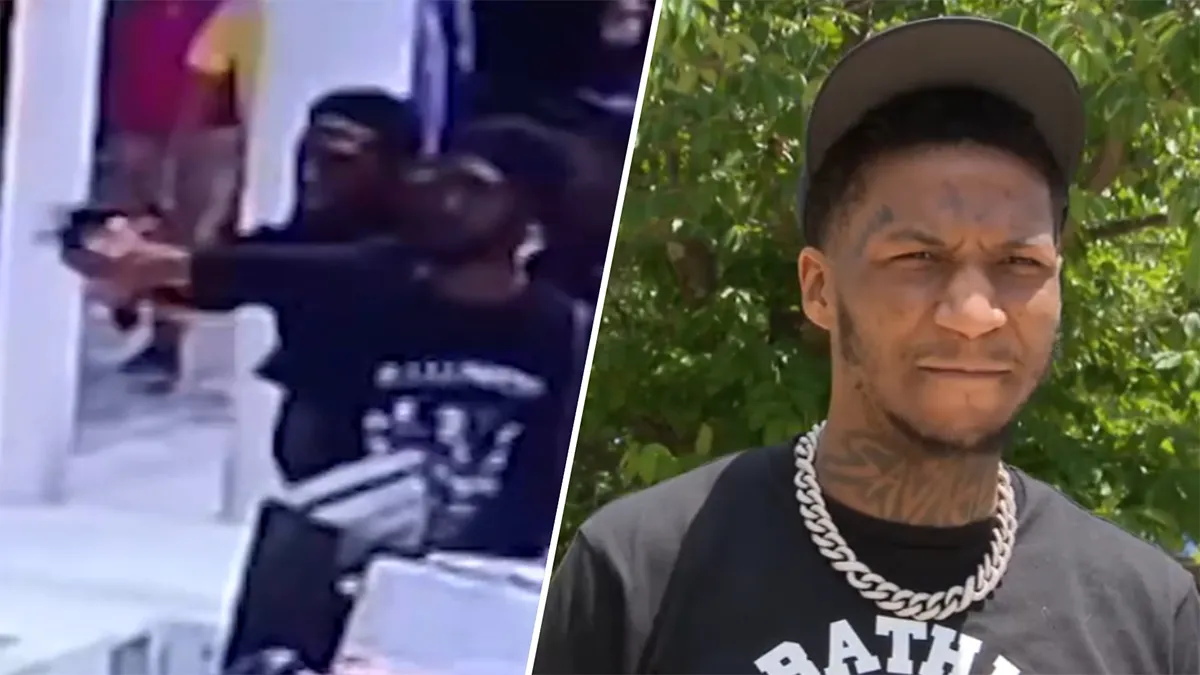
, born Noah Settles, is once again in the spotlight—this time not for his music but for a bold request he made during a court appearance. The 23-year-old artist, who served time in prison for firing a gun at a busy Virginia mall, recently appeared in court after violating the terms of his probation. What drew headlines was his demand to be allowed to use marijuana, citing that his upbringing in the music and social scene made cannabis an inseparable part of his life.
Settles had served three years in prison for an incident that occurred in 2022 at the Tysons Corner Center near Washington, D.C. During a confrontation with a rival group, he discharged a firearm inside the shopping center, triggering chaos and panic. Fortunately, no one was injured. Though his actions led to serious criminal charges, he avoided a long prison sentence due to a plea agreement that came with probation and mandatory substance abuse treatment.
However, his return to court revealed that he had failed drug and alcohol tests and had not completed the court-ordered substance abuse treatment. While that alone could have resulted in his return to prison, Settles instead used the moment to ask for a relaxation of the terms of his probation—specifically, permission to use marijuana.
Probation Violations and the Weed Request
The court appearance came after it was confirmed that Rapper No Savage had violated several conditions of his probation. He failed both drug and alcohol tests and also did not attend or complete the required substance abuse program that was mandated as part of his suspended sentence. This raised significant concerns for the court, as it appeared that the rapper was not taking the terms of his probation seriously.
Despite these violations, Settles’ attorney made an unexpected appeal to the judge: to allow his client to legally use marijuana while under supervision. The reason? The music culture and the environment that Settles grew up in, the attorney argued, are heavily intertwined with marijuana use. According to the defense, abstaining from cannabis is not only challenging but also culturally isolating for the rapper, who is trying to rebuild his career and stay connected to the industry.
Read : 11 Students of Fort Dearborn Elementary School Hospitalized After Eating Marijuana Edibles
The judge responded skeptically, asking if he was truly being asked to allow marijuana use for someone who had not yet completed a basic treatment program. There was visible concern in the judge’s words, especially when he remarked that such leniency might end in tragedy—either with Settles committing another serious offense or ending up dead due to failure in rehabilitation.
Read : Nicki Minaj Arrested at Amsterdam Airport for Alleged Drug Possession
Nonetheless, the judge decided not to send Settles back to prison immediately. Instead, he chose to let the rapper remain free while his lawyer and probation officer work out a potential new plan. This decision gives Settles some breathing room, though he is expected to return to court next month for a review.
A Cultural Argument or a Legal Loophole?
This situation highlights an ongoing debate in the legal system about the role marijuana plays in society, particularly in communities where it is culturally normalized. In the case of No Savage, his defense hinges not just on the legality of marijuana in several states, but also on the claim that abstaining from cannabis is out of step with the environment he was raised in.
The question is complex: should probation terms be modified based on cultural and occupational context? For many in the rap industry, marijuana is not just recreational—it is part of a lifestyle and a means of creative inspiration. Settles’ argument is that his continued use of marijuana is not indicative of defiance, but of consistency with his life and profession.

However, the legal system doesn’t usually make accommodations based on personal or professional background—especially when the individual has already violated the terms of their release. The judge’s concern is valid: if leniency is shown now, what precedent does it set for future cases?
Still, Settles’ statement to the media following the hearing reflected relief more than anything else. “I’m just happy I ain’t going to jail,” he said. “That’s the biggest blessing ever.” He defended his marijuana use by claiming, “It’s legal everywhere. I don’t do no other drugs.” While this isn’t entirely accurate—since marijuana is still illegal under federal law and not universally accepted across all states—it does reflect a common perception among many young people today.
What Comes Next for No Savage
Noah Settles claims he’s working hard to stay on the right path. With new music on the horizon, he expressed confidence that he will overcome the challenges in his life. “I’mma get through this. I’ve been through a lot. I ain’t never folded under pressure,” he told NBC 4 Washington.
Whether his court request will be granted remains to be seen. The upcoming court date will likely involve a proposed plan from his legal team and probation officer, which may include conditions for monitored cannabis use, increased supervision, or alternative treatment programs. For now, however, Settles must comply with the original terms of his probation—which means no marijuana use, regardless of cultural ties.
The rapper has built a following with tracks like “Reaper,” “Dirty 38,” and “Mood Switch,” which features fellow D.C. rapper Shy Glizzy. His raw lyrics and street credibility have gained him popularity, but legal troubles continue to overshadow his musical accomplishments.
His case reflects a broader challenge facing many artists with troubled pasts—balancing a high-profile career with the responsibilities and expectations of legal rehabilitation. If Settles succeeds in convincing the court to amend his probation, it could set a precedent not only for entertainers but for how courts view marijuana in the context of personal identity and professional culture.
The question now isn’t just about whether No Savage will be allowed to use marijuana—it’s about whether the justice system can adapt to changing cultural norms while still maintaining accountability and public safety. Settles’ next court date may provide an answer. Until then, the spotlight remains fixed on a young rapper trying to find a balance between the life he came from and the one he’s trying to build.