

In the shimmering waters of the Gulf of Mexico, where the Texas coast meets the endless horizon, nature has a way of delivering unexpected spectacles. This week, beachgoers and marine enthusiasts alike were treated to a rare and mesmerizing display: the appearance of the “pink meanie” jellyfish, a colossal creature known scientifically as Drymonema larsoni. With its cotton-candy pink hue and tentacles stretching up to an astonishing 70 feet, this jellyfish isn’t just a fleeting oddity—it’s a reminder of the ocean’s hidden wonders and the delicate balance of its ecosystems.
Spotted in clusters along a 10-mile stretch of shoreline near Port Aransas, these giants have sparked a wave of excitement and curiosity, drawing crowds to the sands and social media feeds buzzing with photos and videos. The sightings began earlier this week, as reported by Jace Tunnell, director of community engagement at the Harte Research Institute for Gulf of Mexico Studies. Tunnell, an avid beachcomber, documented more than 10 of these elusive jellyfish in just a few days, including one particularly striking encounter in the Port Aransas marina.
There, a pink meanie was observed draped around its favorite prey: a moon jellyfish, its long tentacles coiled like a predator claiming its catch. These jellyfish, which can weigh over 50 pounds, resemble oversized floating desserts bobbing in the waves, their translucent bells pulsing gently with the tide. For locals and visitors accustomed to more common Gulf marine life, this influx feels like a surreal invasion from a deep-sea fairy tale—one that’s as beautiful as it is bizarre.
What makes this event even more noteworthy is the rarity of the pink meanie in such numbers. Typically solitary drifters, these jellyfish only surface in abundance when conditions align just right, turning a quiet beach walk into an impromptu wildlife show. As the sun sets over the Texas Gulf, casting golden hues on the water, these pink specters add a touch of otherworldly magic. But beneath the allure lies a story of scientific discovery, ecological intrigue, and a gentle warning to those who venture too close. In the following sections, we’ll dive deeper into the origins of this enigmatic species, explore its unique biology, and consider what these sightings mean for the coastal environment.
The Discovery of a Jellyfish Family Like No Other
The tale of the pink meanie begins not on a Texas beach, but in the annals of marine biology, where a case of mistaken identity led to one of the most exciting taxonomic breakthroughs of the 21st century. First observed in large numbers in the Gulf of Mexico back in 2000, these pink-hued jellyfish initially baffled researchers. At the time, scientists assumed they were a variant of a known Mediterranean species, perhaps carried across oceans by shifting currents.
Beachgoers in Florida and Texas reported swarms of them, their massive forms washing ashore like discarded party decorations. Yet, something about their structure and behavior didn’t quite fit the profile of their supposed relatives. It took more than a decade of meticulous study—genetic sequencing, morphological analysis, and field observations—to unravel the mystery. In 2011, a team led by researchers including Keith Bayha from the Dauphin Island Sea Lab confirmed that these weren’t Mediterranean transplants at all.
Instead, Drymonema larsoni represented an entirely new species, so distinct in its anatomy and genetics that it warranted the creation of a brand-new biological family: Drymonematidae. This was no small feat; the last time a new family of true jellyfish (from the order Scyphozoa) was described dated back to 1921. The name “pink meanie” stuck as a nod to its aggressive hunting style and vivid coloration, but the scientific christening honored David Larson, a pioneering jellyfish expert whose work laid the groundwork for such discoveries.
This revelation wasn’t just a win for taxonomy; it highlighted how little we still know about the ocean’s depths. The Gulf of Mexico, a semi-enclosed basin teeming with biodiversity, serves as a natural laboratory for such surprises. Pink meanies have since been documented in scattered locations, from the Mediterranean to waters off South Africa, suggesting a wider range than initially thought. But their sporadic appearances keep them enigmatic.
Genetic studies revealed unique adaptations, like specialized stinging cells tailored for capturing other jellyfish, setting them apart from passive drifters. The 2000 bloom, which coincided with an explosion of moon jellyfish populations, was the first clue to their life cycle. Warmer waters and nutrient-rich upwellings likely fueled that event, much like the conditions brewing now in the Texas Gulf.
Read : The Top Ten Most Beautiful PINK Sand Beaches in the World
Today, as Tunnell and his team catalog these latest sightings, they echo that original discovery. Each washed-up specimen offers a chance to refine our understanding—measuring bell diameters (up to three feet across), counting gonad clusters (four distinctive horseshoe shapes visible through the translucent dome), and noting environmental triggers. It’s a humbling reminder that the sea guards its secrets closely, revealing them only when the tides turn just so. For marine biologists, these Texas encounters are a living archive, bridging past breakthroughs with future research.
Anatomy and Hunting Prowess: A Predator in Pink
At first glance, the pink meanie might seem like a gentle giant, its bell a rosy dome no wider than a dinner plate yet capable of housing a body that tips the scales at over 50 pounds. But peel back the ethereal exterior, and you’ll find a formidable predator engineered for the open ocean. The jellyfish’s bell, or medusa, is saucer-shaped and semi-transparent, allowing sunlight to filter through and illuminate the four horseshoe-shaped gonads that give it a subtle internal glow. This design isn’t just aesthetic; it’s optimized for buoyancy, enabling the pink meanie to drift effortlessly with currents while conserving energy.
The real marvel—and menace—lies in its tentacles. Extending up to 70 feet, these trailing appendages are lined with millions of nematocysts, specialized stinging cells that deploy like microscopic harpoons. Unlike many jellyfish that sting indiscriminately to capture plankton, pink meanies are specialized carnivores. They target other jellyfish, particularly the abundant moon jellies (Aurelia aurita), wrapping their victims in a suffocating embrace.
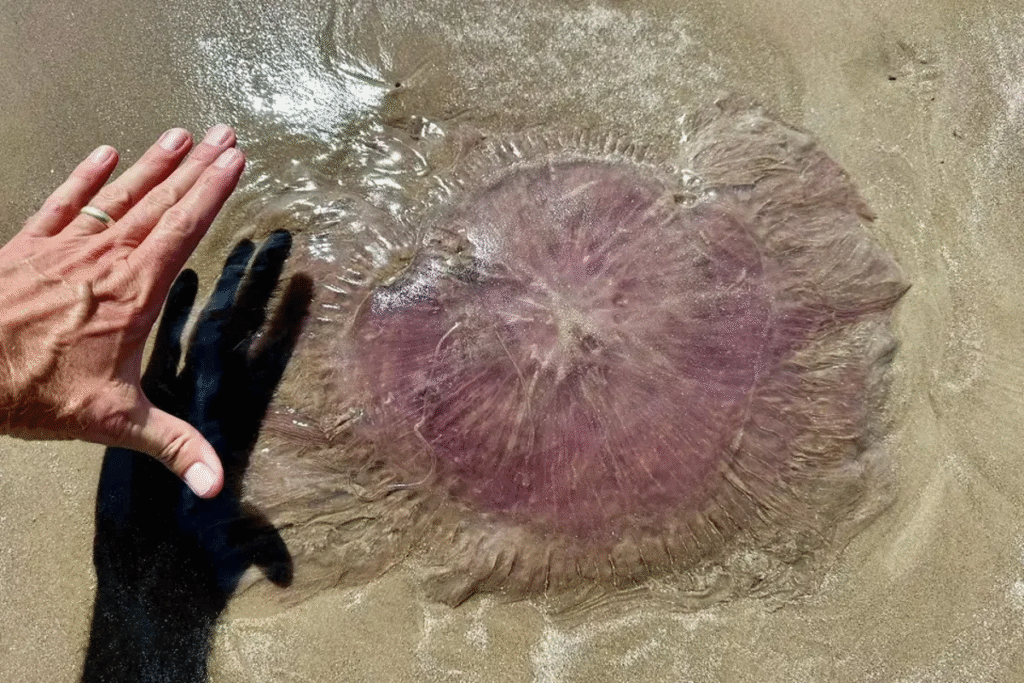
Observations show a single pink meanie can consume up to 34 moon jellies at once, dissolving them externally with digestive enzymes before absorbing the nutrient-rich slurry. This “mean” feeding strategy earned its nickname; it’s not content to wait for prey— it actively hunts, pulsing its bell to maneuver toward blooms of unsuspecting jellies. Physically, the pink meanie’s size demands respect. A mature specimen’s bell can reach 30 to 36 inches in diameter and 22 to 27 inches in height, with tentacles that coil and uncoil like living lassos.
Coloration varies from pale rose to deep magenta, derived from pigments in its diet and symbiotic algae. Reproduction follows a classic jellyfish pattern: polyps attach to substrates like seafloor rocks, releasing ephyra larvae that grow into adults during favorable seasons. Warmer Gulf temperatures accelerate this cycle, explaining sporadic booms. Despite their ferocity toward kin, pink meanies pose minimal threat to humans. Their sting rates a mere “2 out of 10” on the pain scale—more like a bee’s nip than a box jellyfish’s agony. Still, sensitivity varies; those with allergies should steer clear.
In the wild, these traits make pink meanies ecosystem engineers. By controlling moon jelly populations, they prevent overgrazing of plankton, maintaining food web stability. Tunnell’s marina sighting captured this dynamic perfectly: the pink meanie, tentacles entangled around its meal, exemplified nature’s raw efficiency. Up close, through a beachcomber’s lens, it’s a ballet of survival—graceful, gruesome, and utterly captivating.
Ecological Signals and Safety Tips for Coastal Explorers
The sudden surge of pink meanies along the Texas coast isn’t mere coincidence; it’s a barometer for the Gulf’s health. These jellyfish thrive in nutrient-laden waters, often following blooms of their prey triggered by seasonal upwellings or mild hurricanes stirring the depths. This September’s mild weather and steady currents have likely concentrated moon jellies near shore, drawing the meanies in tow. For ecologists, it’s a positive sign—indicating resilient plankton cycles amid broader climate pressures like warming seas and algal blooms.
Yet, it underscores vulnerabilities: as oceans acidify, jellyfish like these may proliferate, outcompeting fish for resources and altering fisheries. Locally, the impact is twofold. Tourists flock to spots like Mustang Island for the novelty, boosting eco-tourism while fostering appreciation for Gulf biodiversity. Harte Research Institute’s outreach, through Tunnell’s videos, educates on sustainable beachgoing—picking up trash to protect polyp habitats and reporting sightings to aid citizen science. On the flip side, increased jellyfish activity prompts purple flag warnings, signaling hazardous marine life. Swimmers should heed these, as even mild stings can spoil a day.
For safety, knowledge is key. If encountered, admire from afar; their size makes evasion easy. Should a tentacle brush skin, rinse immediately with vinegar to neutralize nematocysts, then apply hot water for relief. Avoid rubbing the area, which spreads stingers. Tunnell, stung while filming, emphasized caution without panic: “They’re impressive, but not out to get us.” Children and pets warrant extra vigilance.
Ultimately, these pink meanie sightings celebrate the Texas coast’s wild pulse—a call to cherish and safeguard our watery frontiers. As they fade back into the blue, they leave behind stories, samples for labs, and a spark of wonder. In a world of routine tides, such rarities remind us: the ocean always has one more surprise up its sleeve.