

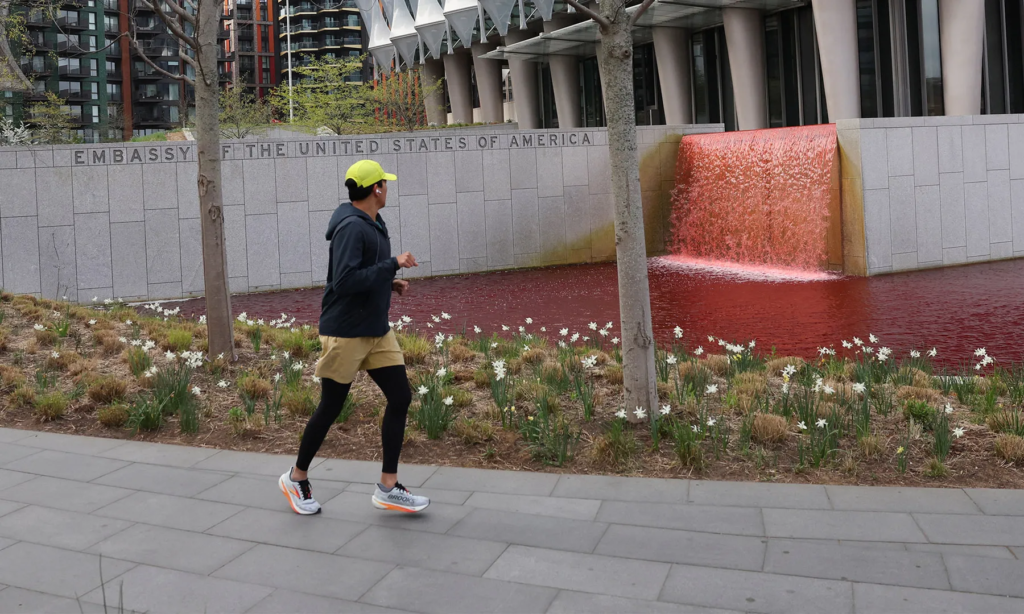
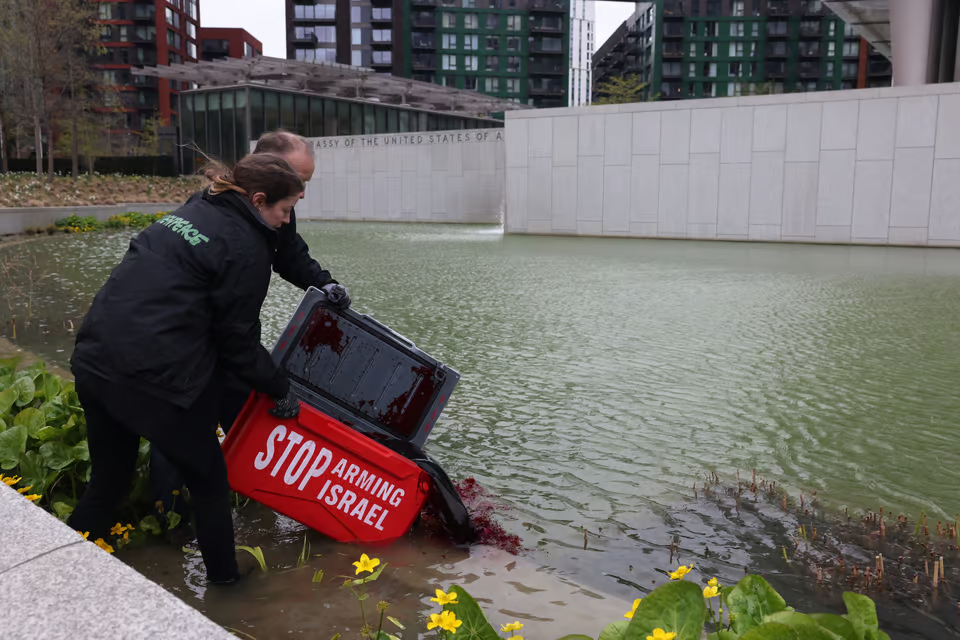
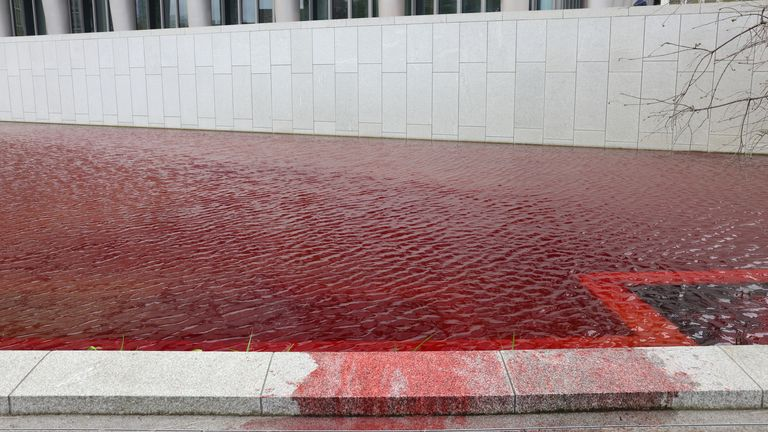
In a dramatic act of protest, six individuals were arrested in London after dumping 300 litres of blood-red dye into a pond outside US Embassy. The protest, carried out by Greenpeace activists, was a demonstration against the United States’ continued arms sales to Israel, which activists claim are contributing to the humanitarian crisis in Gaza.
The symbolic action, staged early on Thursday morning, drew immediate attention and prompted a swift response from the Metropolitan Police. The scene outside the embassy in Nine Elms, with the bright red dye saturating the water, was intended to represent the bloodshed and devastation in the ongoing conflict in Gaza.
Greenpeace UK’s co-executive director, Will McCallum, was among those arrested. The protest was meant to call out the US government’s role in supplying weapons to Israel, a nation engaged in a prolonged and deadly military campaign in Gaza following the October 2023 Hamas-led attacks.
Greenpeace has defended the action as peaceful and symbolic, emphasizing that the dye used was non-toxic, biodegradable, and would naturally wash away without causing environmental harm.
Metropolitan Police officers stationed at the embassy were alerted around 7:30am, and despite the protestors attempting to flee the scene, six individuals were apprehended shortly thereafter.
The suspects were taken into custody on suspicion of criminal damage and conspiracy to commit criminal damage. Authorities confirmed that there was no breach of the secure perimeter of the US embassy, as the pond is accessible via a public footpath.
A bold protest against US arms sales to Israel
The protest comes amid growing public concern over the scale and impact of US arms transfers to Israel during its military operations in Gaza. According to Areeba Hamid, another co-executive director of Greenpeace UK, the action aimed to hold the United States accountable for the consequences of its foreign policy.
“We took this action because United States weapons continue to fuel an indiscriminate war,” she said. “Bombs have been dropped on schools and hospitals, entire neighbourhoods reduced to rubble, and tens of thousands of Palestinian lives obliterated.”
The protest sought to challenge what Greenpeace views as complicity on the part of the United States and UK governments. Hamid urged these governments to stop prioritizing political alliances over human lives and instead listen to the increasing number of citizens calling for an arms embargo on Israel.
Greenpeace activists in the UK used red dye to turn the US Embassy’s waterfalls into a river of blood, for Washington’s involvement in Israel’s genocide in Gaza pic.twitter.com/130VU3AcpL
— Afshin Rattansi (@afshinrattansi) April 10, 2025
She emphasized that this was not just a symbolic act but a moral appeal to halt the supply of lethal military hardware that activists believe contributes to war crimes and civilian suffering. While the act of dyeing the pond red was undeniably theatrical, it served its intended purpose of drawing attention to a contentious and deeply emotional issue.
With images of the red-stained water spreading rapidly across social media, the protest successfully captured global attention and reignited debates about the ethical responsibilities of arms-exporting nations in conflicts where civilian casualties are alarmingly high.
The Gaza conflict: a humanitarian catastrophe
The backdrop of this protest is the Israel-Hamas war that erupted on October 7, 2023, when Hamas-led militants invaded southern Israel, killing around 1,200 people and taking 251 hostages. In response, Israel launched a massive and sustained military campaign in Gaza.
According to the Gaza Health Ministry, run by Hamas, more than 50,000 Palestinians have since been killed, and over 115,000 have been wounded. These figures, while not independently verified, have sparked widespread concern among international human rights organizations and humanitarian agencies.
Israel maintains that its military efforts are aimed at eliminating Hamas militants and that roughly 20,000 of those killed have been identified as fighters. However, critics argue that the scale of destruction and the number of civilian casualties far exceed any reasonable interpretation of proportionate military response. Entire neighborhoods have been flattened, medical facilities targeted, and essential infrastructure reduced to ruins.
Recent footage verified by Sky News has shown Israeli forces targeting ambulances and emergency convoys, even those with flashing lights. While Israeli authorities initially claimed that these convoys were not clearly identifiable, the evidence presented by news outlets contradicts those claims and adds further fuel to allegations of indiscriminate or even deliberate targeting of civilians.
This mounting evidence has led to increasing public outcry in Western countries, including the United States and the United Kingdom, where citizens and advocacy groups are demanding greater accountability and an immediate cessation of arms exports to Israel.
Escalating tensions and global reactions
The protest outside the United States’ embassy is one of many expressions of civil unrest emerging across Europe and North America in response to the conflict in Gaza. Demonstrations, vigils, and sit-ins have become more frequent, with university campuses, public squares, and embassies serving as flashpoints for protest.
These actions reflect a growing sentiment among many citizens that their governments are complicit in the Gaza conflict through financial, military, or diplomatic support for Israel.
In the UK, the issue has sparked political debate, with some Members of Parliament pushing for a review of arms export licenses to Israel. Meanwhile, the United States Congress has seen similar calls for reevaluating the nation’s defense partnerships, although strong bipartisan support for Israel remains a significant barrier to legislative change.
The protest in London, while peaceful, also raises questions about the limits of acceptable political dissent. The arrests made under charges of criminal damage could be seen as a warning to activists who might consider similar forms of protest.
However, as Areeba Hamid pointed out, “Rather than passing laws that make it easier for police to arrest people who make their voices heard on the issues they care about, the United States and UK governments should listen to the majority of Americans and Brits who support an arms embargo on Israel.”
Indeed, recent polling has shown a shift in public opinion in many Western countries, with increasing numbers of citizens expressing discomfort with their governments’ foreign policies related to the Israel-Palestine conflict. Calls for humanitarian ceasefires, international investigations into alleged war crimes, and the suspension of arms sales have become louder and more organized.
As the war drags on, with no clear resolution in sight, such acts of protest are likely to continue. Whether through symbolic actions like the Greenpeace dye protest or through legislative initiatives, the pressure on Western governments to reassess their role in the conflict is mounting. In the face of immense human suffering, activists argue that silence and inaction are not neutral—they are a form of complicity.
For now, the six individuals arrested in London await possible charges, but their message has already reverberated globally. Their act of protest has brought renewed attention to the humanitarian crisis in Gaza and reignited critical discussions about the ethics of arms sales in modern warfare.
Whether this leads to meaningful policy change remains to be seen, but the incident underscores the power of symbolic protest to challenge the status quo and demand accountability from those in power.