
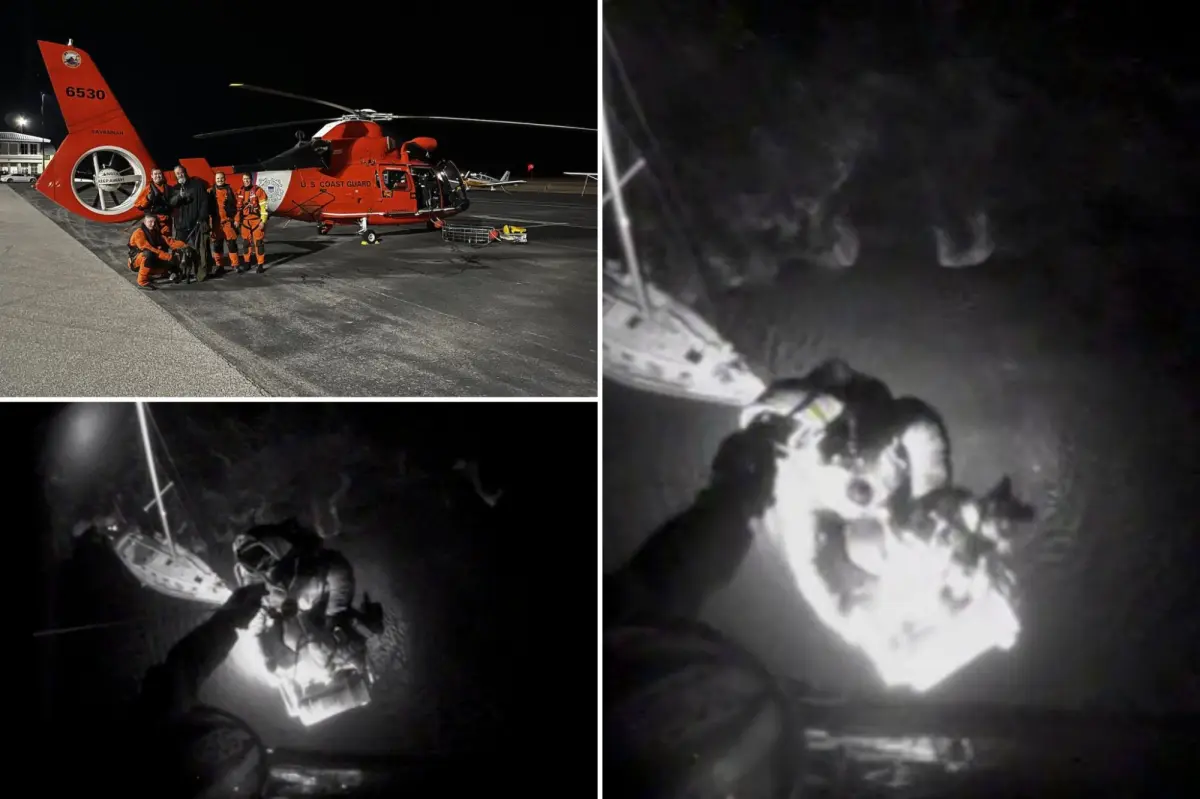
A routine evening along the South Carolina coastline turned into a dramatic maritime rescue when a 37-foot sailboat ran aground near Winyah Bay, leaving a man and his dog stranded on the vessel’s deck as conditions around them grew increasingly uncertain. The grounding occurred near rocky terrain known for shifting waters and unpredictable hazards, transforming what may have begun as a standard boating journey into a potentially dangerous situation requiring swift emergency response.
Within minutes of recognizing the severity of his circumstances, the mariner issued a distress call, setting in motion a coordinated rescue effort that demonstrated both the effectiveness of emergency communication systems and the readiness of trained rescue crews. The stranded vessel, identified as the Chusan, had come to rest on rocks in an area where water movement, structural stress on the hull, and changing tide patterns can rapidly escalate risk.
While the boat remained intact long enough for the occupants to await help, such groundings can quickly deteriorate into emergencies involving flooding, structural collapse, or hazardous exposure. The presence of a companion animal added another dimension to the rescue, requiring careful handling to ensure the safe evacuation of both passengers.
Responders acted quickly after receiving the distress signal, deploying a helicopter crew trained for maritime extraction operations. The rescue unfolded with precision, involving aerial maneuvering above the grounded sailboat, coordinated hoisting procedures, and rapid transport to shore.
Despite the tense circumstances, both the man and his dog were recovered safely and transported without medical concerns. The operation served as a vivid reminder of how quickly maritime environments can shift from calm to perilous, and how preparation, communication, and rapid response remain essential components of safe navigation on open water.
The Grounding of the Sailboat and Escalating Risk
The grounding of the Chusan occurred during the early evening hours, when visibility conditions can begin to change and tidal movement may intensify along coastal waterways. Winyah Bay, while navigable, contains rocky sections and areas where currents can shift quickly, especially around shoreline formations. These environmental characteristics create hazards for vessels that drift off course or encounter unexpected underwater obstructions. Even experienced mariners can find themselves in difficult situations when depth changes rapidly or when navigational margins narrow near rock formations.
Running aground is not simply an inconvenience for boaters. When a vessel strikes or settles onto rocks, pressure on the hull can cause structural damage, even if it is not immediately visible. Stress fractures, shifting balance, or gradual water intrusion may follow. In many cases, the vessel’s stability becomes uncertain, especially if wave action repeatedly forces it against hard surfaces. This creates danger not only to the craft but also to anyone remaining onboard. Passengers may face risks from slipping surfaces, sudden movement of the vessel, or worsening weather conditions.
In the case of the Chusan, the mariner recognized that remaining stranded without assistance could lead to serious consequences. The decision to issue a distress call demonstrated situational awareness and an understanding of maritime safety protocols. Contact was made using VHF-FM channel 16, the internationally recognized emergency frequency monitored continuously by maritime rescue authorities. This channel serves as a critical lifeline for boaters in distress, enabling immediate communication with response units capable of coordinating rescue operations.
Read : South Carolina Circuit Court Judge Diane Goodstein’s $1.5 Million Home Destroyed in Massive Fire
The presence of rocky terrain amplified the urgency of the situation. Unlike sandy or soft-bottom groundings, rock groundings often involve unpredictable vessel movement as waves and tide shifts interact with the hull. Even relatively calm conditions can produce sudden jolts or repositioning that complicate rescue access. For aerial rescue crews, approaching a grounded vessel requires careful assessment of wind direction, rotor clearance, and deck stability. These factors must be evaluated quickly yet thoroughly to ensure a safe extraction.
Read : 10 Countries That Are Totally Prepared for Artificial Intelligence
The mariner’s dog also required consideration during the rescue planning. Animals can react unpredictably to loud helicopter noise, strong wind from rotor wash, and unfamiliar handling procedures. Rescue crews must adapt their techniques to maintain calm conditions, often securing the animal carefully before hoisting. Such operations demand coordination, patience, and specialized training to avoid injury to both rescuers and those being rescued.
The grounding of the Chusan thus represented more than a navigational mishap. It was a situation with the potential to worsen rapidly, shaped by environmental hazards, structural uncertainty, and the challenges of extracting occupants from a compromised vessel. Prompt communication and swift response prevented escalation, illustrating how critical early action can be when maritime emergencies arise.
Precision Rescue from the Air
Once the distress signal was received, rescue personnel mobilized quickly, dispatching a helicopter crew trained specifically for maritime response operations. Aerial rescue remains one of the most effective methods for reaching vessels stranded in locations that are difficult or dangerous for surface craft to access. In rocky or shallow areas, traditional rescue boats may risk running aground themselves, making helicopter deployment the safest and fastest option.
Approaching a grounded sailboat requires careful planning even before the aircraft reaches the scene. Pilots must assess wind patterns, altitude stability, and potential obstacles such as masts or rigging that could interfere with hoisting equipment. Communication between the flight crew and rescue swimmers or hoist operators is constant, ensuring precise positioning above the vessel. Even slight misalignment can create hazards when lowering equipment or personnel onto a moving or unstable deck.
During the operation involving the Chusan, the helicopter crew maneuvered into position above the grounded sailboat and prepared for extraction. The hoisting process involves lowering a rescue device, typically a harness or basket, to the vessel below. Occupants must be secured carefully before being lifted upward through powerful downdrafts generated by the helicopter’s rotors. These conditions can be disorienting, particularly for individuals unfamiliar with aerial rescue procedures.
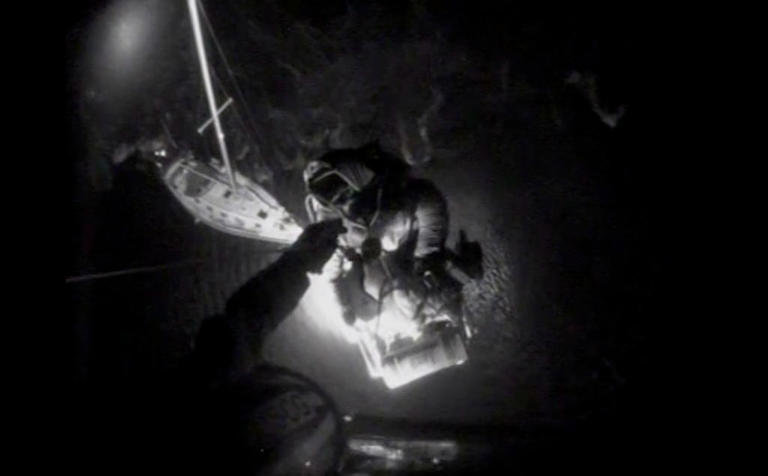
The successful evacuation of both the mariner and his dog demonstrated the crew’s training and coordination. Handling an animal during a hoist requires additional attention, as sudden movement or fear responses can complicate lifting procedures. Rescue personnel must ensure the animal is safely restrained and positioned to prevent injury during ascent. The smooth execution of the hoist reflected both technical expertise and careful planning.
After extraction, the helicopter transported the rescued pair to a nearby airport, where they were safely disembarked. The absence of reported medical concerns indicated that the rescue had been conducted swiftly enough to prevent exposure-related issues or injury. However, the operation remained a vivid example of how quickly aerial response units must act once a distress call is received.
Helicopter rescue missions demand extensive training, not only in flight operations but also in emergency medicine, survival assessment, and rapid decision-making. Crews rehearse scenarios involving unstable vessels, rough weather, and limited visibility, preparing for a wide range of maritime emergencies. Each real-world mission reflects the cumulative effect of this preparation, translating simulated training into effective lifesaving action.
The extraction from the Chusan illustrated the precision required in maritime aerial rescue and the critical role of rapid deployment. Without timely response and skilled execution, groundings in hazardous areas can escalate into far more serious incidents. The successful outcome underscored the value of maintaining highly trained rescue teams ready to respond at a moment’s notice.
Maritime Safety and the Importance of Emergency Communication
One of the most significant factors contributing to the successful rescue was the mariner’s ability to send a distress call using a functioning VHF radio. Maritime communication systems form the backbone of emergency response at sea, providing a direct link between those in danger and the agencies equipped to assist them. Continuous monitoring of designated emergency channels allows rescue services to respond immediately when distress signals are transmitted.
VHF-FM channel 16 serves as the primary international emergency frequency for maritime communication. Boaters are strongly encouraged to monitor this channel while underway, ensuring that help can be summoned without delay if conditions deteriorate. A working radio, properly maintained and accessible, can mean the difference between rapid rescue and prolonged exposure to dangerous circumstances.
Maritime authorities consistently emphasize preparedness as a fundamental aspect of safe boating. Carrying reliable communication equipment, maintaining awareness of navigational hazards, and understanding emergency procedures are essential responsibilities for vessel operators. Environmental conditions on open water can shift rapidly, leaving little margin for delayed response when problems arise.
The rescue of the mariner and his dog highlighted how preparedness and proper equipment work together with trained response teams to produce positive outcomes. The ability to communicate distress clearly allowed rescuers to identify the location, assess the nature of the emergency, and deploy the appropriate response method. Without this communication link, locating a stranded vessel in coastal waters could become significantly more difficult and time-consuming.
Groundings, in particular, illustrate the unpredictability of maritime travel. Even familiar routes can present hidden hazards due to tide changes, shifting sediment, or submerged obstacles. Maintaining situational awareness and remaining prepared for emergencies is therefore essential regardless of experience level. Rescue officials frequently remind boaters that vigilance and communication readiness are among the most effective safeguards against escalating danger.
The events surrounding the grounding of the Chusan reinforced these principles. A potentially hazardous situation was resolved safely through prompt distress signaling, rapid response coordination, and skilled rescue execution. The successful outcome reflects not only the effectiveness of emergency response teams but also the vital role of preparation and communication in maritime safety practices.