

For centuries, the Pyramids of Giza have remained a source of fascination, speculation, and countless myths. Recently, a controversial claim has surfaced, suggesting the discovery of the legendary “Halls of Amenti” in a vast underground city beneath the pyramids. This claim, made by researchers from Italy and Scotland, has sparked both excitement and skepticism in the archaeological community.
The findings, however, have been met with significant criticism from leading Egyptologists who dismiss them as “fake news.” While the idea of hidden chambers beneath the ancient structures is captivating, the lack of peer-reviewed evidence has cast doubt on these extraordinary claims.
The Alleged Discovery: A Breakthrough or a Hoax?
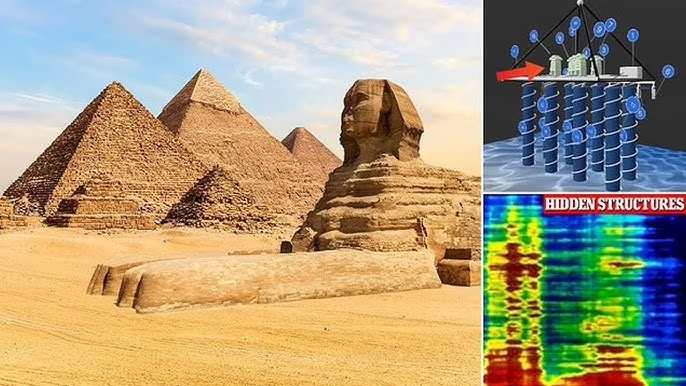
A team of researchers led by Corrado Malanga from Italy’s University of Pisa and Filippo Biondi of the University of Strathclyde in Scotland initiated what they called the “Khafre Project.” Using advanced Synthetic Aperture Radar (SAR) technology, the team claimed to have located five small room-like structures within the Pyramid of Khafre, which they believed were previously undiscovered.
Their findings, as they suggested, indicated the presence of an elaborate underground network stretching thousands of feet below the Giza Plateau. The researchers asserted that electromagnetic signals converted into phononic data revealed large-scale underground infrastructure.
The images were used to generate a rough 3D model that depicted spiral pathways descending into an extensive subterranean city. One of the primary assertions was that these structures bore a strong resemblance to the mythical “Halls of Amenti,” a concept deeply rooted in ancient Egyptian lore.
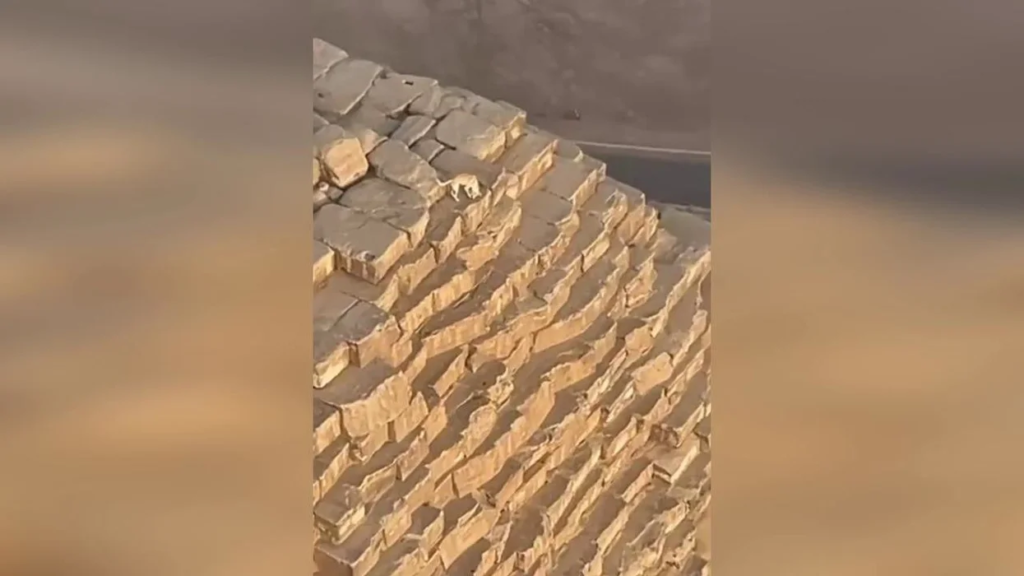
Read : Dog Climbs on Top of Great Pyramid of Giza: Paraglider Shares Video
According to the researchers, the newly discovered structures could be part of a sacred underground complex containing hidden wells and pathways, potentially rewriting our understanding of Egyptian history. However, these claims have not been published in any peer-reviewed journal, raising concerns about their scientific credibility.
Scientific Scrutiny and Skepticism
Despite the dramatic nature of these claims, experts in Egyptology and archaeology have largely dismissed them. Dr. Zahi Hawass, Egypt’s former minister of antiquities, outright rejected the findings, labeling them as “completely wrong” and “fake news.”
According to him, no radar technology has been employed within the pyramid, and the techniques used by the researchers are neither scientifically approved nor validated. Prominent radar expert Lawrence Conyers from the University of Denver also weighed in, stating that the available technology is not advanced enough to provide such detailed subterranean images.
He explained that while radar can detect anomalies beneath the surface, it cannot conclusively confirm the existence of an entire underground city. Furthermore, he pointed out that the structures found just below the surface could be remnants of earlier civilizations that predated the construction of the pyramids.
Read : Mysterious L-shaped Structure Found Underground in the Western Cemetery of Giza
Another major issue with the study is the lack of verifiable archaeological data. If such a vast underground city existed, one would expect evidence of its construction, tools, artifacts, and historical documentation.
Yet, no physical excavation has been conducted to support the researchers’ claims. Without excavation or peer-reviewed validation, their assertions remain speculative at best.
The Myth of the Halls of Amenti: Fact or Fiction?
The Halls of Amenti are a legendary concept found in ancient Egyptian texts and later elaborated in esoteric traditions. These mythical halls are believed to contain the “Hall of Records,” a chamber supposedly filled with ancient knowledge about humanity’s origins, past civilizations, and cosmic secrets.
Some interpretations suggest that the Hall of Records lies beneath the Great Sphinx, while others claim it is hidden beneath the pyramids. Despite their significance in myth and legend, no credible archaeological evidence has ever confirmed the existence of the Halls of Amenti.
The belief in these halls primarily stems from mysticism and alternative history rather than established Egyptology. While many ancient Egyptian texts mention the afterlife and sacred burial sites, they do not provide any concrete evidence of an underground city beneath Giza.
Over the years, various theories about hidden chambers and lost knowledge beneath the pyramids have surfaced, but none have been substantiated by mainstream archaeology.
The most famous of these claims include Edgar Cayce’s prophecies about the Hall of Records and alternative historians suggesting extraterrestrial involvement in pyramid construction. However, without tangible proof, these theories remain speculative.
The idea of a vast underground city beneath the Pyramids of Giza is undoubtedly intriguing, but the lack of credible evidence makes it difficult to accept as fact. While the Khafre Project researchers have presented an exciting hypothesis, their findings remain unverified by the wider scientific community.
Without excavation, peer-reviewed studies, or independent verification, their claims risk being relegated to the realm of pseudoscience rather than genuine archaeological discovery.
The pyramids continue to be one of the most mysterious and studied structures in the world, and new discoveries are always possible. However, extraordinary claims require extraordinary evidence. Until such evidence emerges, the notion of an underground city and the fabled Halls of Amenti will remain a captivating legend rather than an accepted historical truth.