
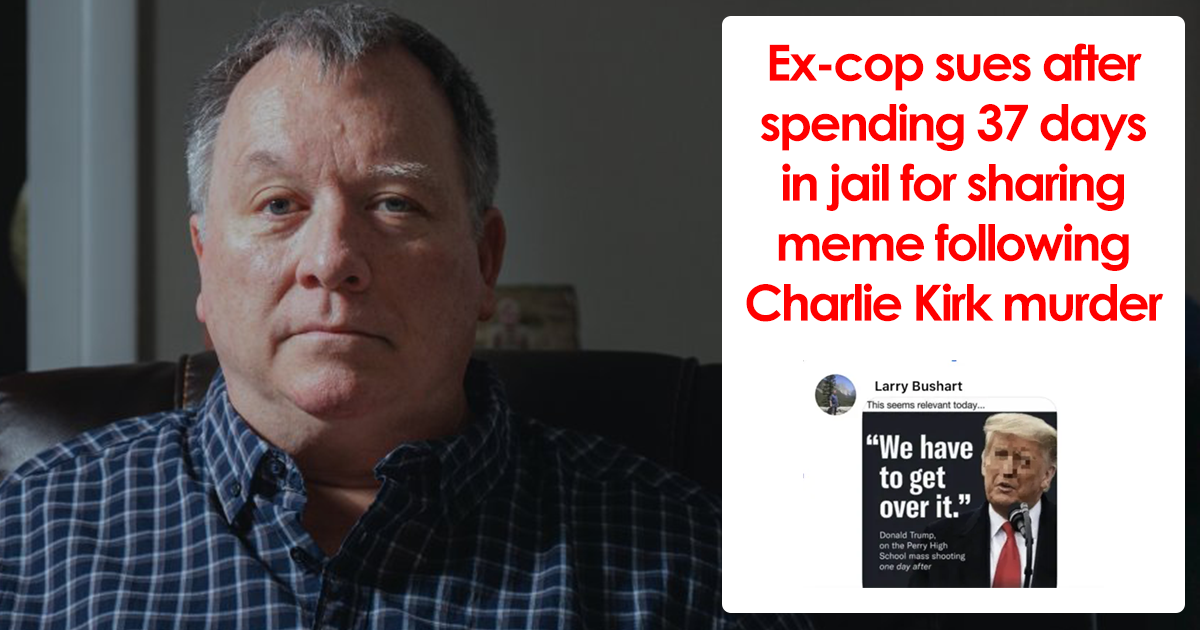
The arrest and prolonged detention of retired Tennessee law enforcement officer Larry Bushart has emerged as a flashpoint in the broader national debate over free speech, political polarization, and the limits of law enforcement authority in the digital age. Bushart, a former officer with more than three decades of experience, spent 37 days in jail this fall after being arrested over a Facebook meme he shared following the assassination of conservative activist Charlie Kirk.
Although prosecutors ultimately dropped the sole criminal charge against him, Bushart’s incarceration and the circumstances surrounding it have now become the basis of a federal civil rights lawsuit that raises fundamental questions about constitutional protections and government accountability.
Filed in federal court in Tennessee, the 30-page lawsuit argues that Larry Bushart was unlawfully arrested and prosecuted for protected political speech, in violation of the First Amendment. Represented by the Foundation for Individual Rights and Expression, Bushart contends that county officials knowingly mischaracterized political commentary as a criminal threat, leading to his arrest, a $2 million bond he could not afford, and more than a month behind bars.
The case has drawn attention not only because of Bushart’s background in law enforcement, but also because it unfolded amid an already tense political climate following Kirk’s killing, when public discourse surrounding the activist became highly charged and, at times, closely scrutinized by authorities.
According to the lawsuit, Bushart’s experience reflects a broader pattern of overreach fueled by fear and political sensitivity rather than evidence of wrongdoing. His attorneys argue that no reasonable interpretation of the meme constituted a threat, and that officials involved in the case understood its political nature even as they pursued his arrest. As the case proceeds, it is likely to test how courts balance public safety concerns with free expression rights in an era when online speech is increasingly policed, sometimes with severe personal consequences.
The Facebook Meme and the Arrest
Larry Bushart’s legal troubles began roughly ten days after Charlie Kirk, a prominent conservative activist and ally of former President Donald Trump, was fatally shot during an outdoor event at Utah Valley University on September 10. In the days following the assassination, vigils and memorials were held in various states, including Tennessee. Against this backdrop, Bushart shared a meme on Facebook referencing one such vigil. The meme included a photograph of Donald Trump and quoted a remark Trump made in 2024 following a shooting at Perry High School in Des Moines, Iowa: “We have to get over it.”
The meme was captioned, “This seems relevant today,” and was presented, according to Larry Bushart and his attorneys, as political commentary on gun violence, public reactions to mass shootings, and the broader national debate over firearms and political rhetoric. There was no explicit reference to any planned action, nor any mention of a specific threat. Nevertheless, the day after Bushart posted the meme, four law enforcement officers arrived at his home, arrested him, and charged him with “threatening mass violence at a school.”
Authorities later claimed that the post was interpreted locally as a threat to an area school with a name similar to the Iowa school referenced in Trump’s quote. Court records indicate that investigators believed the meme could be read as an implied threat, despite the absence of any direct language suggesting violence. Larry Bushart’s lawsuit disputes this interpretation entirely, arguing that it was both unreasonable and unsupported by any evidence.
BREAKING: FIRE is now representing Larry Bushart, the 61-year-old retired Tennessee policeman who spent 37 days in jail for posting a meme a local sheriff didn’t like.
— FIRE (@TheFIREorg) November 18, 2025
What happened was absurd, cruel, and unconstitutional — and we’ll see the sheriff in court. pic.twitter.com/06yEXl55nS
The arrest was followed by the imposition of a $2 million bond, an amount Larry Bushart was unable to pay. As a result, he remained incarcerated for 37 days. During this period, the lawsuit alleges, there was no corroborating evidence produced to justify the charge. According to court filings, the Perry County School District had no records relating to Bushart or the meme, and no individual reportedly came forward to say they perceived the post as a threat.
Larry Bushart’s attorneys further allege that key officials involved in the decision to arrest him, including Perry County Sheriff Nick Weems and county investigator Jason Morrow, understood that the meme constituted political speech rather than a genuine threat. Despite this understanding, the lawsuit claims, they proceeded with the arrest and prosecution, resulting in Bushart’s prolonged detention.
In late October, the district attorney moved to drop the single charge against Larry Bushart. He was subsequently released from jail. The dismissal of the case, however, did not undo the personal and professional consequences of his incarceration, which now form a central part of his civil lawsuit.
The Lawsuit and Allegations of Rights Violations
Larry Bushart’s federal lawsuit names Perry County, Sheriff Nick Weems, and investigator Jason Morrow as defendants. The complaint asserts that Bushart was targeted “simply for speaking his mind” and that his arrest constituted a clear violation of well-established First Amendment protections. His lawyers argue that the right to engage in political speech, even speech that some may find objectionable or controversial, is among the most strongly protected forms of expression under the Constitution.
The complaint states that it is “clearly established that the First Amendment prohibits government officials from arresting people for protected political speech.” It further alleges that the defendants lacked probable cause to arrest Bushart and that they acted with reckless disregard for his constitutional rights. By imposing an extraordinarily high bond and allowing Bushart to remain jailed for more than a month, the lawsuit claims, officials compounded the harm caused by the initial arrest.
Central to Bushart’s argument is the claim that no reasonable person could interpret the meme as a true threat of violence. The lawsuit emphasizes that the meme did not reference any specific school in Tennessee, did not call for violence, and did not suggest any intent on Bushart’s part to carry out an attack. Moreover, his attorneys note that the absence of any complaints or records from the local school district undermines the notion that the post created a credible threat.

The lawsuit also highlights Bushart’s background as a retired law enforcement officer, arguing that his long career demonstrates both his understanding of the law and his respect for public safety. According to the complaint, Bushart had no history of making threats or engaging in violent behavior, and there was no evidence suggesting he posed any danger at the time of his arrest.
Larry Bushart is seeking a jury trial and is asking for both compensatory and punitive damages. The lawsuit contends that his incarceration resulted in significant financial losses, including the loss of a post-retirement job. It also alleges emotional distress and reputational harm, as well as a chilling effect on his willingness to participate in online political discussions. His attorneys argue that such chilling effects extend beyond Bushart himself, potentially discouraging others from engaging in lawful political expression out of fear of similar repercussions.
CNN has reported that it reached out to Perry County for comment, though responses from the county and the named officials were not immediately available. As the case moves forward, it is likely to involve detailed scrutiny of the decision-making process that led to Bushart’s arrest and the standards used by local authorities to assess online speech.
Broader Implications for Free Speech and Policing
The Bushart case has broader implications that extend well beyond Perry County. It arrives at a moment when law enforcement agencies across the country are grappling with how to respond to online speech in the aftermath of high-profile acts of violence. Social media posts, memes, and political commentary are increasingly scrutinized for potential threats, sometimes leading to rapid enforcement actions aimed at preventing harm. While public safety is a legitimate concern, civil liberties advocates argue that such efforts can cross constitutional lines when political expression is treated as criminal conduct without clear evidence of intent or danger.
Read : Truth Behind Norwegian Tourist’s Claim of Being Denied Entry into the US Over Bald JD Vance Meme
Bushart’s lawsuit underscores the tension between preventive policing and free speech rights. Courts have long distinguished between true threats, which are not protected by the First Amendment, and political hyperbole or commentary, which generally is protected even if it is provocative or unsettling. Determining where a particular statement falls on that spectrum can be difficult, particularly in emotionally charged contexts. However, Bushart’s attorneys argue that this difficulty does not justify abandoning constitutional safeguards.

The case also raises questions about the use of high bail amounts in cases involving alleged speech-based offenses. A $2 million bond effectively guaranteed that Bushart would remain incarcerated while his case was pending, despite the absence of violence or physical harm. Critics of such practices argue that excessive bail can function as a form of punishment before guilt is established, especially for defendants without substantial financial resources.
From a policing perspective, the lawsuit may prompt renewed examination of training and policies related to evaluating online speech. If Larry Bushart’s claims are upheld, the case could serve as a cautionary example for law enforcement agencies about the risks of conflating political commentary with criminal threats. It may also influence how prosecutors assess similar cases in the future, particularly when evidence of intent is weak or nonexistent.
For Larry Bushart personally, the lawsuit represents an effort to reclaim his reputation and assert what he describes as fundamental rights. In a statement released through his attorneys, he emphasized his respect for the law and his belief that his arrest was unjust. He described the experience as an attempt to bully him into silence, a claim that resonates with broader concerns about self-censorship in polarized political environments.
As the case proceeds through federal court, it is likely to attract attention from civil liberties organizations, legal scholars, and law enforcement professionals alike. The outcome could help clarify the boundaries of lawful police action in response to online political speech and reaffirm, or potentially reshape, the legal standards governing when speech crosses the line into criminal conduct.
I’ve been using vin68bet for a while now, and I’ve gotta say, I’m pretty happy with it. Good odds and a decent selection of bets. Just my two cents. vin68bet