
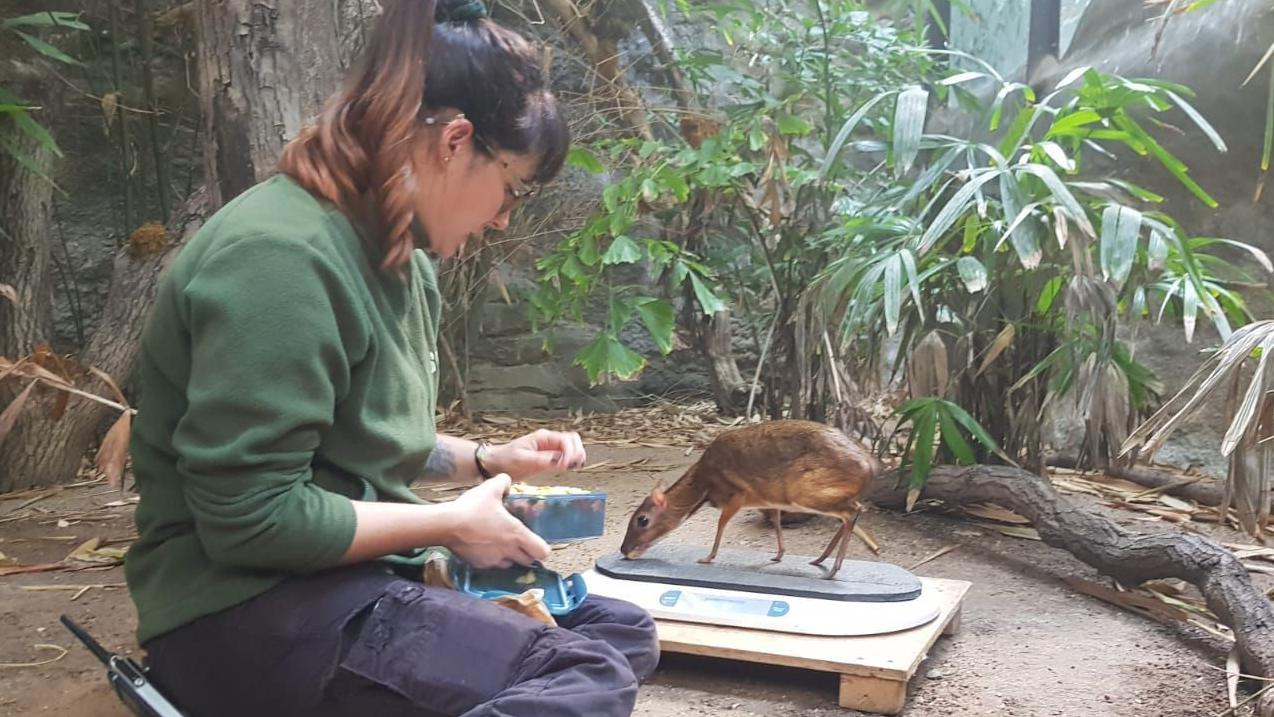
Working closely with animals that many people will never encounter in the wild is an experience few can claim, yet for Rhiannon Wolff it is an everyday reality. As a hoofstock keeper at Marwell Zoo near Winchester in Hampshire, she is responsible for caring for a remarkable variety of species, from towering giraffes and powerful white rhinos to zebras, tapirs, red river hogs, and Visayan warty pigs.
Her role places her at the intersection of animal welfare, scientific management, and global conservation, offering both routine structure and moments of extraordinary significance. For Wolff, the experience often feels surreal. She describes the opportunity to work with so many unique and often endangered species as a privilege—one that sometimes feels almost unbelievable. Her work reflects not only a personal passion for animals but also a deeper commitment to protecting species whose survival increasingly depends on human intervention.
From Animal Lover to Hoofstock Specialist
Rhiannon Wolff’s path into zookeeping was shaped by a lifelong fondness for animals, though her career direction did not initially point toward the zoo environment. Like many who are drawn to animal care, she once considered becoming a veterinarian. Over time, however, she discovered academic pathways that focused specifically on exotic species and conservation, offering a different but equally meaningful way to contribute to animal welfare. These specialized courses opened the door to a profession that combined hands-on care with broader ecological impact.
Her academic journey led her to pursue a university degree in zoo management, where she developed both theoretical understanding and practical skills related to the care of non-domestic animals. This educational foundation was followed by an unpaid internship at a major zoological institution, an experience that provided essential exposure to the realities of professional animal care. Internships of this kind are often demanding, requiring dedication, adaptability, and resilience, yet they serve as crucial stepping stones into the field.
Wolff’s eventual move to Marwell Zoo came in 2020 when she accepted a maternity cover position. What began as a temporary role quickly became a permanent chapter in her professional life. She relocated for the opportunity and has remained ever since, building expertise and deep familiarity with the animals under her care. The transition from student and intern to full-time keeper marked the beginning of a career defined by both responsibility and fulfillment.
Her role as a hoofstock keeper is highly specialized. The term “hoofstock” refers to a broad category of hoofed mammals, many of which are large, powerful, and complex in both behaviour and physical care requirements. Managing such species demands not only knowledge but also precision and consistency.
Read : Dollars for Dung! Maryland Zoo Offers to Name Animal Poop After Your Ex This Valentine’s Day
Wolff’s daily responsibilities include enclosure cleaning, monitoring fencing systems, preparing and delivering nutritional enrichment, maintaining detailed records, collecting biological samples, and closely observing animal behaviour. These tasks form the backbone of professional zoo management, ensuring both physical health and psychological well-being.
Read : 22-Year-Old Boy Publicly Executed for Watching K-pop Videos in North Korea
Training is another essential component of her work. Large animals such as giraffes and rhinos require cooperative medical procedures that must be performed safely for both animals and staff. Through consistent behavioural training, these animals learn to voluntarily participate in examinations, X-rays, blood draws, and vaccinations while fully awake. This approach reduces stress and risk, demonstrating the importance of trust-based interaction in modern animal care. For Wolff, working with such enormous creatures in controlled but cooperative medical settings is both technically demanding and deeply rewarding.
Daily Life Among Rare and Remarkable Species
The daily rhythm of Wolff’s work is shaped by the diversity of animals she oversees. Each species has distinct dietary needs, behavioural tendencies, and environmental requirements, making routine care both complex and varied. Observation plays a particularly significant role. By carefully monitoring how animals move, eat, interact, and respond to their surroundings, keepers can identify early signs of illness or stress, enabling prompt intervention. Behavioural awareness is therefore not simply an aspect of care but a central pillar of animal welfare.
Many of the animals under Wolff’s supervision are listed on the International Union for Conservation of Nature Red List, meaning they face varying degrees of extinction risk in the wild. Working with such species adds weight to even the most ordinary tasks. Feeding, cleaning, and monitoring are not merely maintenance activities; they are contributions to global preservation efforts. For Wolff, this awareness heightens the significance of her role. Caring for animals that are rarely seen in natural habitats, or that exist in limited numbers worldwide, transforms routine work into something deeply meaningful.
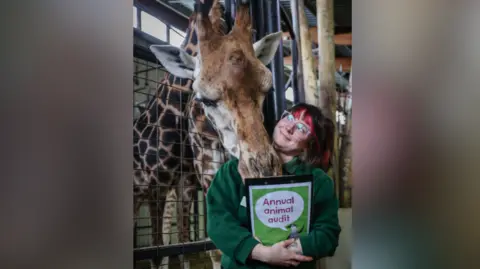
Among the animals she particularly enjoys working with are okapi, known for their sensitivity and unique physical features. They require gentle handling and attentive care, yet many individuals display remarkable resilience. Interacting with them demands patience and respect, qualities that define successful long-term relationships between keepers and animals.
The physical scale of many hoofstock species also shapes daily experience. Rhinos and giraffes, for instance, are among the largest land animals managed in zoological environments. Their size alone requires carefully designed facilities, specialized feeding systems, and strict safety protocols. Yet these same animals often display calm, cooperative behaviours when trained effectively. Wolff’s work therefore involves balancing caution with confidence, understanding that effective care relies on trust built gradually over time.
Perhaps most importantly, her work extends beyond individual animal care to participation in coordinated conservation initiatives. Some species maintained at Marwell have been part of successful reintroduction programmes, including animals that were once extinct in the wild. These programmes involve international collaboration, scientific planning, and long-term monitoring. For keepers like Wolff, contributing to such efforts provides a powerful sense of purpose. The knowledge that animals born or raised under human care may eventually help restore wild populations adds a profound dimension to everyday responsibilities.
A Special Bond with Przewalski’s Horses and Conservation in Action
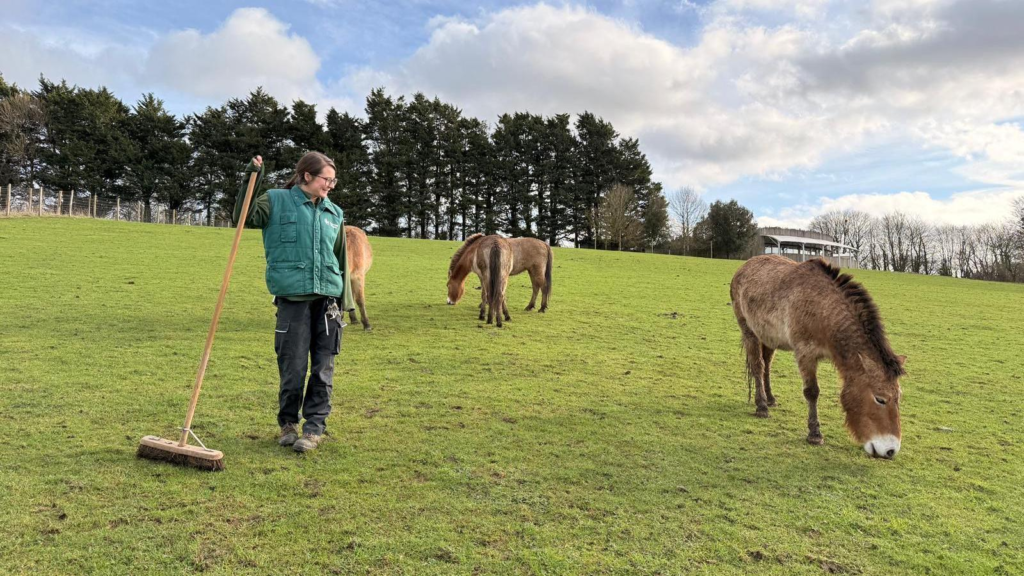
Among all the animals she works with, Przewalski’s horses hold a particularly special place in Wolff’s experience. These horses, distinct from domestic breeds, represent one of the most remarkable conservation success stories in modern zoology. Once declared extinct in the wild, the entire surviving population descended from a small number of captive individuals. Today, carefully managed breeding and reintroduction programmes are gradually restoring them to their native habitats.
Read : The Zoo Club Bar Goes Viral After Refusing To Switch Turning Point USA’s Halftime Show For Bad Bunny
Wolff describes these horses as compact, sturdy, and strikingly resilient. Adapted to harsh environments, they possess a feisty temperament and complex social dynamics that make them both fascinating and challenging to manage. Their interactions can be intense, and keepers must remain attentive to shifting group relationships. Observing these behaviours provides valuable insight into natural herd structures and survival strategies.
Her connection to two particular females, Shara and Togs, illustrates the emotional dimension of conservation work. Wolff cared for them from birth until the day they left the zoo as part of a reintroduction effort. Their journey marked the beginning of a carefully planned process aimed at returning them to the wild landscapes of Kazakhstan. When they departed, their first destination was Berlin, representing the initial stage of relocation and acclimatization.
The experience of seeing animals she had helped raise embark on a journey back toward wild living was deeply meaningful. She describes the moment as bittersweet—both a farewell and a triumph. While keepers naturally form attachments to the animals they care for, the ultimate goal of conservation sometimes requires letting them go. For Wolff, participating in this transition represents one of the most significant aspects of her profession.
The remaining group of Przewalski’s horses at Marwell continues to grow and evolve. Plans to introduce a new stallion aim to expand the herd and support future breeding. Each development contributes to the broader objective of strengthening global population numbers and maintaining genetic diversity.
What makes these horses especially compelling for Wolff is their willingness, at times, to approach and engage with human observers on their own terms. Standing beside an animal that remains fundamentally wild, yet curious enough to interact voluntarily, creates moments she describes as unforgettable. Such encounters capture the essence of her work—being present with creatures that retain their natural instincts while benefiting from human protection.
For Wolff, these experiences reinforce the sense that her role extends far beyond routine animal care. Each interaction, each behavioural observation, and each conservation milestone contributes to a larger effort to preserve species that might otherwise disappear. The combination of scientific responsibility, emotional connection, and global impact defines her daily life as a hoofstock keeper.
This is seriously useful. Straight to the point and easy to follow. Check this out: https://yakzrobyty.com.ua/yak-pravylno-pyshetsya-andriyivskyj-uzviz-za-novym-pravopysom/
A really good blog and me back again.
每天都在战争,希望2026和平.