
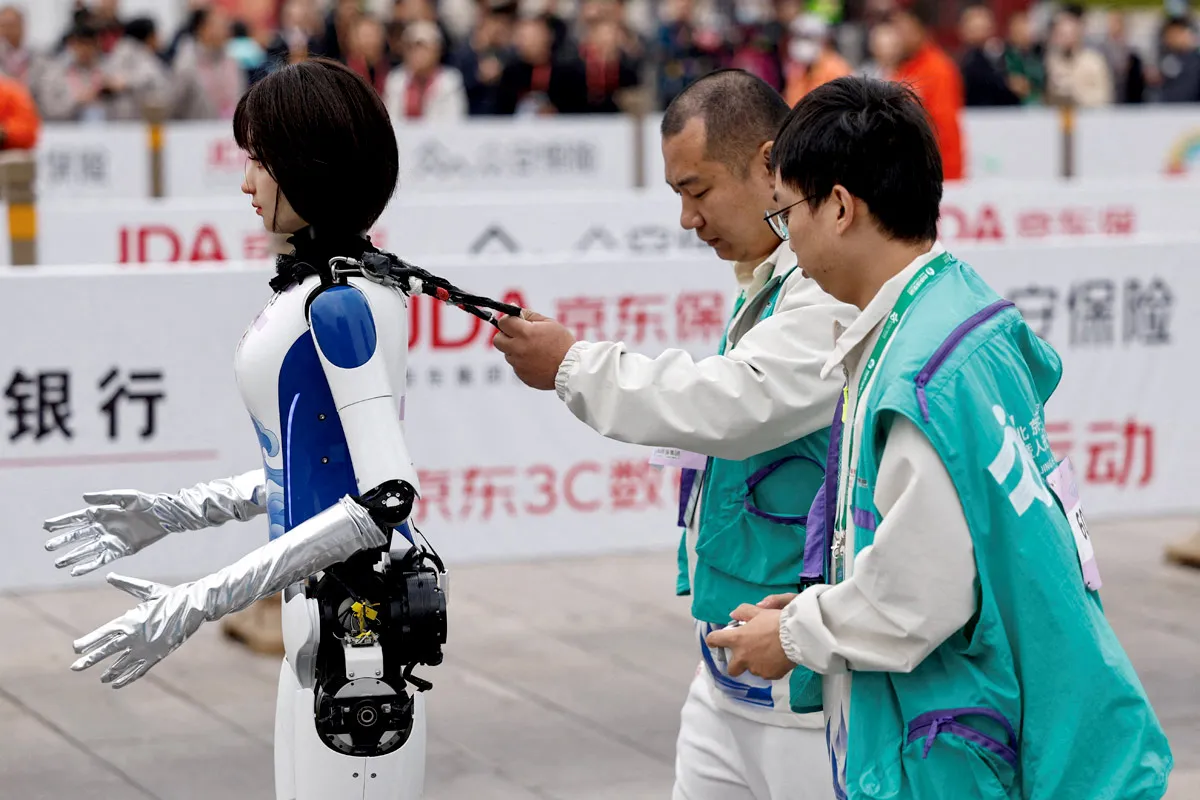
The Yizhuang half-marathon in Beijing recently made history by hosting 21 humanoid robots alongside thousands of human runners. This event, held for the first time, marked a significant moment in the field of robotics, with Chinese manufacturers showcasing their latest robotic advancements.
The race itself wasn’t just a test of endurance but a demonstration of how far robotics and artificial intelligence have come, as well as the future potential of integrating machines with human activities.
The robots, with their diverse designs and capabilities, added an unexpected twist to a traditional sporting event. Let’s take a closer look at how this historic event unfolded and what it means for the future of robotics.
A Historic First: Humanoid Robots Competing in a Marathon
For the first time ever, humanoid robots were put to the test in a competitive environment against human runners in the Yizhuang half-marathon. This was a milestone for both the robotics industry and the sport of long-distance running.
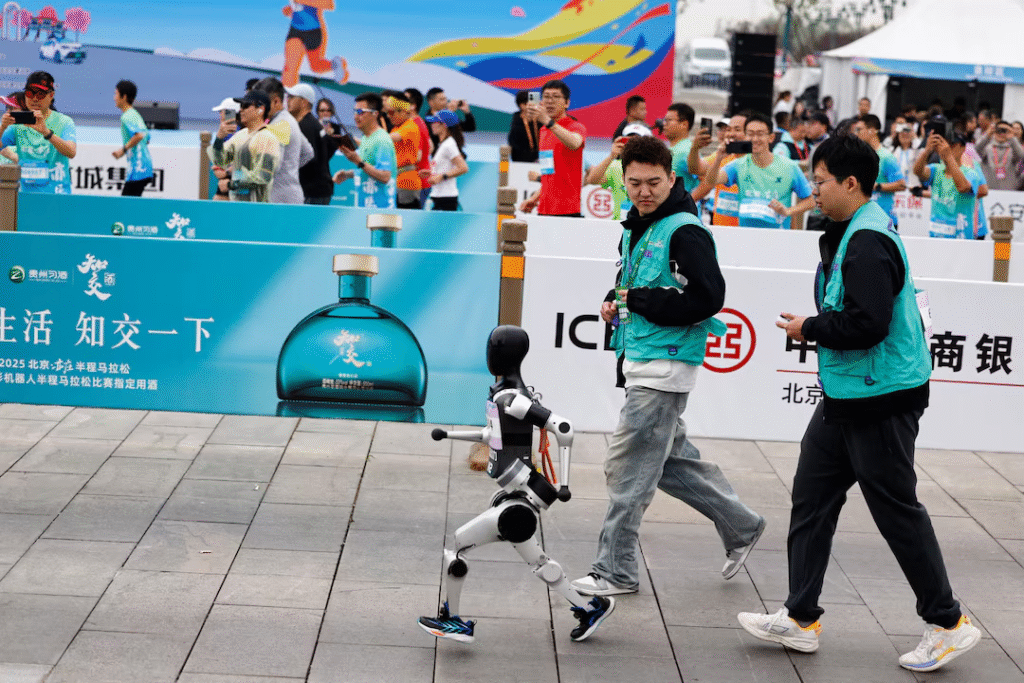
With 21 humanoid robots participating, each was designed and manufactured by different companies across China, such as DroidVP and Noetix Robotics. These robots varied in height, with some standing at less than 1.2 meters and others reaching up to 1.8 meters.
The robots were not just advanced machines that could walk; they were designed to run, with some equipped with high-tech features to mimic human behavior.
One robot even featured feminine characteristics, capable of performing subtle actions like winking and smiling, making it one of the more lifelike robots on display. Despite their sophisticated appearances, the robots needed a great deal of human support to make it through the course.
Read : Future Robots Might Be Able to Sense Human Feelings Just by Touching Skin
Beijing officials, who observed the event, likened it to a motor race rather than a traditional marathon. Much like the pit crews in motorsports, robotics teams were stationed along the racecourse to monitor the robots’ performance and make adjustments when necessary.
Humanoid robots ran alongside humans in a half-marathon in Beijing. The robots navigated the 21.1-kilometer (13.1-mile) course supported by teams of human navigators, operators and engineers, in what event organizers say was a first. Read here: https://t.co/qpVN6y2Szy pic.twitter.com/DcAMLGenJt
— The Associated Press (@AP) April 20, 2025
The robots’ successful navigation of the course required more than just advanced machinery; it demanded constant oversight, engineering precision, and algorithmic expertise. The event highlighted the complexity of making robots that can perform in dynamic, real-world environments.
The Robotics Behind the Race: Technology and Innovation
The robots used in the Yizhuang half-marathon were the product of years of development, combining cutting-edge robotics with artificial intelligence to achieve performance in real-world conditions. The most notable robot, Tiangong Ultra, stood out due to its advanced design and exceptional performance.
With a time of 2 hours and 40 minutes, it was the fastest of the humanoid robots, though it still lagged behind the men’s race winner, who finished in just 1 hour and 2 minutes.
One of the key reasons for Tiangong Ultra’s success was its ability to imitate human running styles through a carefully developed algorithm. According to Tang Jian, the Chief Technology Officer for the Beijing Innovation Centre of Human Robotics, Tiangong Ultra’s long legs and sophisticated running algorithm gave it a significant advantage.
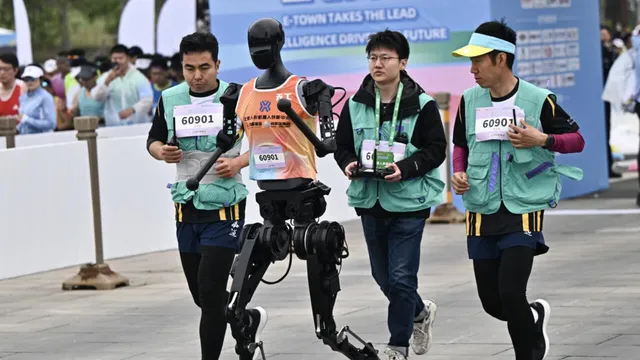
The robot’s ability to adjust its gait and movement in real time played a crucial role in helping it complete the race, though it required three battery changes throughout the 21 km course to ensure consistent performance.
The competition was also a test of endurance, with robots needing to sustain their performance over the full marathon distance. Several robots faced challenges that humans wouldn’t typically encounter.
One robot fell at the starting line and had to restart after a few moments of recovery, while another robot crashed into a railing, causing its human operator to tumble over. These mishaps were a reminder of the inherent risks and challenges robots face in real-world applications, especially in high-stress environments like races.
Despite these difficulties, the robots’ ability to run and maintain stability for extended periods was a sign of how far technology has come. The humanoid robots weren’t just impressive in their speed or mobility—they also demonstrated the potential of artificial intelligence to tackle complex tasks that require fine motor skills and coordination.
The Future of Robotics: Economic Growth and Technological Integration
The Yizhuang half-marathon was not just a showcase of technological prowess; it was also part of China’s larger strategic push to invest in frontier industries like robotics and artificial intelligence.
The event was an opportunity to highlight the capabilities of China’s burgeoning robotics sector, which has been steadily gaining international recognition. By participating in high-profile events like marathons, these robots are being positioned as symbols of technological progress and innovation.
The robotics sector is seen as a key driver of economic growth, particularly in a rapidly industrializing country like China. In a time when many traditional industries are facing challenges, emerging technologies like robotics, AI, and automation are expected to create new economic opportunities and industries.
Humanoid robots, in particular, are being explored for their potential in a variety of sectors, including healthcare, logistics, entertainment, and customer service. However, while the race in Beijing was a great demonstration of what is possible with current technology, there are questions about how practical humanoid robots are for everyday use.
Analysts have raised concerns about whether events like this half-marathon are truly indicative of robots’ potential in industrial applications. While robots are making strides in performing complex tasks, they still face significant obstacles when it comes to reliability, safety, and efficiency.
The marathon event, despite its innovative nature, also serves as a reminder that robotics has yet to achieve widespread practical use. As the technology continues to evolve, there will be greater opportunities to test its limitations and see how robots can be integrated into various industries. The future of humanoid robots will likely be shaped by how well they can adapt to real-world conditions and perform consistently without human intervention.
The Global Impact: What Other Countries Can Learn from China’s Robotics Push
China’s success in hosting the first humanoid robot marathon is just the beginning of what could be a global movement toward integrating robots into everyday activities.
As the technology becomes more refined, countries around the world will likely follow China’s lead by exploring the potential of humanoid robots in various sectors. However, the integration of robots into human activities will need to be handled carefully to avoid potential disruptions in the job market and society as a whole.

Other countries that are investing heavily in robotics, such as Japan and South Korea, will likely see their own advances in this area. The Yizhuang half-marathon was a reminder that China is positioning itself as a leader in the robotics industry, and it is likely that other countries will soon follow suit in showcasing their own robotic technologies.
This could lead to a global race of sorts, with countries striving to create robots that are not only functional but capable of performing at the highest levels of competition. The Yizhuang half-marathon was a significant step toward the future of humanoid robotics, but the event also highlighted the challenges that lie ahead.
As robots continue to improve, they will likely take on a greater variety of roles, from physical labor to performing complex tasks traditionally done by humans. The potential for robots to impact industries ranging from manufacturing to healthcare is vast, and it will be exciting to see where the technology goes next.
As this sector evolves, there will undoubtedly be new opportunities and challenges for both the robotics industry and the global economy. Whether or not robots can one day run alongside humans in marathons at a competitive level remains to be seen, but the Yizhuang event was a groundbreaking moment that could shape the future of robotics for years to come.