
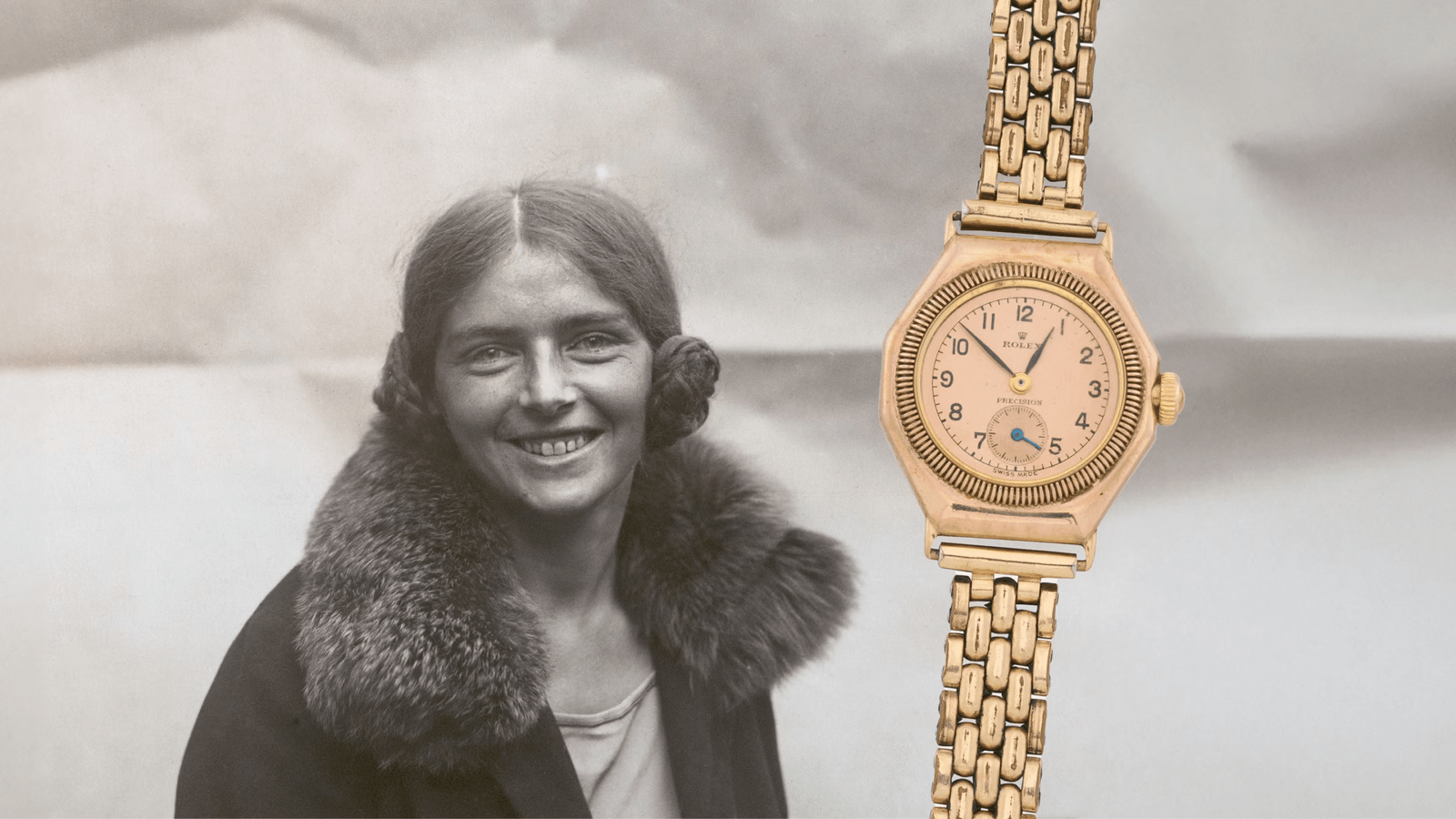
In a remarkable intersection of sports history and horological innovation, the 1927 Rolex Oyster watch worn by endurance swimmer Mercedes Gleitze during her famous Channel crossing is set to hit the auction block. Gleitze, who made history as the first British woman to conquer the English Channel, strapped the timepiece around her neck for a grueling 10-hour submersion in frigid seawater.
Now, nearly a century later, Sotheby’s anticipates the gold Oyster could command over 1 million Swiss francs—equivalent to about $1.3 million—at its Important Watches sale in Geneva on November 9, 2025. This auction marks the watch’s first appearance at market in 25 years, underscoring its status as a pivotal artifact in both swimming lore and Rolex’s ascent to global prominence.
Gleitze’s Channel Triumph: From Typist to Trailblazer
Mercedes Gleitze, born on November 18, 1900, in Brighton, England, to German immigrant parents, began her life far removed from the spotlight of athletic fame. Working as a multilingual stenographer and typist in London during the 1920s, she discovered her affinity for open-water swimming while vacationing on the south coast. What started as a personal passion quickly evolved into a professional pursuit, as Gleitze trained rigorously and entered endurance challenges that tested the limits of human stamina.
Her crowning achievement came on October 7, 1927, when, on her eighth attempt, she successfully swam the English Channel from France to England in 15 hours and 15 minutes. At 26 years old, Gleitze became the first British woman to complete the 21-mile crossing, a feat that had eluded her for years amid failed bids hampered by rough seas and exhaustion. The swim, starting from Cape Gris-Nez and ending at St Margaret’s Bay near Dover, showcased her unyielding determination. Crowds gathered on the Dover cliffs, and newspapers hailed her as a national hero, with the Daily Express proclaiming her return as a “triumph of British pluck.”
Yet, Gleitze’s record faced immediate scrutiny just days later. On October 11, American swimmer Ethel Major claimed to have crossed the Channel in a record 15 hours and 11 minutes, casting doubt on Gleitze’s accomplishment and tarnishing her reputation in the press. Major’s story unraveled as a hoax—she had never even entered the water—but the damage was done. Undeterred, Gleitze announced a “vindication swim” to restore her credibility and prove her mettle.
Scheduled for October 21, 1927, the event drew unprecedented attention: a flotilla of boats carrying journalists, family, and supporters trailed her, while musicians played tunes from the deck to keep her spirits high during the ordeal. Aerial photographers from the Daily Mail captured the spectacle, and an estimated 12,000 spectators lined the Dover shores. The vindication attempt unfolded under brutal conditions. Water temperatures hovered between 51°F and 58°F, far colder than average, with relentless waves battering Gleitze for 10 hours and 24 minutes. She abandoned the swim just eight miles from completion, her body pushed to the brink by hypothermia and fatigue.
Read : Stephen Townsend Fined for Stealing Two Rolex Clocks Set Up for BMW PGA Championship
Despite the unfinished crossing, the public display of her endurance silenced doubters. British Prime Minister Stanley Baldwin reportedly commended her resolve, and the press reaffirmed her original record. This episode not only solidified Gleitze’s legacy but also highlighted the era’s fascination with female athletes breaking barriers in male-dominated sports. Gleitze’s Channel exploits were part of a broader career marked by other endurance milestones. In 1928, she became the first woman to swim the Straits of Gibraltar, covering 9 miles in choppy Mediterranean waters.
Read : British Farmer’s Rolex Watch Eaten by Cow in 1970 Recovered After 50 Years
She also set records for marathon swims in the Danube River and around the Isle of Man, amassing over 100 endurance feats by the 1930s. Beyond competitions, Gleitze channeled her success into philanthropy, founding the Mercedes Gleitze Memorial Swimming Club in 1933 to provide free lessons to underprivileged girls in London. Her work empowered hundreds of young women, fostering swimming skills and confidence in an age when access to such opportunities was limited. Gleitze retired from competitive swimming in the late 1930s, passing away on February 9, 1981, at age 80, leaving a legacy as a symbol of grit and gender progress.
The Rolex Oyster: Engineering a Waterproof Revolution
The vindication swim’s true undercurrent was Rolex’s bold gamble on unproven technology. Founded in 1905 by Hans Wilsdorf and Alfred Davis as Wilsdorf & Davis in London, the company rebranded to Rolex in 1915, driven by Wilsdorf’s vision for reliable wristwatches to supplant fragile pocket watches. By the early 1920s, Wilsdorf fixated on waterproofing, acquiring patents for hermetically sealed cases and screw-down crowns between 1922 and 1925. These culminated in the Rolex Oyster, unveiled in 1926 as the world’s first truly waterproof wristwatch, featuring a seamless metal case and a patented crown with a clutch mechanism for easy winding.
Wilsdorf saw Gleitze’s high-profile swim as the perfect real-world test. Days before her October 21 attempt, he approached her through the S.T. Garland Advertising Service, offering the Oyster for promotional use. Gleitze, strapped for funds after years of self-financed training, agreed. She wore the 9-karat yellow gold Oyster—likely produced in late 1926, predating the crown patent—tethered by a pink ribbon around her neck, ensuring full submersion throughout the 10-hour ordeal. The watch, measuring 32.5mm with an octagonal case, fluted bezel, and thin wire lugs, endured constant battering from waves, extreme cold, and a rapid temperature shift upon rescue without faltering.
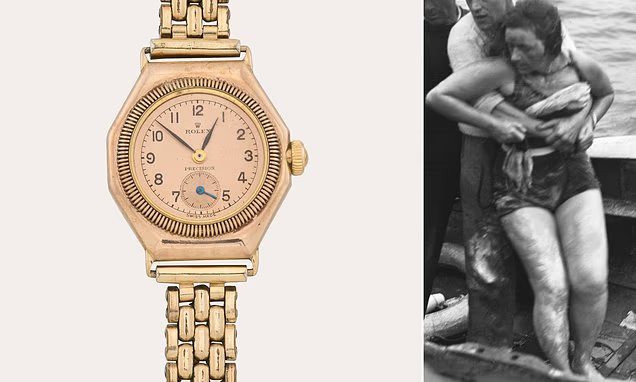
Four days later, on October 25, 1927, Gleitze penned a handwritten endorsement: “After 10 hrs. in the water, this reliable and accurate time-keeping companion has proved itself to be the ideal companion for any swimmer.” Rolex seized the moment, publishing a full-page advertisement in the November 24, 1927, edition of the Daily Mail. The ad featured a dramatic photo of Gleitze emerging from the sea, captioned “The Rolex Oyster,” and declared the watch had withstood “the buffeting of the waves” unscathed. This campaign marked Rolex’s inaugural use of an athlete as a brand ambassador, predating modern endorsements by decades and establishing the Oyster as a tool for adventurers.
The partnership proved transformative. Gleitze wore only this original Oyster for the rest of her life, returning it to Rolex for servicing despite offers of newer models. The swim’s publicity propelled Rolex from niche importer to symbol of durability, aligning the brand with explorers and professionals in harsh environments. By 1927’s end, Oyster sales surged, and the model laid groundwork for icons like the Submariner. Sotheby’s global watches chairman Sam Hines emphasized that Gleitze’s endorsement “laid the foundation for Rolex’s enduring legacy of tool watches engineered for real-world performance.”
Auction Bound: Provenance and Market Significance
Provenance elevates this Oyster beyond mere memorabilia. Passed down through Gleitze’s family after her death, the watch starred in Rolex’s 1976 50th-anniversary exhibition at the National Maritime Museum in Greenwich, England, as the centerpiece of Oyster’s history. It last traded hands at Christie’s London in June 2000, fetching 17,037 British pounds—about $22,869 in today’s dollars—for a staggering 5,500% appreciation since. Now consigned anonymously, Sotheby’s has authenticated its story through archival deep dives, including Gleitze’s letters and press clippings.
The November 9 auction at Geneva’s Mandarin Oriental Hotel positions the piece in Sotheby’s Important Watches sale, alongside other rarities. Experts peg its value above 1 million Swiss francs, reflecting not just scarcity—one of few pre-patent Oysters—but its narrative heft. As GQ noted, this “is one of history’s most important watches,” bridging women’s sports milestones with luxury innovation.
For collectors, acquiring Gleitze’s Oyster means owning a talisman of resilience: a timepiece that outlasted Channel tempests and skepticism, much like its wearer. As the gavel falls, it reaffirms Rolex’s Oyster as the dawn of modern dive watches, while honoring Gleitze’s overlooked role in pioneering female endurance athletics. In an era of record-shattering sales, this auction promises to etch another chapter in horology’s annals.