
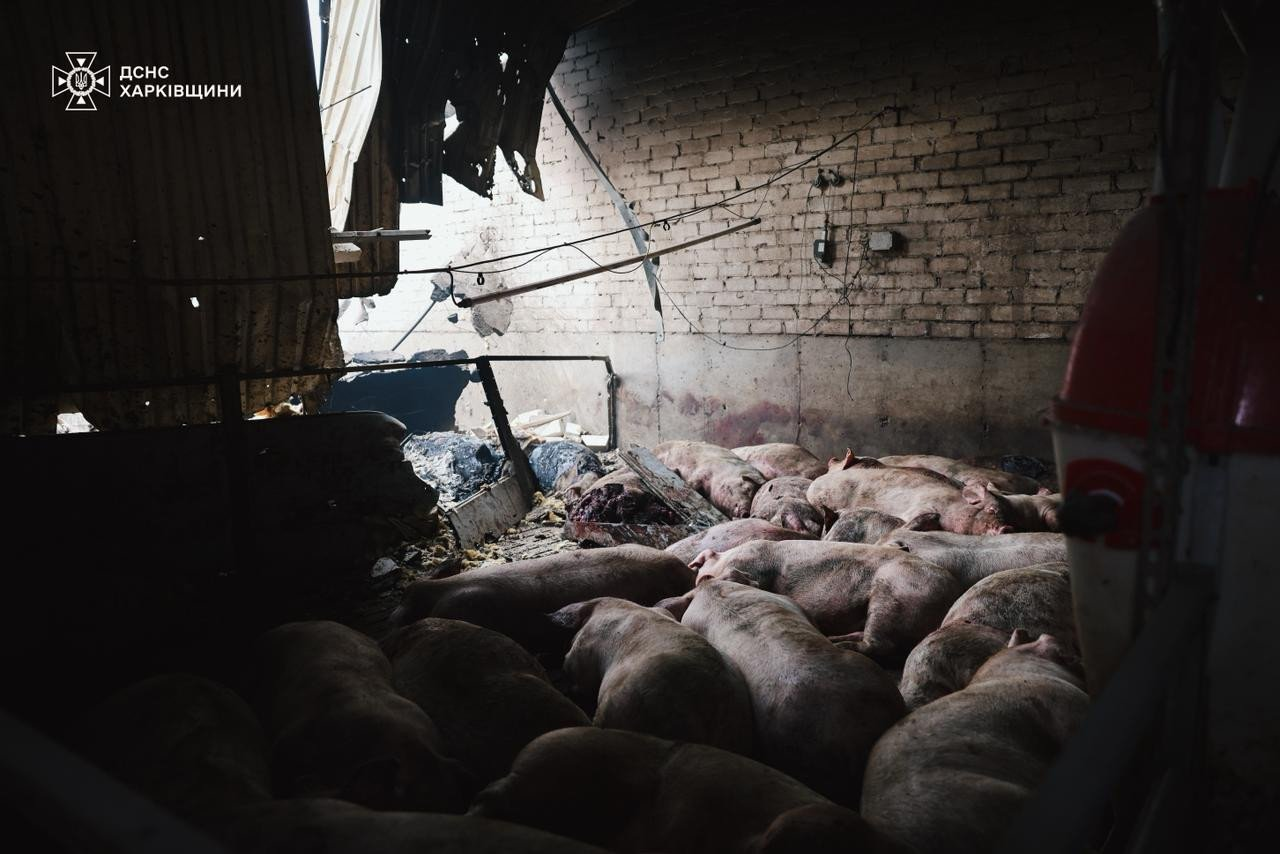
In a devastating escalation of aerial assaults on civilian infrastructure, a Russian drone strike targeted a major pig farm in Ukraine’s Kharkiv Oblast on October 3, 2025, resulting in the deaths of approximately 13,000 pigs and a massive blaze that engulfed multiple structures. The attack, carried out using Shahed-type drones, struck the agricultural enterprise in the Novovodolazka community, a rural area in the northeast of the country. Ukraine’s State Emergency Service (SES) confirmed the incident, reporting that the fire destroyed eight buildings housing the livestock, marking one of the most significant losses to Ukraine’s agricultural sector amid the ongoing conflict with Russia.
The strike occurred overnight, catching responders off guard as flames rapidly spread through the confined spaces of the farm. Local authorities described the scene as catastrophic, with thick smoke billowing over the fields and the acrid smell of burning structures permeating the area. No human casualties were reported from the farm itself, but the sheer scale of animal loss underscores the indiscriminate nature of such drone operations. This event fits into a pattern of intensified Russian drone campaigns targeting non-military sites, including energy facilities and transportation hubs, as the war enters its fourth year.
Emergency crews from the SES battled the inferno for hours, deploying water tenders and foam suppressants to contain the spread to nearby vegetation. By dawn, the fire was under control, but the damage assessment revealed the full extent of the tragedy. The farm, a key supplier of pork products to regional markets, now stands as a charred skeleton, with cleanup efforts underway to remove debris and assess structural integrity for potential salvage. Officials estimate the economic toll in the millions, factoring in lost livestock, feed stocks, and infrastructure repairs.
Details of the Drone Assault
The Russian drone barrage on the Kharkiv farm was part of a broader overnight operation that involved at least 20 Shahed drones launched from occupied territories. These Iranian-designed, one-way attack drones, known for their low cost and ease of deployment, have become a staple in Moscow’s arsenal since early 2022. Intelligence reports indicate the drones approached from the east, navigating low-altitude flight paths to evade Ukrainian air defenses concentrated around major cities like Kharkiv.
Eyewitness accounts from nearby villagers described hearing a series of explosions around 2 a.m., followed by the roar of flames. “It lit up the entire sky,” said one local resident, who requested anonymity due to security concerns. “We thought it was another power substation hit, but the smoke smelled different—horrible, like burning meat.” The primary impact point was a cluster of pig pens and feed silos, where the initial detonation ignited volatile materials, accelerating the fire’s growth.
Ukraine’s Air Force issued a statement confirming that air raid alerts had been active across the region, but the farm’s remote location limited immediate interception capabilities. SES teams arrived within 30 minutes, prioritizing containment to prevent the fire from reaching adjacent crop fields harvested for winter storage. Forensic analysis of the wreckage, ongoing as of October 4, points to shrapnel from the drones embedding in wooden beams and electrical wiring, which likely served as ignition sources.
This was not an isolated incident. On the same night, Russian drones struck two passenger trains in the Sumy region, causing derailments and injuries to over a dozen civilians. The Kharkiv attack, however, stands out for its direct hit on agricultural assets, a sector already strained by previous incursions. Satellite imagery released by Ukrainian monitoring groups shows the farm’s layout pre-strike: a sprawling complex with over 15,000 head of swine, processing facilities, and worker barracks. Post-strike photos depict twisted metal and ash-covered ground, a grim testament to the precision—or lack thereof—in targeting.
The russians are only good at two things: killing and destroying.
— Jürgen Nauditt 🇩🇪🇺🇦 (@jurgen_nauditt) October 3, 2025
russia killed 13,000 pigs in an attack on a farm in the Kharkiv region, — SES
The russians directed 20 (!) drones toward the farm. pic.twitter.com/wnEvlCdROx
Military analysts note that Shahed drones carry warheads of up to 50 kilograms, sufficient to breach reinforced structures but often resulting in secondary fires in organic-rich environments like farms. The Novovodolazka site, operational since the 1990s, had no known military affiliations, reinforcing claims that such strikes aim to erode civilian morale and economic resilience. Ukrainian President Volodymyr Zelenskyy addressed the incident during a morning briefing, calling it “a barbaric act against food security” and vowing to bolster rural defenses with mobile anti-drone units.
Economic and Agricultural Fallout
The loss of 13,000 pigs represents a staggering blow to Ukraine’s pork industry, which supplies nearly 40% of the nation’s domestic meat consumption. The farm in question was a mid-sized operation under the management of a local cooperative, employing around 50 workers and contributing significantly to the regional GDP. Preliminary valuations place the livestock alone at over $5 million, with additional costs for destroyed equipment pushing the total closer to $10 million.
Ukraine’s agricultural ministry has activated emergency aid protocols, including subsidies for affected farmers and expedited imports of feed from EU partners. Pork prices in Kharkiv markets are already ticking upward by 5-7%, analysts predict, exacerbating inflationary pressures in a war-torn economy. The ripple effects extend beyond immediate finances: the farm’s output fed into supply chains for sausages, bacon, and canned goods distributed across eastern Ukraine and even exported to neighboring Poland before the invasion.
Environmental concerns compound the economic hit. Runoff from the fire suppression efforts has raised fears of contamination in nearby groundwater, potentially affecting irrigation for wheat fields that form the backbone of Ukraine’s “breadbasket” status. Soil samples are being collected, with initial tests showing elevated levels of heavy metals from drone fragments. Veterinary teams are also monitoring for disease spread, as mass animal deaths could harbor pathogens if not handled promptly.

On a human level, the farm’s workforce faces uncertainty. Many employees, drawn from surrounding villages, relied on steady wages amid disrupted job markets. The cooperative has pledged severance and retraining programs, but recovery will take months. “These weren’t just animals; they were our livelihood,” stated a farm supervisor in a local radio interview. “Rebuilding means starting from scratch while shells fall nearby.” International aid organizations, including the FAO, have dispatched experts to assess long-term viability, emphasizing the need for hardened shelters in future farm designs.
This strike highlights vulnerabilities in Ukraine’s rural economy, where 70% of farmland lies within 50 kilometers of the front lines. Previous attacks on grain silos and dairy operations have already halved national output since 2022, per government data. The pig farm incident could accelerate diversification efforts, with some experts advocating for smaller, dispersed herds less susceptible to single-point failures.
Strategic Ramifications in the Conflict
The Kharkiv drone strike underscores Russia’s evolving tactics in the Ukraine war, shifting from high-value military targets to economic chokepoints that amplify psychological impact. With Ukrainian forces holding ground in Donetsk and advancing in Kursk, Moscow appears to be leveraging drone swarms for asymmetric warfare, overwhelming defenses through sheer volume. The SES reported intercepting 12 of the 20 drones in the wave, but the eight that broke through inflicted disproportionate damage.
Geopolitically, the attack draws fresh scrutiny to Iran’s role as a supplier of Shahed technology, with Western sanctions tightening further. U.S. officials, in a State Department readout, condemned the strike as “deliberate targeting of civilians’ sustenance,” linking it to broader food weaponization strategies reminiscent of the Black Sea grain blockade. NATO allies have responded by fast-tracking $200 million in anti-drone aid to Kyiv, including radar systems deployable to agricultural zones.
For Ukraine, the incident bolsters calls for enhanced air sovereignty. Defense Minister Rustem Umerov announced plans to integrate AI-driven detection networks along the border, aiming to reduce response times from minutes to seconds. Public sentiment, gauged through social media and polls, shows growing frustration with rural exposure, potentially influencing recruitment drives for territorial defense units.
In the larger theater, this event may signal intensified winter campaigns, as drones perform reliably in cold weather unlike manned aircraft. Russian state media downplayed the strike, framing it as a “precision operation against logistical threats,” but independent verification contradicts such claims. As negotiations stall in Geneva, incidents like this erode trust, prolonging a conflict that has already claimed over 500,000 lives.
Recovery efforts at the farm continue, symbolizing Ukraine’s defiance. Volunteers from Kharkiv city have donated supplies, and reconstruction bids are out. Yet, the charred remains serve as a stark reminder: in this war, no sector is spared. As autumn harvest season peaks, the nation braces for more such assaults, determined to safeguard its fields and flocks against the unrelenting sky.