

The Democratic Republic of Congo (DRC) is once again facing a severe crisis as the M23 rebels, allegedly backed by Rwanda, have taken control of the key city of Bukavu. This latest development marks a significant escalation in the long-standing conflict in eastern Congo, raising concerns about the country’s stability and the potential for a broader regional war.
The capture of Bukavu follows the recent fall of Goma, highlighting the inability of the Congolese forces to counter the rebels’ rapid advances effectively. The ongoing crisis threatens to push the region into further chaos, with thousands of civilians displaced and fears of a deepening humanitarian disaster.
The Fall of Bukavu and Its Strategic Importance
Bukavu, the capital of South Kivu province, is a crucial city in eastern Congo, with a population of over one million people. Situated on the shores of Lake Kivu, it has long been a key economic and administrative center.
The M23 rebels, after capturing Goma in January, swiftly moved toward Bukavu, taking control of the city with little resistance from the Congolese army (FARDC).
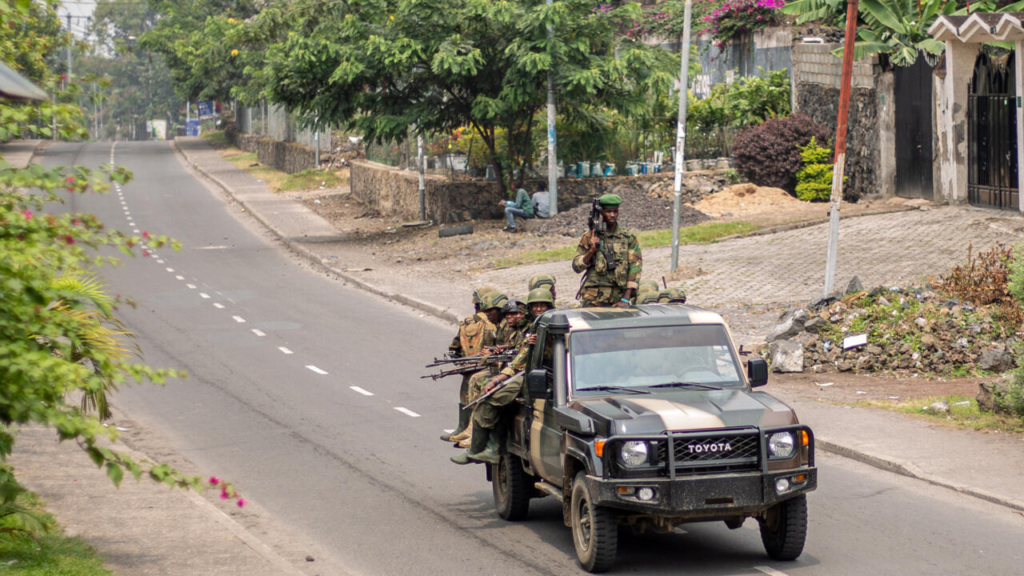
On Friday, the rebels reached the outskirts of Bukavu after seizing control of its airport, which is located about 30 kilometers away. By Sunday, M23 fighters had entered the city’s central districts, encountering minimal opposition from government forces.
The capture of Bukavu solidifies M23’s hold over the Lake Kivu region, providing them with significant territorial control and access to crucial trade routes. The Congolese military, already struggling to maintain its presence in the eastern provinces, was unable to mount a strong defense.
Read : M23 Takes Control of Nyabibwe Town in Congo Despite Declaring Ceasefire
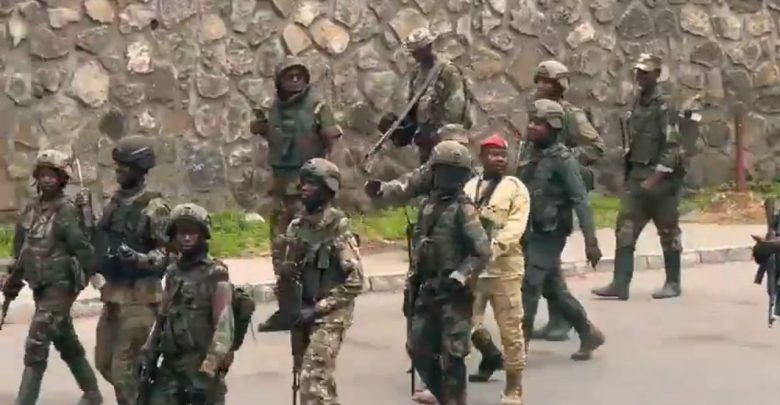
Many FARDC soldiers reportedly retreated ahead of the rebel advance, leaving civilians vulnerable to looting and chaos. Videos circulating online showed M23 fighters parading in the city center, with some locals appearing to welcome them, while others fled in fear.
M23 majestically walking into Bukavu. What a disciplined force pic.twitter.com/flblFDxFQN
— African (@ali_naka) February 16, 2025
Despite government statements claiming that Bukavu remains under its control, eyewitness reports suggest otherwise. The Congolese army has been largely absent from the streets, and M23 fighters have taken over key government buildings, including the provincial governor’s office.
The city’s main military camp, Camp Saio, witnessed intermittent gunfire, but it was not enough to stop the rebel forces. Residents expressed mixed reactions to the rebels’ arrival, with some hoping that M23’s presence would bring an end to lawlessness and looting, while others feared the continuation of violence and repression.
Regional Implications and the Risk of a Wider War
The rapid expansion of M23’s control has heightened tensions between Congo and its neighbors, particularly Rwanda. The Congolese government has long accused Rwanda of supporting M23, an allegation that both the rebel group and Kigali deny. The involvement of foreign troops in eastern Congo is further complicating the situation, as regional players take sides in the conflict.
Burundian troops have been deployed to assist the Congolese military in Bukavu, while South African forces have been stationed in Goma. The presence of Rwandan, Burundian, and Ugandan troops in the region has stoked fears of a larger regional war, reminiscent of the two devastating Congo Wars that occurred between 1996 and 2003.
These conflicts, fueled by ethnic tensions and resource competition, resulted in millions of deaths and widespread destruction. The current crisis bears alarming similarities to those earlier wars, with various armed groups vying for control and foreign governments accused of interfering in Congo’s affairs.
President Felix Tshisekedi has warned that the ongoing violence could destabilize the entire region, calling for international intervention to prevent further escalation.
The African Union has expressed concern over the potential fragmentation of the DRC, urging all parties to engage in dialogue. However, diplomatic efforts have so far failed to produce any concrete solutions, as M23 continues to advance and the Congolese government struggles to respond effectively.
The underlying causes of the conflict are deeply rooted in historical grievances, ethnic tensions, and economic interests. Eastern Congo is home to vast mineral wealth, including tantalum, cobalt, copper, coltan, lithium, tin, tungsten, and gold. These resources are essential for global industries, particularly in the production of electronic devices and electric vehicle batteries.
The struggle for control over these lucrative resources has fueled violence for decades, with various armed groups, including M23, seeking to dominate the trade. The involvement of foreign actors further complicates the situation, as regional powers compete for influence and economic gains.
Humanitarian Crisis and the Suffering of Civilians
As the conflict escalates, the humanitarian situation in eastern Congo is deteriorating rapidly. The United Nations has warned of a growing crisis, with thousands of civilians forced to flee their homes in search of safety.
Many have sought refuge in overcrowded camps, while others have attempted to cross into neighboring countries. The displacement crisis is exacerbating existing challenges, as humanitarian organizations struggle to provide adequate food, water, and medical assistance to those in need.
The capture of Bukavu has led to widespread panic, with reports of looting and a mass prison break on Saturday. With the Congolese army withdrawing, the city experienced a temporary power vacuum, allowing criminal elements to exploit the situation.
The fear of further violence is pushing more people to flee, adding to the already high number of displaced individuals. According to the UN refugee agency, approximately 350,000 people have been left without shelter due to the recent fighting.
Civilians caught in the crossfire face severe risks, including targeted attacks, sexual violence, and forced recruitment by armed groups. Human rights organizations have documented numerous abuses committed by various factions, including M23.
The situation in Goma, which fell to M23 in January, serves as a grim warning of what could happen in Bukavu. Reports indicate that around 3,000 people were killed in the days leading up to Goma’s capture, highlighting the brutal nature of the conflict.
Despite the dire conditions, international attention on the crisis remains limited. The world’s focus on other global conflicts has overshadowed the ongoing suffering in Congo, leaving many civilians feeling abandoned by the international community. Calls for urgent intervention have grown louder, but concrete action has yet to be taken.
The UN peacekeeping mission in Congo, MONUSCO, has been criticized for its failure to prevent the rebel advances and protect civilians. With tensions rising and the humanitarian crisis worsening, the need for immediate international intervention is becoming increasingly urgent.
The fall of Bukavu to M23 rebels marks a critical moment in Congo’s ongoing conflict, raising fears of further instability and regional escalation.
The inability of the Congolese army to defend its territory has left millions vulnerable, while foreign involvement threatens to turn the crisis into a broader war. The humanitarian consequences are devastating, with thousands displaced and basic services collapsing.
The international community must act swiftly to address the root causes of the conflict and prevent further bloodshed. Diplomatic efforts must be intensified to bring all parties to the negotiating table and establish a lasting peace.
Additionally, stronger measures should be taken to cut off external support to armed groups and hold accountable those responsible for fueling the violence. Without immediate intervention, eastern Congo risks descending into deeper chaos, with catastrophic consequences for its people and the entire region.