
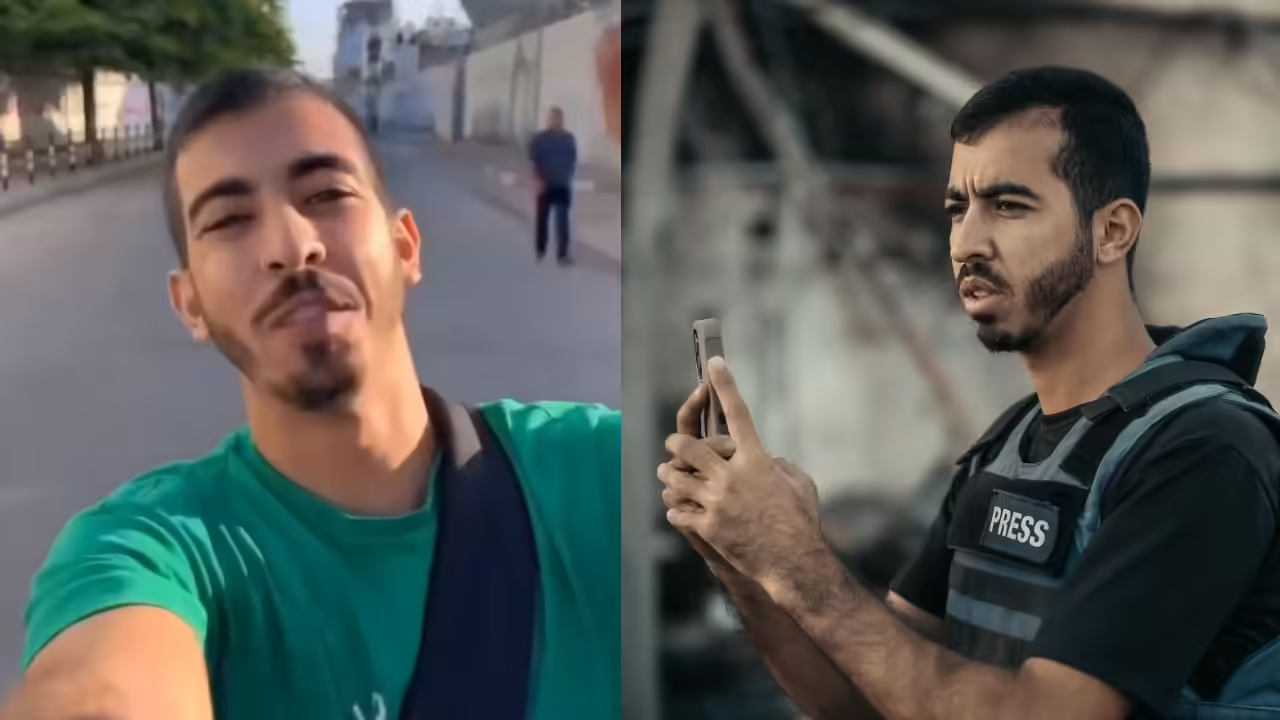
Saleh al-Jafarawi, a polarizing figure in Gaza’s social media landscape, was killed during violent clashes between Hamas and the powerful Doghmush clan militia in Gaza City. Known widely by the derisive nickname “Mr. FAFO,” al-Jafarawi became an infamous online personality after posting celebratory videos of Hamas’s October 7, 2023, attack on Israel, only to later go viral again for tearful recordings amid Israel’s retaliatory bombardment. His death on Sunday marked the end of a tumultuous life shaped by propaganda, opportunism, and the brutal internal conflicts now tearing Gaza apart.
According to reports circulating on social media and in regional outlets, al-Jafarawi was accompanying members of Hamas’s “Saham” unit when fighting erupted between the group and the Doghmush clan, one of the largest and most heavily armed families in Gaza. Footage purportedly showing his lifeless body soon spread online. Palestinian-American commentator Ahmed Fouad Alkhatib, a prominent critic of Hamas, described the killing as part of the factional chaos gripping the enclave, suggesting multiple possible motives — from robbery of his digital assets to revenge for his alleged participation in Hamas-led raids.
While pro-Palestinian activist groups mourned him as a martyr, others — including Israelis and anti-Hamas Palestinians — viewed his death as a grim but inevitable consequence of his deep entanglement in Gaza’s militant politics and online disinformation networks.
From Propagandist to Pariah: The Rise and Fall of ‘Mr. FAFO’
Saleh al-Jafarawi first came to global attention on October 7, 2023, when he posted a triumphant video praising Hamas’s coordinated assault across southern Israel. That attack, which killed around 1,200 people and resulted in the abduction of hundreds more, was condemned internationally. Yet within pro-Hamas circles, al-Jafarawi’s euphoric message — filmed against the backdrop of explosions and gunfire — went viral as a moment of defiant celebration.
As the war progressed and Israeli airstrikes devastated large parts of Gaza, al-Jafarawi’s tone shifted. In later videos, he was seen weeping amid the destruction, lamenting the suffering of civilians and calling for international solidarity. For pro-Israel viewers, the contrast between his early jubilation and later despair embodied the phrase “FAFO” — short for “fuck around and find out” — a slang term used to mock those whose actions lead directly to their own downfall. Thus, the moniker “Mr. FAFO” was born, cementing his reputation as a symbol of hypocrisy and self-inflicted misfortune.
In the months that followed, al-Jafarawi became a curious internet phenomenon. He recorded dozens of short videos in which he appeared in different roles — a doctor treating the wounded, a journalist covering airstrikes, a fighter, even a patient in a hospital bed. To many observers, the shifting personas seemed designed to attract sympathy or to generate viral content rather than convey genuine suffering. Israeli and Western commentators derided his productions as crude propaganda, while some Gazans privately criticized him for exploiting tragedy to build his own brand.
Despite the criticism, al-Jafarawi continued to amass a following across Arabic-language social media platforms. He positioned himself as a voice of “the resistance,” raising what he claimed were millions of dollars in donations for humanitarian projects, including a children’s hospital in Gaza. But rumors soon emerged that much of this money had been misappropriated. In early 2024, several Telegram channels accused him of pocketing up to $10 million in donations. Although no official investigation followed, the allegations severely damaged his credibility even among Hamas supporters.
Mr. FAFO was the happiest person alive when Israelis were massacred and tortured from Hamas on live video. pic.twitter.com/kyiEWAfRnX
— Aggelos Chorianopoulos 𝕏 (@aggelos210) October 12, 2025
By mid-2025, al-Jafarawi’s influence had waned. His increasingly erratic posts, combined with accusations of theft and collaboration with Hamas’s propaganda wing, alienated large segments of Gaza’s online audience. According to analysts, his attempt to reinvent himself as a “citizen journalist” embedded with Hamas forces during internal operations proved fatal.
Factional Warfare and Gaza’s Internal Unraveling
Al-Jafarawi’s death occurred against the backdrop of escalating conflict between Hamas and rival Palestinian factions in Gaza, particularly the Doghmush clan. The Doghmush family, known for its private militia and history of clashes with both Hamas and Fatah, wields significant power in Gaza City’s Sabra and Al-Zaytoun neighborhoods. Tensions between the two groups have flared repeatedly in recent months as Hamas has sought to consolidate control amid public anger over corruption, mismanagement, and worsening humanitarian conditions.
According to reports shared by Ahmed Fouad Alkhatib and others, al-Jafarawi was traveling with Hamas fighters when they clashed with the Doghmush clan. Some accounts suggest he was acting as a cameraman or propagandist, documenting the confrontation for Hamas-affiliated media outlets. Alkhatib, citing sources inside Gaza, claimed his body showed signs of torture — an indication that he may have been captured before being killed.
Three possible scenarios have been floated by analysts: that Hamas killed him to seize his digital assets and frame the Doghmush clan; that the Doghmush clan targeted him for participating in Hamas operations against their forces; or that anti-Hamas elements executed him in retribution for his role in spreading militant propaganda. None of these possibilities has been verified, but all reflect the deepening chaos within Gaza’s fractured political landscape.

Hamas-controlled Telegram channels have publicly acknowledged al-Jafarawi’s death, describing him as a “martyr of resistance.” Some observers believe the group’s decision to amplify his death serves a broader propaganda purpose — to galvanize its base, vilify the Doghmush clan, and justify continued crackdowns on rival factions.
Meanwhile, Gaza’s ongoing internal violence has drawn increasing concern from regional analysts who warn that the enclave is sliding toward civil war. With much of Gaza’s civilian infrastructure in ruins after years of conflict with Israel, power struggles between armed factions have intensified. Reports of extrajudicial killings, disappearances, and executions of suspected collaborators have become commonplace.
Within this volatile environment, figures like al-Jafarawi — part influencer, part propagandist, and part opportunist — have become both pawns and casualties in the information war that mirrors Gaza’s physical destruction.
Global Reactions and Political Ripples Beyond Gaza
Reactions to al-Jafarawi’s death were sharply polarized, reflecting the deep divisions surrounding Gaza’s conflict and the global discourse it inspires. In pro-Hamas and anti-Israel activist circles, al-Jafarawi was eulogized as a martyr silenced by “Zionist collaborators.” New York-based protest organization Within Our Lifetime issued a statement on X (formerly Twitter) asserting that he had been “murdered earlier today by Zionist collaborators in Gaza after having a target on his back by the occupation for months.” The group also shared what it described as his final message, in which he urged his followers to “hold fast to the resistance” and “remain steadfast.”
Similarly, Students for Justice in Palestine (SJP), a U.S.-based student activist group, posted an image of al-Jafarawi with the caption: “Death to the occupation. Death to Zionism. Death to collaborators.” The post drew backlash from Jewish organizations and critics who accused SJP of glorifying a propagandist linked to terrorism and corruption.
Among those expressing personal grief was Rama Duwaji, wife of Zohran Mamdani, the frontrunner in New York City’s 2025 mayoral race. Duwaji shared an image of al-Jafarawi to her Instagram story, calling him “beloved” and adding four broken-heart emojis. The post drew scrutiny from political commentators who questioned her decision to publicly mourn a figure associated with Hamas propaganda and alleged financial misconduct.
Duwaji’s husband, Mamdani — a Democratic Socialist and state assemblyman representing Astoria, Queens — has built his political profile around left-wing causes, including strong support for Palestinian rights. His wife’s public eulogy for al-Jafarawi could become a political flashpoint as the New York mayoral race intensifies, particularly among voters sensitive to perceptions of extremism or antisemitism within progressive movements.

On the other hand, pro-Israel commentators responded to al-Jafarawi’s death with a mixture of grim satisfaction and dark humor. Former Israeli government spokesperson Eylon Levy reflected on the influencer’s contradictory persona, writing that he had followed “Mr. FAFO” for two years “with a mix of horror and admiration.” Levy described al-Jafarawi as a “ham actor” whose charisma and creativity might have made him “a great friend in another life,” but who instead “dedicated his talents for evil, using his voice to fight for the genocidal terrorist army that perpetrated the October 7 Massacre.”
This divergence of reactions — reverence among Hamas supporters, disdain among its opponents, and ambivalence among outside observers — underscores the complex symbolism al-Jafarawi came to represent. For some, he embodied the defiant resistance narrative that continues to animate pro-Palestinian activism worldwide. For others, he epitomized the moral bankruptcy of propaganda that glorifies violence and manipulates suffering for personal or political gain.
His death, in many ways, illustrates the collapse of the thin line separating activism, opportunism, and complicity in Gaza’s brutal internal conflicts. It also highlights how the information war around Gaza — fought through hashtags, livestreams, and viral videos — has real, often deadly, consequences for those who participate in it.
As Gaza remains mired in bloodshed and humanitarian catastrophe, Saleh al-Jafarawi’s story serves as a dark parable of the modern propaganda age: a man who built his fame on the spectacle of war, only to become one of its countless victims. His death may fade quickly amid the daily torrent of violence and news, but the digital trail he leaves behind — the laughter, the tears, the contradictions — will continue to echo across the polarized global debate over Gaza, resistance, and the meaning of truth in an age where every image is both testimony and theater.
**prostadine**
prostadine is a next-generation prostate support formula designed to help maintain, restore, and enhance optimal male prostate performance.
But wanna input on few general things, The website pattern is perfect, the written content is very good : D.
Those are yours alright! . We at least need to get these people stealing images to start blogging! They probably just did a image search and grabbed them. They look good though!
I’m very happy to read this. This is the type of manual that needs to be given and not the accidental misinformation that’s at the other blogs. Appreciate your sharing this greatest doc.