

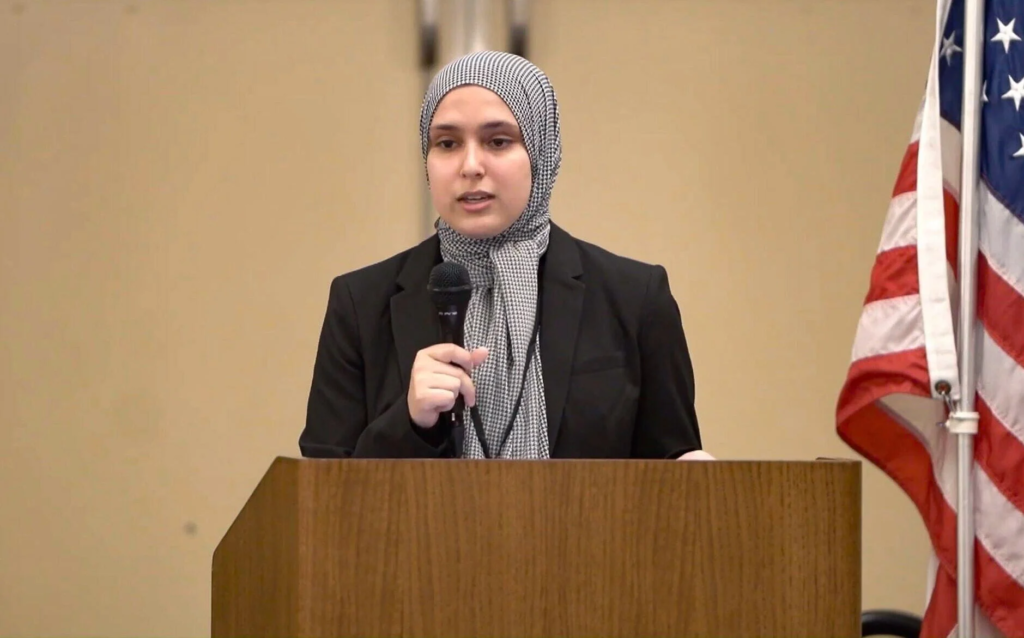
The resignation of Sameerah Munshi from the White House Religious Liberty Commission has drawn widespread attention in political and policy circles, particularly because of the circumstances surrounding her departure and the issues she raised in her statement. Munshi, who served as a policy advisor and the only Muslim woman on the commission, stepped down in protest over what she described as serious injustices carried out by the administration both domestically and internationally.
Her decision came amid rising tensions linked to the United States’ military actions against Iran and internal disputes within the commission regarding freedom of religious expression and political dissent. Munshi publicly announced her resignation through a detailed statement in which she criticized the direction of the administration’s policies and expressed concern about what she described as the erosion of religious liberty.
According to her statement, the resignation was motivated by two major developments: the removal of a fellow commissioner who had expressed controversial views about Israel and Palestine, and the military campaign against Iran, which she described as unlawful and undertaken without proper constitutional or congressional authorization. Her departure from the commission has since sparked debate about the role of religious freedom panels, political dissent within government bodies, and the broader foreign policy context that influenced her decision.
The episode has also highlighted Munshi’s position as a prominent Muslim American voice within a government advisory structure focused on religious liberty. As the only Muslim woman serving on the commission, her resignation carries symbolic weight and has prompted discussions about representation, internal disagreements, and the boundaries of free expression within official advisory institutions. Understanding who Sameerah Munshi is and why her resignation has attracted attention requires examining her background, her role on the commission, and the political developments that led to her decision to step down.
Background And Role On The Religious Liberty Commission
Sameerah Munshi entered the national policy landscape after being appointed in 2025 as a member of the White House Religious Liberty Commission. The commission functions as an advisory body that examines issues related to religious freedom in the United States and abroad. Its members typically include religious leaders, scholars, and policy experts who provide recommendations and guidance on how government institutions should address questions involving faith, civil liberties, and constitutional protections.
Munshi’s appointment made her the sole Muslim woman serving on the commission, a role that placed her in a unique position within the group. The commission itself was created to bring together representatives from various religious backgrounds in order to address concerns about discrimination, religious expression, and the protection of faith-based communities. Members often participate in hearings, discussions, and policy consultations that seek to shape broader government approaches to religious liberty.
As a policy advisor within the administration, Munshi also contributed to discussions about the intersection of religion and public policy. Her role involved engaging with issues that frequently attract national debate, including the balance between free expression and religious sensitivities, as well as the protection of minority religious communities. Being the only Muslim woman on the commission meant that her presence carried both symbolic and practical significance, particularly in conversations about representation and inclusion.
Read : Apple Becomes the First Brand to Cross $1 Trillion in Brand Value
Throughout her time on the panel, Munshi was known for voicing perspectives shaped by her experiences as a Muslim American and as someone working within a government structure focused on faith-based concerns. Her involvement reflected the commission’s stated goal of including a diversity of religious viewpoints. However, the tensions that eventually led to her resignation illustrate how disagreements within such bodies can arise when members interpret issues of religious liberty and political expression differently.
Resignation And Criticism Of Government Policies
Munshi’s resignation statement centered on two developments that she described as deeply troubling. The first involved the removal of fellow commissioner Carrie Prejean Boller, who had been dismissed after using a hearing focused on antisemitism to express criticism of Israel and Zionism. According to Munshi, the decision to remove Boller represented an example of suppressing religiously grounded viewpoints, which she argued undermined the principle of free expression that the commission was meant to uphold.
In her statement, Munshi framed the dismissal as a broader challenge to the idea that people of faith should be able to speak openly about political and moral issues tied to their beliefs. She argued that removing a commissioner for expressing views rooted in religious conviction contradicted the very purpose of a body dedicated to defending religious liberty. The issue, she suggested, raised questions about whether dissenting voices were being restricted in a forum that was supposed to encourage open dialogue.
Read : Ian Valdes Resigns as Turning Point USA President After Racist Messages in Group Chat Leak
Munshi also wrote that individuals with strong convictions about the situation in Palestine were facing pressure and limitations on their ability to speak freely. She argued that such constraints were creating an environment where religious perspectives on political issues were being marginalized. In her view, this trend represented a contradiction between the commission’s stated mission and the way certain disagreements were being handled internally.

The second issue highlighted in her resignation was the military action taken against Iran. Munshi described the campaign as an illegal war conducted without clear constitutional or congressional authorization. She stated that this development was one of the central reasons she could no longer continue serving on the commission, emphasizing that she did not want to remain associated with policies she believed were unjust.
In explaining her decision, Munshi stressed that her resignation was not motivated by fear or pressure from other members of the commission or from government officials. Instead, she said the choice was based on her personal conviction that continuing in her role would conflict with her principles. By stepping down, she sought to distance herself from what she characterized as actions and decisions that violated the ideals of justice and religious freedom.
Her statement made clear that the decision was intended as a form of protest rather than a reaction to intimidation. She emphasized that her experiences within the commission had convinced her that remaining in the role would imply acceptance of policies she strongly opposed. For Munshi, resigning became a way to publicly express her disagreement with both the internal handling of dissent and the broader foreign policy decisions that she believed were unjustified.
Political Context And Broader Debate
Munshi’s resignation took place during a period of heightened geopolitical tension involving Iran and the United States. The resignation came roughly two weeks after coordinated military strikes were launched by the United States and Israel against Iranian targets. The strikes occurred as negotiations over Iran’s nuclear program had stalled, creating an environment of escalating conflict and international uncertainty.
These developments formed the backdrop against which Munshi framed her criticism of the administration’s actions. By describing the military operation as illegal, she raised questions about the constitutional process required for authorizing military force. In the United States, the balance between presidential authority and congressional approval for military action has long been a subject of debate, particularly when operations are undertaken without a formal declaration of war.
Read : Former Harvard President Larry Summers to Resign Professorship Amid Epstein Ties Fallout
The controversy surrounding the dismissal of another commissioner also reflects broader tensions within discussions about Israel, Palestine, and freedom of expression. Public debates over these issues frequently involve disagreements about how criticism of governments, political ideologies, or international policies should be interpreted. Munshi’s statement suggested that such disagreements had begun to influence the internal dynamics of the Religious Liberty Commission itself.
Her resignation has therefore become part of a wider conversation about the limits of dissent within government institutions. Advisory bodies are often designed to encourage a diversity of viewpoints, but conflicts can emerge when members express positions that challenge prevailing policies. In such situations, the question arises whether those viewpoints should be protected as part of open debate or restricted in order to maintain political cohesion.
Another element of the discussion involves representation within government advisory panels. As the only Muslim woman on the commission, Munshi’s departure has prompted reflection on how minority perspectives are included and heard within policy forums. Representation does not necessarily eliminate disagreements, but it can influence how different communities perceive the decisions made by government institutions.
The reaction to her resignation has varied widely, reflecting the polarized nature of the issues involved. Some observers view her decision as an act of principled dissent aimed at drawing attention to concerns about free expression and foreign policy. Others argue that advisory commissions inevitably reflect the political environment in which they operate and that disagreements among members are part of the normal functioning of such bodies.
Regardless of these differing interpretations, Munshi’s resignation has brought renewed attention to the role of the White House Religious Liberty Commission and the challenges faced by advisory groups tasked with navigating complex social and political issues. Her statement highlights the difficulties that can arise when religious perspectives intersect with international conflicts, domestic policy debates, and questions about constitutional authority.
The episode illustrates how individual members of government panels can use their positions to raise concerns about broader policy directions. By stepping down and publicly explaining her reasons, Munshi transformed what might otherwise have been an internal disagreement into a national discussion about religious freedom, political dissent, and the responsibilities of public officials who believe government actions conflict with their principles.