

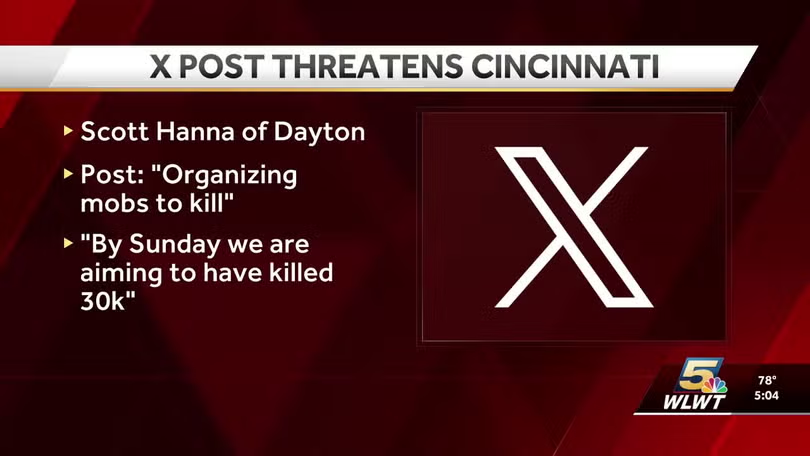
In an incident that has shocked the nation, federal authorities arrested a 30-year-old Ohio man, Scott Hanna, after he posted a chilling message on social media threatening to massacre 30,000 Black residents of Cincinnati. The arrest comes just days after a racially charged street brawl in the city went viral, raising tensions and drawing nationwide attention.
According to a newly unsealed FBI affidavit, Scott Hanna’s social media post, laced with hate and incitement, signaled what investigators believe was a potential mass murder plot. The case underscores the growing threat posed by racially motivated violence and the urgent need for vigilance in the digital age.
An Explicit Threat to “Cleanse” a City
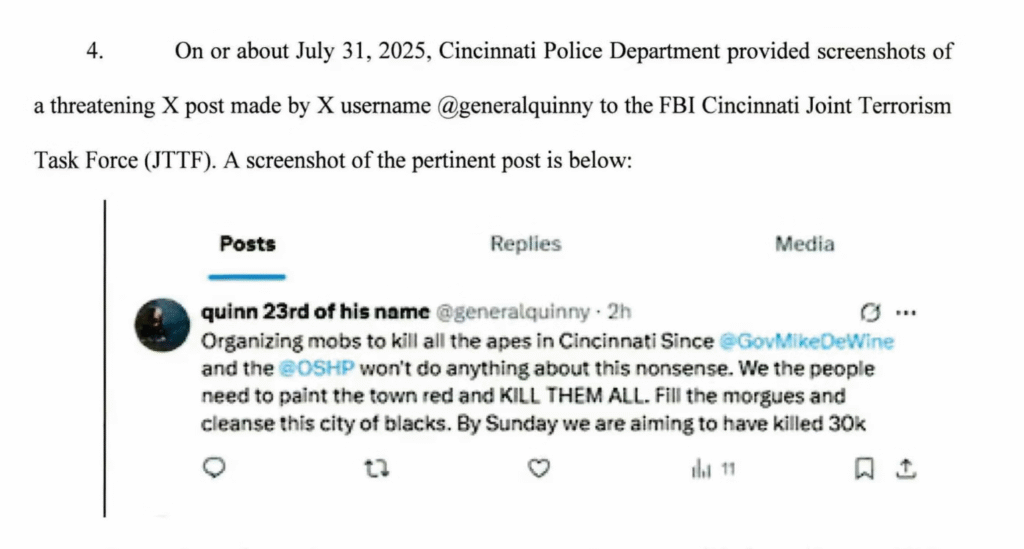
On July 31, 2025, the FBI received screenshots from the Cincinnati Police Department of a post made on X (formerly known as Twitter), authored by the user handle @generalquinny. The message was explicit and deeply disturbing, declaring a plan to kill 30,000 Black people in Cincinnati by Sunday. “Organizing mobs to kill all the apes in Cincinnati Since @GovMikeDeWine and the @OSHP won’t do anything about this nonsense,” the post stated.
“We the people need to paint the town red and KILL THEM ALL. Fill the morgues and cleanse this city of blacks. By Sunday we are aiming to have killed 30k[.]”
Such rhetoric immediately triggered alarm bells. The FBI’s Joint Terrorism Task Force responded swiftly, launching an investigation to determine the identity behind the account and assess the credibility and capability behind the threat. Investigators submitted an emergency disclosure request to X, which responded by providing an email address linked to the user.
Read : Terell Deshawn Bailey-Corsey Threatens to Kill Everyone on Epstein Client List
The email included the first three letters of “Scott” followed by the full surname “Hanna,” leading authorities directly to the Dayton resident. Further investigation linked the IP address associated with the post to Scott Hanna’s residence.
Read : ‘Will Become Godse If He Comes To Odisha’: Man Threatening To Kill Rahul Gandhi
The FBI then followed up with Google, which confirmed that the email was associated with a Google account tied to Hanna’s full name, personal phone number, and home address. A photo posted on the @generalquinny account matched the photo on Hanna’s Ohio driver’s license, providing further confirmation. With this evidence in hand, agents swiftly moved in for the arrest.
A History of Violence and Racial Hatred
This is not the first time Scott Hanna has come to the attention of law enforcement. According to the FBI affidavit, Hanna was previously involved in a violent confrontation on September 11, 2024, where he nearly decapitated a woman using a full-sized sword. Prior to the incident, Hanna reportedly called police and threatened to kill the woman unless action was taken against her.
“[Hanna] told them if they were not going to charge a specified individual then he was going to cut off her head,” the affidavit read. “He stated, ‘If you don’t want an incident then you better send cops to [my address] because I’m fing done with this s.’”
When police arrived at the scene, Hanna had already attacked the woman, causing what officials described as a “serious physical injury and what appeared to be a partial decapitation.” Though court records remain unclear on whether he was prosecuted for the attack, the affidavit notes that Hanna verbally abused a responding officer, calling him the “N-word” and becoming “extremely irate” during the arrest.
Local law enforcement also confirmed that they had prior interactions with Hanna involving the same woman, whom he accused of breaking into his residence. The disturbing history of aggression and escalating behavior painted a picture of a man with a violent disposition and deeply rooted racial animus. This history became central to the FBI’s case for detaining Hanna, as prosecutors argued he was too dangerous to be released pending trial.
Viral Brawl Likely Triggered the Threat
The affidavit does not specify what exactly prompted Hanna’s July 31 threat, but the timing suggests it may have been a reaction to a highly publicized interracial fight in downtown Cincinnati that had gone viral just days earlier. Video footage of the incident showed a chaotic street brawl involving both Black and white participants, sparking heated debates online and offline.
Hanna’s violent message appeared to be his response to what he perceived as lawlessness, accusing the governor and the Ohio State Highway Patrol of doing nothing. By suggesting that “we the people” should “paint the town red,” Hanna aligned himself with vigilante ideology, attempting to rally others to commit acts of racial violence. His choice of words—“cleanse this city of blacks”—evoked genocidal rhetoric, making it one of the most disturbing public threats of racial mass violence in recent memory.
Federal authorities, recognizing the gravity of the message, acted quickly. FBI Special Agent in Charge Elena Iatarola said in a statement, “The FBI aggressively investigates those who threaten our communities with violence. Threats like this impact the entire community and have serious consequences.” Hanna’s arrest may have averted a large-scale tragedy, but it also sheds light on how online hate speech can translate into real-world threats.
According to public records, Hanna lives with his grandfather, a retired judge, in Dayton. He does not yet have a publicly listed attorney, and attempts to reach him have been unsuccessful. At his initial court appearance, federal prosecutors strongly opposed any potential release, citing his violent past and the magnitude of the current threat.
A Broader Crisis of Online Extremism
The Scott Hanna case is a grim reminder of how digital platforms are increasingly being used to spread hate and incite violence. Social media companies have long struggled with balancing free speech and public safety, but incidents like this demonstrate the real-world dangers of unchecked online extremism.
The speed with which the FBI was able to track down Hanna using digital evidence—IP addresses, email accounts, photo matches, and telecommunications records—highlights how law enforcement is adapting to the modern threat landscape. Yet it also raises concerns about how such hateful rhetoric can exist and spread on social media platforms with little to no initial oversight.
X, formerly Twitter, has undergone significant policy and moderation changes under Elon Musk’s ownership. Critics argue that the platform has become a haven for extremists due to relaxed content moderation standards. Although X cooperated with the FBI in this case, the fact that such a violent post was publicly visible long enough to be captured and reported points to systemic flaws in moderation.
Meanwhile, community leaders in Cincinnati and across the nation are grappling with the emotional fallout of this terrifying episode. The Black community, in particular, is left shaken by the magnitude of Hanna’s threat. With Cincinnati home to roughly 120,000 Black residents, the promise to kill a quarter of that population was nothing short of genocidal.
Hanna’s arrest will undoubtedly provide some relief to a frightened public, but the larger issue of domestic extremism fueled by racial hatred remains. The FBI and Department of Homeland Security have repeatedly warned that white supremacist violence is the most persistent and lethal domestic terror threat facing the United States today. The Scott Hanna case exemplifies just how urgent and real that threat is.
As of now, Hanna is charged with making interstate communications with a threat to injure, a federal offense that carries a maximum penalty of five years in prison. However, many are calling for more serious charges, including hate crimes or domestic terrorism statutes, to be considered. The Department of Justice has not commented on whether additional charges will be pursued.
While Scott Hanna awaits trial behind bars, the country is left to reflect on the ease with which one man—motivated by hate and equipped with nothing more than a smartphone—could threaten the lives of tens of thousands. And perhaps more importantly, how many more like him might be out there, hiding behind usernames and avatars, waiting for their moment to strike.