
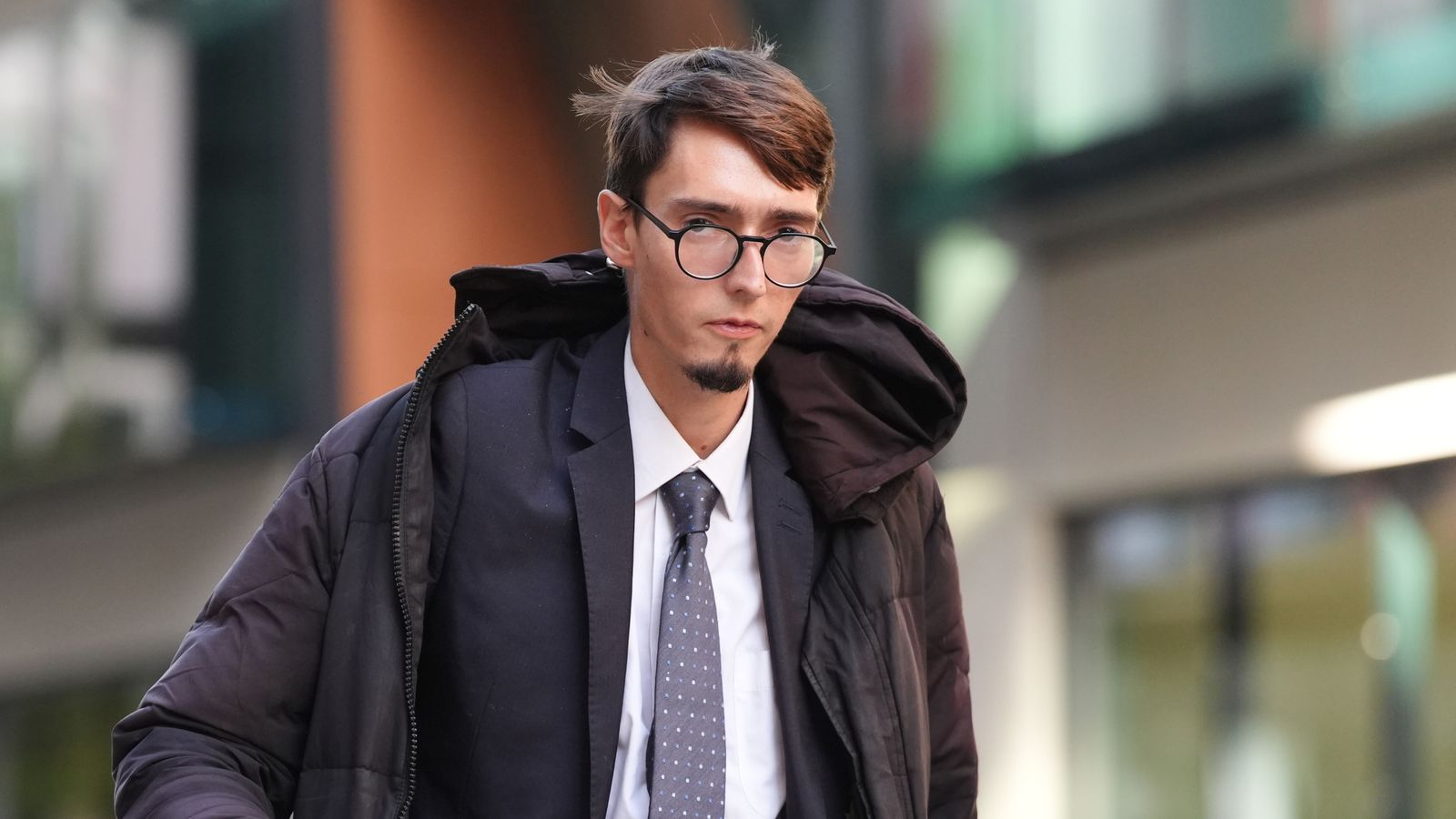
Harry Whittaker, a 33-year-old man from the Bedfordshire village of Caddington, has been sentenced to three years and nine months in prison after a court found he had manufactured and possessed explosives in a makeshift laboratory built inside his garden shed. The case, heard at the Old Bailey, exposed a troubling combination of technical experimentation, extreme right-wing ideology, and explicit violent rhetoric directed at Muslim communities, even as Whittaker sought to portray himself as a harmless science enthusiast with no intention of carrying out an attack.
The investigation into Harry Whittaker did not begin with intelligence-led counterterrorism surveillance or a tip-off from the public. Instead, it was triggered by a medical emergency. On April 18 2024, Whittaker called 999 after suffering a severe allergic reaction that placed him in a life-threatening condition. When paramedics arrived at the home he shared with his mother, Whittaker explained that he had been conducting chemical experiments.
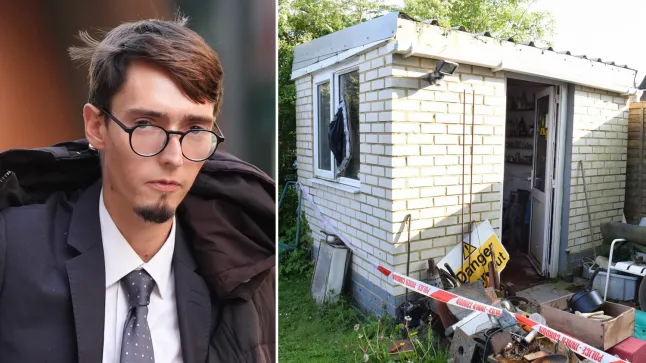
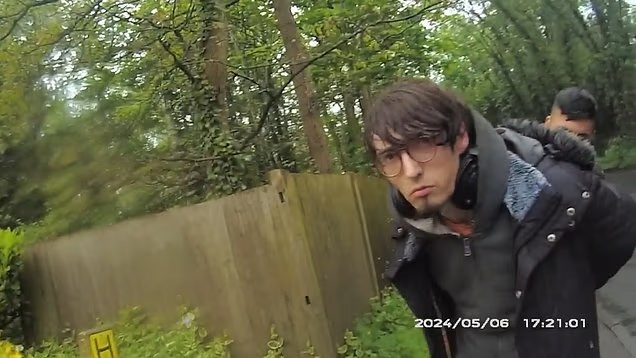
He showed the medics his garden shed, where a previous experiment had caused an explosion that shattered a window. Alarmed by what they saw, the paramedics reported their concerns to the police, setting in motion an inquiry that would ultimately uncover a cache of dangerous materials and a pattern of extremist views. Police searches carried out on May 6 2024 revealed black powder, explosive components, chemicals, lethal poisons, ammunition, suspected improvised explosive devices, and radioactive materials.
Among the most serious discoveries was white phosphorus, an extremely hazardous substance that can ignite spontaneously when exposed to air. The material was deemed so dangerous that it had to be destroyed in a controlled explosion by military specialists. Officers also found a wrap of heroin on Harry Whittaker when he was detained, adding to concerns about his judgment and personal stability. What emerged from the investigation was not simply a case of unlawful possession of chemicals, but a broader picture of risk, ideology, and reckless conduct.
Discovery of the makeshift laboratory and explosive materials
The physical evidence uncovered at Harry Whittaker’s property formed the foundation of the prosecution’s case. Investigators described the garden shed as a makeshift laboratory, containing chemicals, explosive powders, containers marked with warning symbols, and devices that raised immediate safety concerns. Whittaker later told police that he had marked bottles with skull-and-crossbones symbols because he thought they “looked cool,” a remark that prosecutors cited as an illustration of his casual attitude toward extremely dangerous substances.
The court heard that Harry Whittaker had been manufacturing homemade explosives and storing components over a period of time. Although some of the materials were described by the defence as “low-level explosives,” the presence of white phosphorus, radioactive materials, and lethal poisons significantly escalated the seriousness of the case. White phosphorus, in particular, poses extreme risks not only to the individual handling it but also to anyone nearby, as it can ignite on contact with air and burn at very high temperatures.
The decision to store such a substance in a residential garden shed placed Harry Whittaker’s mother, neighbours, and emergency responders at risk. Prosecutors emphasised that the danger was not hypothetical. Whittaker had already caused at least one explosion during an experiment, breaking a window in the shed. The combination of volatile chemicals, limited safety measures, and an uncontrolled environment meant that a far more serious incident could easily have occurred.
Chief Superintendent Jaki Whittred of Bedfordshire Police later said the disruption and distress caused to the local community following the discovery of the materials was considerable, reflecting the scale of the perceived threat once residents learned what had been stored nearby. At trial, Harry Whittaker admitted a charge under the Poisons Act and having ammunition without a licence, but contested the idea that his actions were linked to any intent to harm others.
Read : Rivers of Endless Majesty: Exploring Earth’s Top 10 Longest Waterways
He portrayed himself as a “nerdy” science enthusiast with a fascination for chemistry and experimentation. However, the prosecution argued that his conduct went far beyond innocent curiosity. Judge Simon Mayo KC later concluded that Harry Whittaker’s actions in making and possessing explosives clearly gave rise to a risk of harm to others, regardless of whether a specific attack plan could be proven.
Evidence of extremist ideology and violent rhetoric
While jurors at Whittaker’s trial were not informed of the full extent of his extreme right-wing beliefs, those views were set out in detail during sentencing. Prosecutor Emily Dummett described a pattern of neo-Nazi ideology, racist messaging, and explicit fantasies of mass violence that significantly aggravated the case. Police examination of Whittaker’s phone and online communications uncovered WhatsApp messages in which he directed hatred toward a mosque in Luton and Muslims more broadly.
In one message, Harry Whittaker wrote about needing a tank covered in machine guns and flamethrowers, driving it into the mosque on a Friday afternoon and turning worshippers into “mincemeat.” In another message, he discussed the idea of putting ricin poison into the water supply in Bury Park, an area near Luton with a large Muslim population. Although there was no evidence that Whittaker had taken concrete steps to carry out such plans, the language used was graphic, explicit, and violent.
Further evidence showed that Whittaker had a photograph of Adolf Hitler in his bedroom, a Nazi-associated flag, swastikas, and antisemitic notes. He had downloaded extreme right-wing material and expressed admiration for figures associated with far-right activism. In a message to his brother in 2022, he spoke of wanting Tommy Robinson to lead a “civil war” and “kick out” people of Asian heritage.
Prosecutors argued that these views provided important context for his possession of explosives and toxic chemicals, even if a specific target or timeline could not be established. Ms Dummett told the court that Whittaker had continued to express extreme beliefs and had failed to recognise the seriousness of his actions even after his conviction. This lack of insight, she argued, increased the risk he posed to the public.
Commander Dominic Murphy, head of the Metropolitan Police Counter Terrorism Command, later echoed these concerns, stating that Whittaker’s actions were incredibly reckless and placed his entire neighbourhood at risk. He rejected Whittaker’s claim that the activities were driven solely by scientific curiosity, pointing instead to the combination of ideology, materials, and behaviour.
Sentencing, mitigation, and assessment of future risk
In mitigation, Whittaker’s barrister, Polly Dyer, sought to draw a clear distinction between her client’s offensive beliefs and the offences for which he had been convicted. She argued that the explosives were held for scientific interest and experimentation rather than with the intention of harming others or damaging property. According to the defence, many of the items had been in Whittaker’s possession for years without being used for violence, and there was no direct correlation between the racist messages uncovered by police and the specific materials forming the basis of the charges.
Read : Indiana Senator Chris Garten Posts AI Images of Himself Violently Beating Up Santa Claus
Ms Dyer acknowledged that Whittaker’s views were abhorrent and that he had an interest in Nazism, but insisted he did not pose a significant risk of carrying out a terrorist attack. She highlighted his vulnerabilities, including mental health issues and autism spectrum disorder, and described how he had found the court process extremely distressing. She also noted that while on remand, Whittaker had used his time productively, developing an interest in art and producing a drawing of the composer Ludwig van Beethoven that he hoped to submit to a competition.
The defence further pointed out that Whittaker had been on bail before his trial and that his bail was revoked only after he failed to attend court and was found in a distressed state on two London bridges. This, Ms Dyer suggested, demonstrated emotional instability rather than violent intent. After consulting with her client in the dock, she told the court that Whittaker disputed the suggestion that he desired to cause harm to any group based on race or religion.
Judge Simon Mayo KC accepted that he could not be sure Whittaker had formed a settled intent to use the explosives or chemicals for a violent purpose. However, he made clear that Whittaker had spoken about such violence and had contemplated it to a certain extent. The judge described Whittaker as highly intelligent and stated that his responsibility was not diminished by his mental health issues or autism.
He also took into account a previous conviction for driving off and injuring a neighbour, as well as Whittaker’s disorganised lifestyle. In passing sentence, Judge Mayo concluded that Whittaker met the criteria of a dangerous offender and posed a risk to members of the public in the future.
The sentence of three years and nine months reflected both the seriousness of the offences and the need to protect the public. As he was led down from the dock, Whittaker thanked the judge, a moment that underscored the complexity of a case involving technical knowledge, extremist ideology, and profound questions about risk, intent, and responsibility in the context of domestic extremism.