

In a bizarre international saga that merges religion, deception, and global diplomacy, self-styled godman Nithyananda, the fugitive accused of multiple crimes in India, is back in the spotlight. After fleeing the country in 2019, Nithyananda has been living in exile, claiming to have founded a new nation called “Kailasa” for persecuted Hindus.
Now, his so-called nation has become entangled in a fresh controversy in South America, where its representatives attempted to strike long-term deals with indigenous communities in Bolivia — only to be exposed and deported.
The Rise of ‘Kailasa’ and Nithyananda’s Escape from India
Nithyananda was once a powerful and influential religious figure in India, with thousands of followers and a vast spiritual empire. However, his world began to unravel following a string of serious allegations.
In 2010, he was arrested in connection with a sex scandal, and in 2019, he fled India after being accused of child abduction, sexual assault, and abuse. In the wake of his escape, he resurfaced on the global stage with a strange and audacious claim — that he had founded a new nation, a utopia for Hindus called “Kailasa”.
Though it has no official territory recognized by any country, “Kailasa” is said to be located on an island off the coast of Ecuador. It has its own flag, currency, constitution, passport, and even a central bank.
The self-proclaimed godman declared himself the “supreme pontiff of Hinduism” and claimed that his new status as a head of state granted him immunity from legal persecution.
Despite the absurdity, Nithyananda and his followers have managed to insert themselves into global events. In 2023, representatives of “Kailasa” appeared at a United Nations meeting in Geneva.
Read : Tragic Incident in Hathras: Satsang Leads to Death of 121 People
Clad in traditional attire, they spoke about their nation’s efforts towards sustainable development and sought international protection for their leader, alleging he had been unfairly persecuted for reviving Hindu traditions.
A Grand Scheme in Bolivia: 1,000-Year Land Leases and Deception
But Kailasa’s global outreach didn’t stop at publicity stunts. In a strange turn of events, it appears the self-declared country made a bold attempt to acquire land and influence in Bolivia — a nation rich in indigenous culture and home to large tracts of Amazon rainforest.
According to reports by the New York Times, representatives of Kailasa signed long-term leases with indigenous communities in Bolivia. These leases, some drafted for a staggering 1,000 years, granted access to vast portions of land, airspace, and natural resources.
One indigenous group, the Baure, was persuaded to sign a 25-year lease in exchange for an annual payment of nearly $200,000. However, the version signed by Kailasa’s emissaries was far more expansive and suspiciously generous in their favor.

Pedro Guasico, a leader of the Baure community, admitted that the initial contact with Kailasa’s people began in late 2024. They approached the community offering aid in controlling forest fires and other forms of environmental assistance. But what seemed like a harmless collaboration quickly escalated into a full-blown land acquisition effort.
Guasico later acknowledged that the community had been misled. “We made the mistake of listening to them,” he told the media. “They offered us that money as an annual bonus for conserving and protecting our territory, but it was completely false.” Upon discovering the deceit and the actual terms of the lease, Bolivian authorities moved swiftly.
Twenty individuals linked to Kailasa were arrested and deported to their home countries, including India, the United States, and China. Bolivia’s Ministry of Foreign Affairs publicly clarified that it does not recognize Kailasa as a legitimate state and has no diplomatic relations with the self-proclaimed country. The signed agreements were declared null and void.
Despite the embarrassment, Kailasa’s operatives had already managed to get a photo taken with Bolivian President Luis Arce, further complicating the situation. It appeared to lend some legitimacy to their claims before the truth unraveled.
Global Spotlight and the Absurdity of a Fake Nation
While the Bolivia incident is the latest in a string of surreal developments, it isn’t the first time Nithyananda and Kailasa have attempted to gain international attention.
In addition to the UN stunt and the Bolivia saga, representatives from Kailasa managed to enter into a “sister cities” agreement with the city of Newark in the United States. The city later said it had been scammed, admitting it had been duped by a fictional country.
Despite these controversies, Nithyananda maintains a dedicated online presence and continues to preach to his followers from an undisclosed location. His speeches are often filled with cryptic and nonsensical language, making him the subject of ridicule across social media platforms.
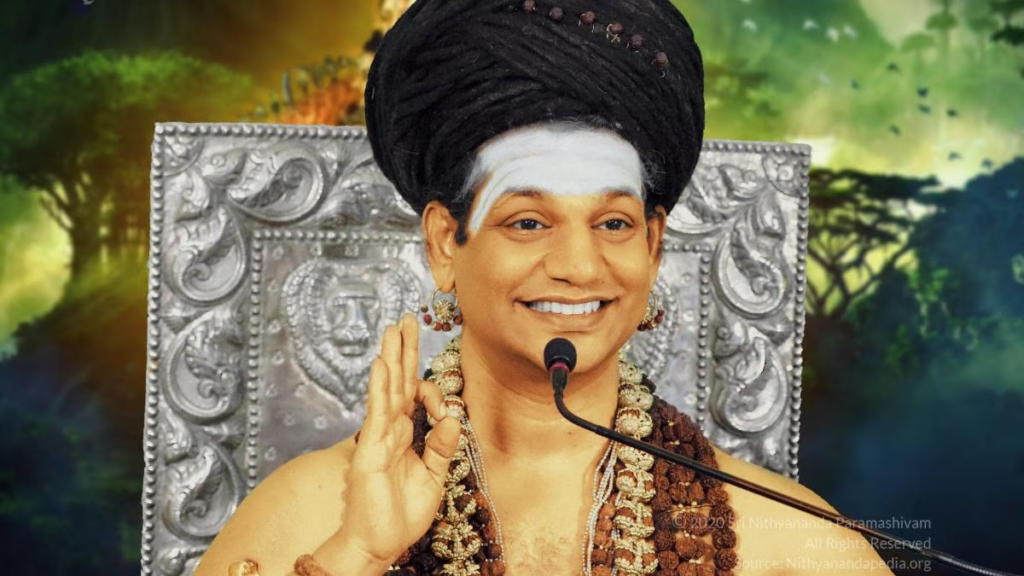
In one widely mocked clip, he famously stated, “So the me resides in this as me is residing in all of that as me so that me through this me talking to me.” In another instance, he declared, “I am going to be active, healthy at least for the next 150 years. The Hindu enemies and Hindu traitors wasted a lot of my time and I don’t go and attack them or react to them… I just decide to live longer.”
Yet behind the comedy and absurdity lies a troubling reality — Nithyananda is a fugitive from justice, facing serious allegations of abuse and exploitation. His attempt to reinvent himself on the global stage under the guise of a fabricated nation raises questions about the loopholes in international diplomacy and the vulnerability of marginalized communities who may be targeted with promises of aid and prosperity.
The Bolivia incident has brought to light how the blending of religion, fantasy, and political opportunism can create real consequences. Indigenous communities, often left without adequate resources or support, can be lured by seemingly benevolent outsiders.
In this case, the deception went beyond simple miscommunication — it involved falsified documents, false promises, and the dangerous ambition of a man fleeing justice.
As Bolivia continues to investigate and as other countries remain vigilant, Nithyananda’s fictional kingdom is facing increasing scrutiny. Whether this marks the beginning of the end for Kailasa or just another chapter in its bizarre saga remains to be seen.
But for now, the global community is beginning to take note — and laugh a little — at the outrageous tale of a fugitive godman, his fake nation, and his 1,000-year Amazonian ambition.