
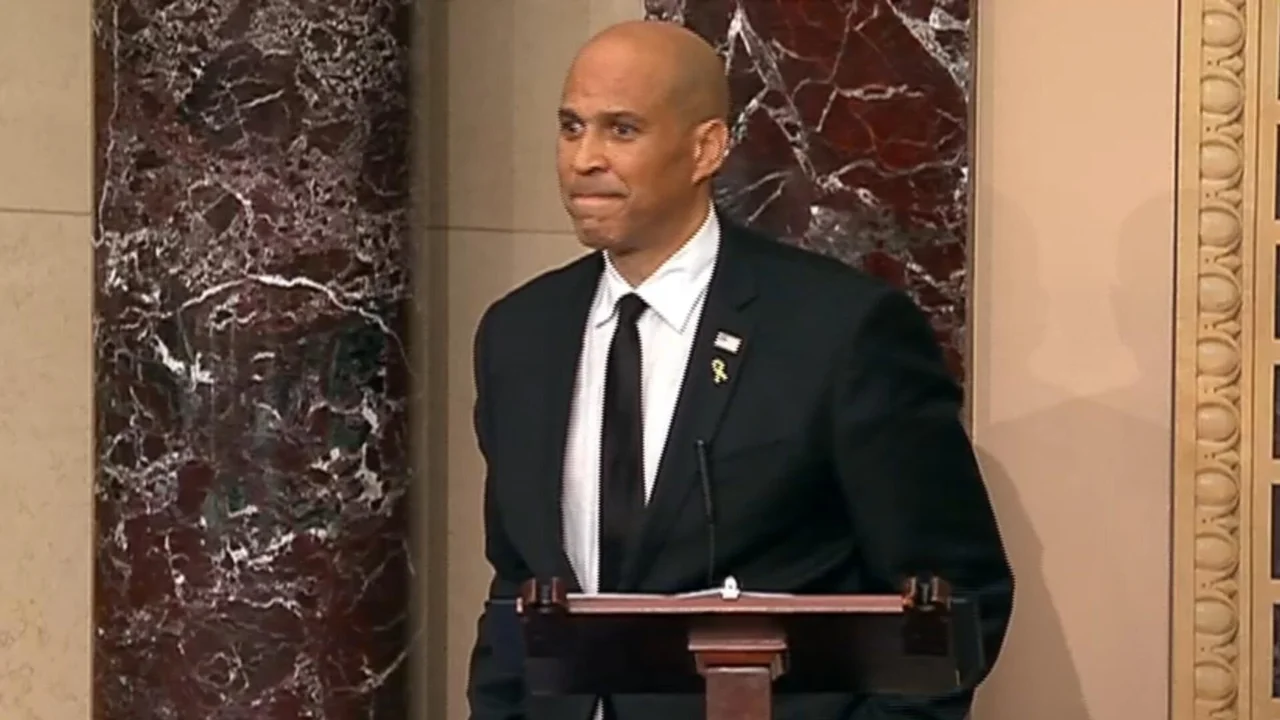
Senator Cory Booker, a Democrat from New Jersey, set a new record in the United States Senate by delivering a non-stop speech that lasted 25 hours and 4 minutes. His marathon address, which began on a Monday evening and extended into the next day, surpassed the previous record of 24 hours and 18 minutes set by Strom Thurmond in 1957.
Booker’s speech was a direct critique of the Trump administration, its policies, and the threats he claimed they posed to American democracy. His passionate oratory drew significant attention from both lawmakers and the public, with millions tuning in to watch him speak live.
As he surpassed the previous record at 7:19 p.m. ET, Democratic senators applauded, and even one Republican, Senator Cynthia Lummis of Wyoming, joined in the acknowledgment of his endurance. Cory Booker finally concluded his remarks at 8:04 p.m. with a powerful statement: “This is a moral moment. It’s not left or right; it’s right or wrong. Let’s get in good trouble.”
His words, referencing the late civil rights leader John Lewis, were met with a standing ovation from his colleagues in the Senate chamber.
A Defiant Stand Against Trump
Cory Booker’s speech was not just about setting a record; it was a deliberate and calculated act of defiance against what he called the “grave and urgent” threat posed by the Trump administration. His remarks focused on several key issues, including massive cuts to the federal workforce, aggressive deportation policies, and sweeping tariffs that had sparked economic concerns.
He argued that the fundamental principles of democracy and governance were under attack, and he used his extended floor time to highlight the policies he believed were most damaging to the American people.
Throughout the speech, Booker read letters from constituents who had shared their fears and frustrations regarding Trump’s policies. He also cited historical parallels, warning that the erosion of democratic norms could have long-term consequences.
Read : Comedian Amber Ruffin Who Roasted Trump Dropped as Host of Annual White House Dinner
Holding up a copy of the Constitution, he declared, “Twelve hours now I’m standing, and I’m still going strong, because this president is wrong, and he’s violating principles that we hold dear and principles in this document that are so clear and plain.” His words resonated with many who viewed Trump’s administration as a departure from established democratic norms.
"I don't want a Disney vacation of our history! I don't a whitewashed history, I don't want a homogenized history. Tell me the wretched truth about America, because that speaks to our greatness" — 20 hours into his speech, Cory Booker is spitting absolute 🔥 pic.twitter.com/IXxRaT5vKE
— Aaron Rupar (@atrupar) April 1, 2025
The impact of Booker’s speech extended beyond the Senate chamber. His TikTok livestream garnered over 350 million likes, demonstrating significant public engagement. Additionally, his office reported receiving over 28,000 voicemails of encouragement from people across the country. This overwhelming response underscored the extent to which his message resonated with a wide audience.
The Physical and Political Endurance Test
Delivering a speech of this length required an extraordinary level of physical and mental endurance. Unlike past filibusters, where senators could take strategic breaks, Cory Booker remained standing for the entire duration of his speech. If he had left the floor for even a bathroom break, he would have lost control of the session.
To prepare for this grueling test, he stopped eating days in advance and ceased drinking liquids the night before. Despite experiencing dehydration and muscle cramps, he powered through, demonstrating an unwavering commitment to his cause.
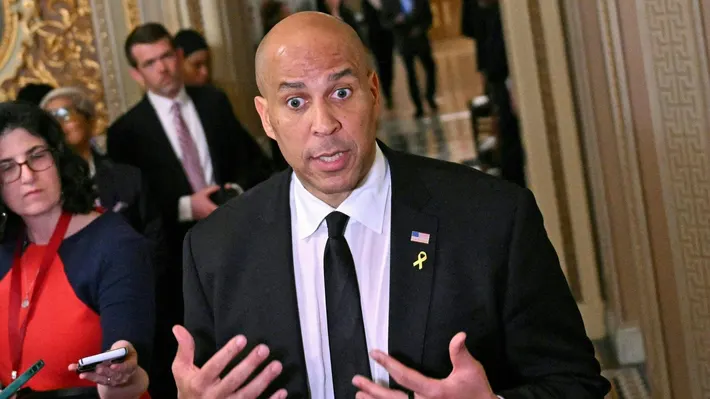
Several Democratic senators supported Booker during his speech, occasionally stepping in to ask questions or provide brief moments of respite for his voice. Senator Chris Murphy of Connecticut, who had himself conducted a nearly 15-hour filibuster on gun control in 2016, was among those who praised Booker’s perseverance. “It’s really hard to get your body past hour 22 and 23,” Murphy remarked. “I just don’t think he’s going to stop until he has to stop.”
Republican reactions to Booker’s speech were mixed. While some dismissed it as a political stunt, others acknowledged the discipline required to sustain such a lengthy oration.
Senator Lisa Murkowski of Alaska noted, “Whether you agree with him or not, the past 24+ hours was what most people think a filibuster actually looks like.” Meanwhile, a White House spokesperson mocked Booker’s effort, comparing it to his 2020 presidential campaign and past statements.
A Symbolic Moment in Senate History
Booker’s decision to break the Senate’s longest speech record carried symbolic weight beyond its immediate political impact. The previous record, held by Strom Thurmond, was set in opposition to the Civil Rights Act of 1957. Thurmond, a segregationist at the time, used his marathon speech to resist racial integration and equal rights.
Speaking after his own record-breaking speech, Booker acknowledged that Thurmond’s legacy had always bothered him. “The longest speech on our great Senate floor was someone who was trying to stop people like me from being in the Senate,” he said. “So to surpass that was something I didn’t know if we could do, but it was something that was really—once we got closer, became more and more important.”
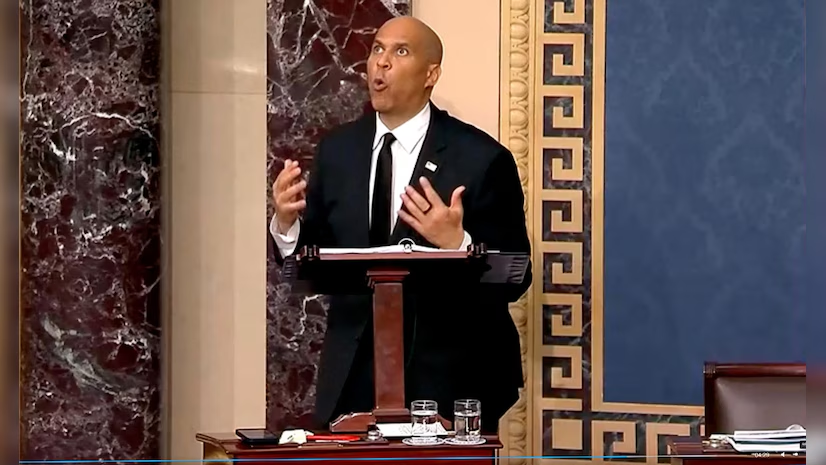
His speech served as a stark contrast to Thurmond’s, shifting the record from an act of obstruction against civil rights to a call for justice and accountability. Booker invoked the words of John Lewis repeatedly, reinforcing the idea that activism and “good trouble” are necessary in times of crisis. His address was a reminder of the power of persistence and the importance of speaking out against perceived injustices.
Although Booker’s speech delayed a scheduled vote on eliminating tariffs on Canadian imports, its broader impact was in shaping the political narrative. It signaled to both his supporters and critics that he was willing to use every available tool to challenge Trump’s policies. The NAACP and other advocacy groups praised his efforts, urging other lawmakers to take bold actions to counter the administration’s agenda.
As the dust settled, Cory Booker reflected on his experience, acknowledging his exhaustion but expressing hope that his message would have a lasting impact. “History will show we rose to meet this moment,” he wrote on X, encapsulating the sentiment that had driven him to stand and speak for over a day. Whether or not his speech leads to concrete policy changes, it has already secured its place as a defining moment in modern Senate history.