
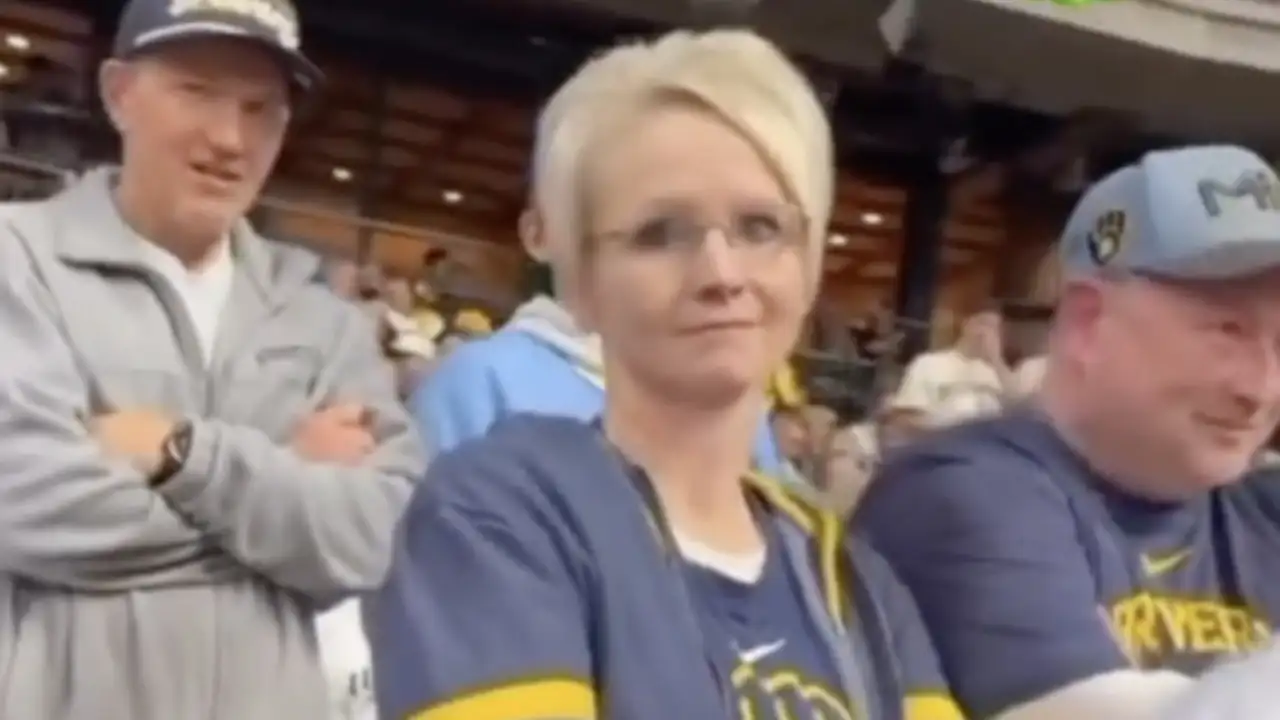
The Milwaukee Brewers’ home crowd fell unusually quiet during Game 2 of the National League Championship Series, but the silence did not last long. A brief and tense encounter between two fans—one cheering for the Los Angeles Dodgers and the other for the Milwaukee Brewers—quickly spiraled into a viral controversy. Shannon Kobylarczyk, a Brewers supporter, was captured on camera telling a Latino Dodgers fan she was going to “call ICE,” a remark that spread widely online and drew intense backlash.
Within days, Shannon Kobylarczyk lost her job and resigned from a charitable board, while the targeted fan, Ricardo Fosado, found himself unexpectedly at the center of a national debate about race, sportsmanship, and accountability in the age of social media. The incident has prompted questions about how far public outrage should go, the consequences of viral exposure, and whether one offensive comment should end a person’s career. The story of Kobylarczyk and Fosado is both a snapshot of modern fan culture and a reminder of how quickly a heated moment can reverberate beyond the ballpark.
The Confrontation That Sparked a Firestorm
The incident took place during the seventh inning of Tuesday’s NLCS Game 2 in Milwaukee. The Dodgers, the reigning World Series champions, were up 4-1 against the Brewers, and the atmosphere in the stands was subdued. Ricardo Fosado, a Dodgers fan and U.S. military veteran, decided to record the quiet crowd, playfully asking, “Why is everybody quiet?” His lighthearted question was met with an angry response from one Brewers fan, later identified as Shannon Kobylarczyk.
Shannon Kobylarczyk, who appeared to have been drinking, shouted back, “Real men drink beer, (expletive)!” The exchange escalated as she turned to a man beside her and added, “Ya know what, let’s call ICE.” Immigration and Customs Enforcement, or ICE, is the U.S. federal agency responsible for enforcing immigration laws, and the phrase “call ICE” is widely recognized as a racially charged insult when directed at people perceived to be Latino or immigrant.
Fosado, visibly unfazed, replied, “ICE is not going to do nothing to me. Good luck … call ICE. Call them, (expletive) idiot.” He then told her that he was a U.S. citizen and had served in two wars. As the camera continued to record, Shannon Kobylarczyk appeared to swipe at his phone, ending the clip. The video, posted to social media soon after, spread quickly across platforms like X (formerly Twitter) and TikTok, where viewers condemned the woman’s remark as racist and inappropriate. By the next morning, the clip had been viewed hundreds of thousands of times, and internet users had identified Kobylarczyk by name.
Consequences Beyond the Ballpark
Once her identity became public, the fallout for Shannon Kobylarczyk was swift. The Milwaukee Journal Sentinel confirmed that she worked for Manpower Group, a global staffing and workforce solutions company headquartered in Milwaukee. Within 48 hours, the company released a statement announcing her termination. “ManpowerGroup has zero tolerance for discriminatory behavior,” the company said. “The employee involved in the recent viral incident is no longer with our organization.”
In addition to losing her job, Shannon Kobylarczyk resigned from her position on the board of directors for Make-A-Wish Wisconsin, a nonprofit that grants wishes to children with critical illnesses. The organization confirmed her resignation and reiterated its commitment to inclusion and respect for all communities. While the public response largely applauded these actions, some questioned whether firing Kobylarczyk went too far. Others argued that, as a representative of both a global company and a respected nonprofit, her behavior reflected poorly on those institutions and therefore warranted disciplinary action.
Read : University of Kentucky Student Laken Snelling Arrested in Connection with Death of Her Infant
Interestingly, the man she directed her comments toward, Ricardo Fosado, expressed a surprisingly empathetic view. Speaking to the Journal Sentinel, he said he did not believe Shannon Kobylarczyk deserved to lose her job. “I don’t think it was horrible or something that should get her fired,” Fosado said. “I feel bad for her.”
meet Shannon Kobylarczyk aka Brewers Karen. she was an employee of the Manpower Group in Milwaukee and served on the board of directors for Make-A-Wish Wisconsin. WAS cuz she is fired now pic.twitter.com/pdfZXP2q3E
— Amy aka Scarlet Witch of Sports (@AmyHarber) October 17, 2025
He acknowledged that she had made a mistake, one likely amplified by the intensity of the game and the effects of alcohol, but maintained that the punishment seemed harsh. However, he also revealed that after their argument, Shannon Kobylarczyk reported him to stadium security, and he was ejected from the game. “I got kicked out, not her,” Fosado said. “That’s the ironic part of it. I’m the one who served my country and got thrown out of the ballpark.”
Public Backlash and the Larger Debate
The viral video ignited a broader discussion about race, free speech, and accountability in public spaces. For many viewers, Kobylarczyk’s “call ICE” remark struck a deep nerve in a country where immigration remains one of the most divisive issues. Critics argued that such comments, especially when directed at someone based on perceived ethnicity, reflect a pattern of casual racism that has no place in sports or society.
Others saw the incident as a symptom of what they perceive as “cancel culture,” in which individuals lose their livelihoods for a single moment of poor judgment caught on camera. They argued that while Kobylarczyk’s comment was wrong, firing her was disproportionate and indicative of corporate overreaction to online outrage. In many ways, the debate mirrors similar incidents that have occurred in recent years—public figures, employees, or ordinary citizens making racially insensitive remarks that are recorded, shared, and dissected online. Social media users have become adept at identifying people in viral videos, often through digital “sleuthing,” which can lead to rapid professional consequences.
Legal experts note that while private employers generally have broad discretion to terminate employees for behavior that violates company values, the ethical implications are more complicated. Some argue that the immediacy of social media punishment leaves little room for personal growth or rehabilitation. Others insist that public accountability is necessary to deter discriminatory conduct. Fosado himself seemed to embody that tension—while recognizing the hurtful nature of the comment, he also expressed forgiveness. “I think people should learn from their mistakes,” he said. “Everyone says stupid things sometimes.”
Still, for many Latino fans and immigrant communities, the phrase “call ICE” is far from harmless. It carries with it a history of fear, intimidation, and discrimination, particularly in light of aggressive immigration enforcement policies and rising anti-immigrant rhetoric in recent years. The idea of weaponizing that phrase, even as a drunken taunt, underscores the continuing social divides that persist around identity and belonging in the United States.
From Viral Outrage to Lasting Reflection
The Brewers-Dodgers confrontation is a reminder of how easily a moment of anger can become a career-defining scandal in the digital age. In decades past, such an exchange might have remained a brief, regrettable incident between two fans. Today, smartphones and social media ensure that every interaction has the potential to reach millions of viewers within hours.
Shannon Kobylarczyk’s story is also a case study in how institutions navigate reputational risk. Manpower Group’s swift response reflected an effort to distance itself from controversy and reaffirm its stated values. For nonprofits like Make-A-Wish, maintaining a reputation for inclusivity is particularly vital, and Kobylarczyk’s resignation likely preempted growing public pressure. Yet, the incident raises deeper questions about empathy and forgiveness in public life. Should one offensive comment, made in a heated environment, permanently tarnish a person’s reputation? Or is there room for remorse and redemption once an apology is made?
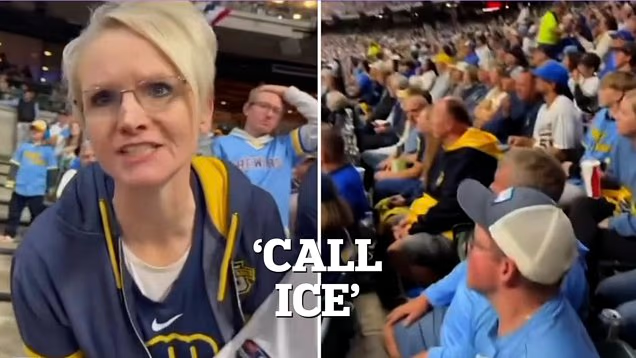
At the same time, it cannot be ignored that such comments, however spontaneous, reveal underlying social attitudes that can be deeply harmful. When “call ICE” is used as an insult, it serves as a reminder that xenophobia can still surface in ordinary settings—from ballparks to workplaces—especially when emotions run high. The accountability that follows these incidents, while harsh, also signals a broader cultural shift toward zero tolerance for discriminatory behavior.
For Ricardo Fosado, the ordeal was both frustrating and eye-opening. As a Latino man who proudly served his country, being accused of not belonging cut particularly deep. Yet his response—measured, dignified, and compassionate—has drawn praise. He declined to fuel the outrage and instead urged understanding. “We should all just try to be better,” he told reporters. “It’s just a game.” For Kobylarczyk, the episode has likely been a painful reckoning. Losing her job and charitable position has placed her in the national spotlight for all the wrong reasons. Whether she publicly apologizes or chooses to stay silent remains to be seen, but the lesson is clear: in an era where every word can be recorded, the line between private behavior and public accountability has all but disappeared.
As the dust settles, what lingers from this story is less about a single baseball game and more about the cultural moment it reflects. Sports are often a mirror of society, revealing both its divisions and its potential for unity. The brief, volatile exchange between a Brewers fan and a Dodgers supporter was a microcosm of America’s ongoing struggle with identity, tolerance, and the boundaries of acceptable speech. Perhaps the most striking aspect of this story is that the person targeted by the insult chose to forgive, while the person who made it faced the full weight of social and professional consequences. It is a paradox of our time: compassion from the aggrieved, and condemnation from the crowd.
In the end, the episode serves as a cautionary tale for anyone attending a public event in the age of viral video. A few words, uttered in anger or jest, can reverberate far beyond the stands, affecting reputations, careers, and lives. But it also offers a glimmer of hope—that amid outrage and division, individuals like Ricardo Fosado can still respond with grace, reminding us that understanding and restraint are as essential to civic life as accountability and justice.
I’ve been browsing online more than three hours today, yet I never found any interesting article like yours. It’s pretty worth enough for me. In my view, if all webmasters and bloggers made good content as you did, the net will be much more useful than ever before.
Great website. Plenty of useful info here. I am sending it to some friends ans also sharing in delicious. And obviously, thank you to your effort!