
The relationship between early humans and the large predators that shared their landscapes has long been understood in broad terms, often inferred from tools, hunting sites, and scattered fossil remains. Humans of the Upper Paleolithic were capable hunters who developed sophisticated strategies to survive harsh environments, yet they lived alongside formidable megafauna that posed constant danger.
Direct evidence of violent encounters between humans and predators is rare, not because such events were uncommon, but because the archaeological record is unforgiving. Bodies were seldom buried, and when people were killed by animals, scavengers often destroyed the evidence. Against this background, the skeleton of a teenage boy who lived around 27,000 years ago offers an unusually intimate and tragic glimpse into prehistoric life.
His remains, preserved in a richly furnished burial, show unmistakable signs of a bear attack, making this one of the clearest cases in which an ancient human can be shown to have been mauled by a large predator. The teenager, known to researchers as “Il Principe,” was discovered more than eighty years ago in the Arene Candide Cave on the Italian coast.
For decades, speculation surrounded his cause of death, but only recent advances in analytical techniques have allowed scientists to reconstruct the final chapter of his life with greater confidence. What emerges is not merely a story of violence, but one that reveals how vulnerable even skilled foragers could be, how communities responded to loss, and how modern science can recover deeply human narratives from ancient bones.
The Discovery of “Il Principe” and the Archaeological Context
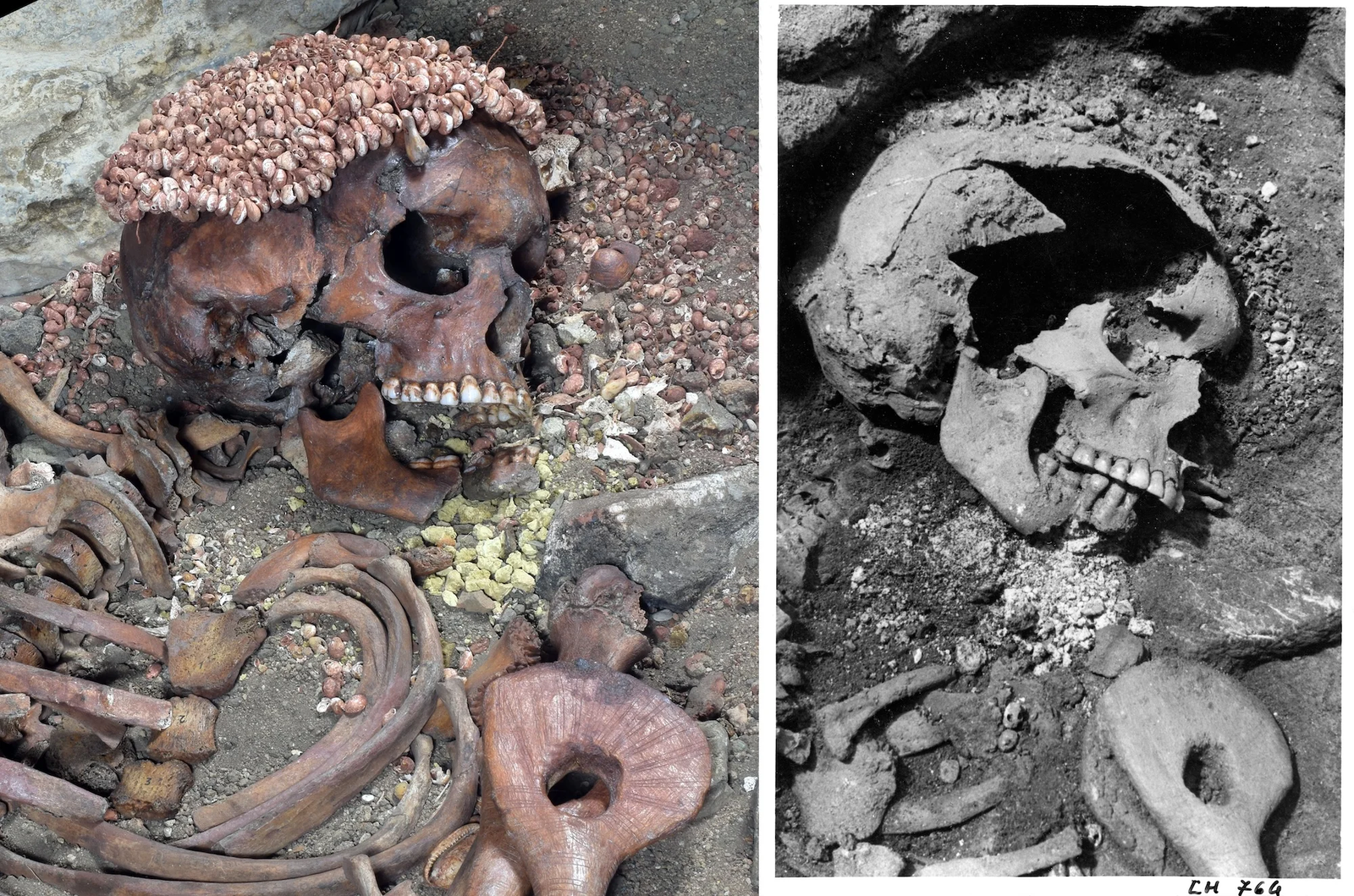
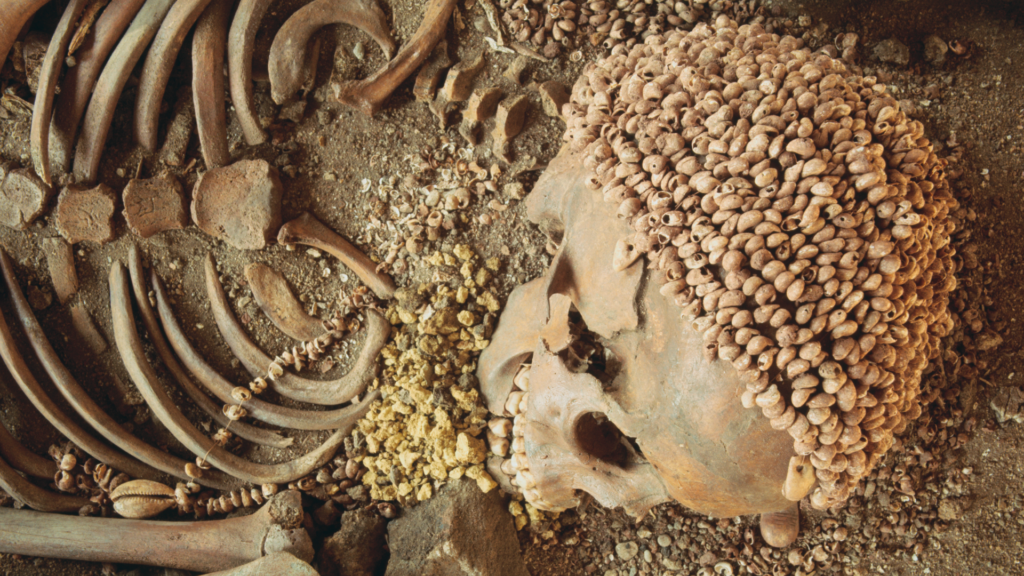
The Arene Candide Cave, located in Liguria near the Mediterranean coast, has long been recognized as one of Europe’s most important Upper Paleolithic sites. Excavations carried out in the early twentieth century revealed multiple human burials spanning thousands of years, many of them accompanied by elaborate grave goods. Among these discoveries, the burial of a teenage boy stood out for its richness and care. Unearthed in 1942, the remains were found adorned with a handwoven cap decorated with shells, alongside stone blades, ornaments, and other objects that suggested ritual significance.
The boy was estimated to be around 15 years old at the time of his death. His nickname, “Il Principe,” meaning “The Prince,” reflects the exceptional nature of his burial rather than any indication of social rank in the modern sense. In Upper Paleolithic societies, such elaborate treatment of the dead was rare and likely reserved for individuals who held symbolic importance or whose deaths carried special meaning for the group.
From the outset, researchers noted unusual damage to the skeleton and proposed that the boy may have died as a result of an animal attack. However, at the time, the methods available to study skeletal trauma were limited, and the idea remained speculative. It was not until recent years that researchers returned to the remains with fresh eyes and new tools.
Read : Jonathan Gerlach Arrested After Stealing Over 100 Skeletons from Mount Moriah Cemetery
Using optic magnification and modern forensic approaches, scientists reexamined the bones in detail, focusing on lesions and fractures that could distinguish between injuries caused by tools, post-burial damage, or animal aggression. This careful reassessment transformed a long-standing hypothesis into a well-supported conclusion. The injuries were not random or incidental; they followed patterns consistent with bites and claw marks inflicted by a large carnivore, most likely a cave bear or a brown bear.
Read : Exploring the Roof of the World: Himalayan Mountains
This reanalysis underscores how archaeological interpretations evolve over time. Finds made decades ago can yield new insights when revisited with improved techniques and refined questions. In the case of “Il Principe,” the cave context, the integrity of the burial, and the preservation of the skeleton combined to create an extraordinary opportunity to study a moment of prehistoric life and death in detail.
Trauma on the Bones and Evidence of a Bear Attack
The most compelling aspect of the new research lies in the specific injuries documented on the teenager’s skeleton. Lesions on the skull show deep grooves and puncture marks that align closely with the shape and spacing of bear teeth and claws. One particularly telling injury involves the mandible, which appears to have been dislodged, suggesting a powerful bite to the face or head. Additional trauma includes a fractured clavicle, bite marks on the right ankle, and damage to the left pinky toe, which was broken.
Such a distribution of injuries provides important clues about the nature of the encounter. Rather than a single fatal blow, the pattern suggests a violent struggle in which the bear attacked multiple parts of the body. The ankle injury, for instance, may indicate an attempt by the animal to immobilize the boy, while the cranial trauma reflects the immense force exerted during the attack.
Importantly, the absence of healing in the clavicle fracture indicates that the injuries were sustained shortly before death, and that the boy survived for at least some time after the initial encounter, possibly enduring days of pain before succumbing. The researchers argue that the bear involved was likely acting defensively rather than predatory. Cave bears, which inhabited Europe during the last Ice Age, were primarily herbivorous, feeding largely on plants, roots, and fruits.
While capable of lethal violence, they did not typically hunt humans for food. Instead, encounters likely occurred when humans inadvertently threatened a bear, perhaps by approaching a den or surprising the animal while foraging. In such cases, a bear might attack to neutralize what it perceived as a danger, then withdraw rather than consume the body.
This interpretation is supported by the fact that the boy’s remains were recovered intact and carefully buried, rather than showing signs of extensive scavenging. If the bear had treated him as prey, more severe damage and partial consumption would be expected. Instead, the injuries suggest a brief but devastating encounter, followed by the boy’s retreat or rescue by others, who later tended to him and eventually laid him to rest with ceremony.
From a scientific perspective, this case represents some of the earliest direct evidence of a predator attacking an ancient human. While indirect clues exist elsewhere, such as cut marks on animal bones or defensive structures in settlements, few examples allow researchers to pinpoint a specific event with such clarity. The combination of forensic detail and archaeological context makes “Il Principe” a rare and valuable witness to the dangers faced by early foragers.
Life, Death, and Meaning in the Upper Paleolithic World
Beyond the physical evidence of violence, the burial of “Il Principe” opens a window onto the emotional and cultural lives of Upper Paleolithic communities. The care invested in his burial suggests that his death resonated deeply with those who survived him. Objects placed with the body were not utilitarian leftovers but carefully selected items that likely held symbolic meaning. The shell cap, in particular, stands out as a labor-intensive creation, implying that considerable time and effort were devoted to honoring the boy.
Read : Mysterious Skeleton with Alien-Like Head Spotted on Margate Beach in England
Anthropologists have long debated the significance of such burials. Rather than simple disposals of the dead, they are increasingly seen as expressions of social bonds, beliefs, and attempts to impose meaning on loss. In this case, the elaborate burial may have served multiple purposes: commemorating the boy, reinforcing group identity, and perhaps even seeking protection from future harm. The inclusion of ritual objects could reflect an effort to ward off evil or danger, especially in the wake of a traumatic death caused by a powerful animal.

The age of the boy adds another layer of poignancy. At around 15 years old, he was likely in a transitional phase of life, learning the skills necessary for adulthood. Researchers have suggested that he may have been a novice hunter or forager, still acquiring experience when he encountered the bear. His death would have represented not only a personal tragedy but also the loss of future potential for the group. In small prehistoric communities, every member mattered, and the death of a teenager could have significant social and emotional consequences.
For modern scholars, the story of “Il Principe” humanizes a distant past that can otherwise feel abstract. It reminds us that Ice Age humans were not just toolmakers or hunters, but individuals who experienced fear, pain, care, and mourning. The bones record a violent encounter, but the burial records compassion and remembrance. Together, they form a narrative that bridges tens of thousands of years, allowing contemporary readers to glimpse the humanity of those who lived during the last Ice Age.
The findings also reshape how we think about human resilience and vulnerability. Early humans were adaptable and resourceful, yet they lived in a world where survival was never guaranteed. Encounters with large predators were a constant risk, and even routine activities like foraging could turn fatal. That such an event was remembered and marked so carefully in death speaks to the depth of social connections and the emergence of complex cultural responses to tragedy.
In the end, the skeleton of “Il Principe” does more than prove that a teenager was mauled by a bear 27,000 years ago. It provides a rare, tangible link between the biological realities of prehistoric life and the emotional worlds of ancient people. Through careful scientific analysis and thoughtful interpretation, a single set of bones has illuminated not just how a young person died, but how a community lived, cared, and remembered.