
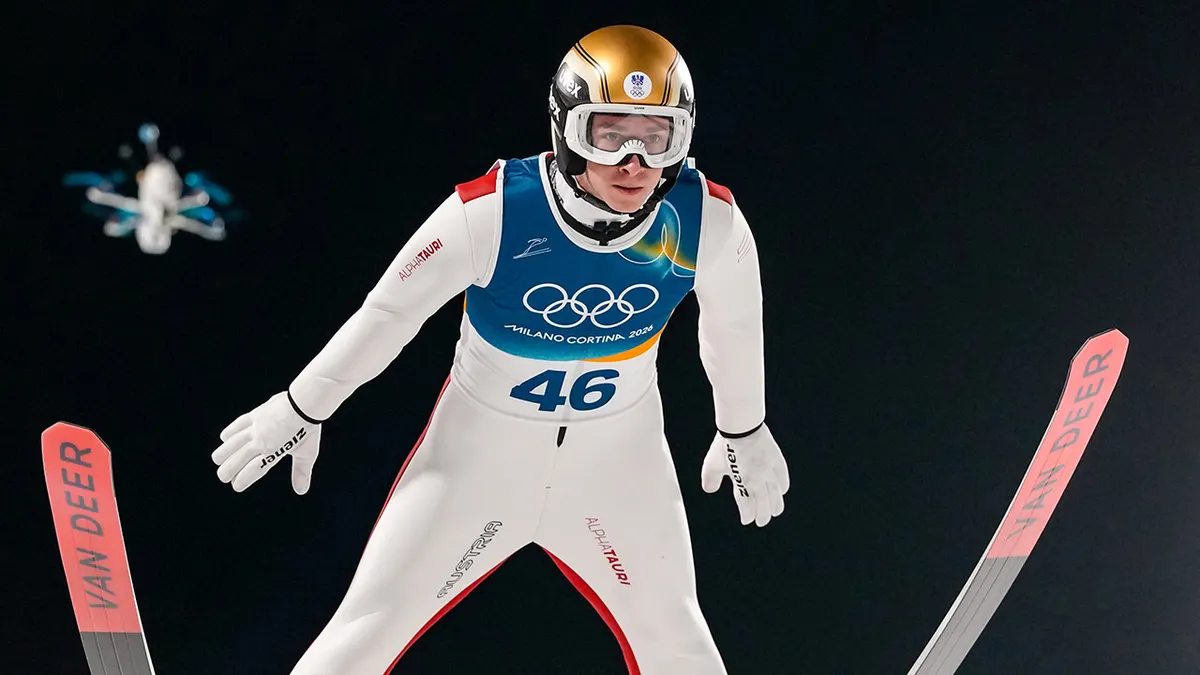
The women’s large hill ski jumping competition at the 2026 Winter Olympics in Milan Cortina delivered both historic achievements and unexpected disappointment, as American athlete Annika Belshaw was disqualified from the final standings due to an equipment violation. The ruling came shortly after she completed her second jump in what had appeared to be a strong and promising Olympic performance. Her disqualification underscored the strict technical regulations that govern elite ski jumping, where even the smallest deviation from equipment standards can overturn results at the highest level of competition.
Belshaw, a 23-year-old competitor from Steamboat Springs, Colorado, had successfully advanced to the final round of the women’s large hill individual event and delivered two solid jumps. Her combined score placed her within competitive range before officials determined that her skis exceeded the maximum permitted length. According to official event measurements, her skis were just over one centimeter longer than allowed under regulations set by the International Ski and Snowboard Federation.
Though the margin was minimal, the rules leave no room for tolerance, and the disqualification was enforced immediately. The decision brought renewed attention to the technical precision required in Olympic ski jumping, where equipment measurements are closely tied to athlete safety, fairness, and performance balance. It also highlighted the unpredictable nature of equipment-based regulations, which can be influenced by factors beyond simple oversight, including fluctuations in an athlete’s body weight during competition.
The incident occurred during the Olympic debut of the women’s large hill event, a milestone moment for the sport that introduced new levels of visibility and opportunity for female ski jumpers worldwide. While the event produced historic medal wins for some competitors, Belshaw’s disqualification became one of the most widely discussed developments of the competition, reflecting how quickly fortunes can change in Olympic sport.
Equipment Regulations and Fine Margins of Ski Jumping Competition
Ski jumping is among the most technically regulated winter sports, with detailed equipment requirements designed to ensure competitive fairness and athlete safety. Among the most closely monitored measurements is ski length, which is not fixed universally but calculated individually based on an athlete’s body mass index. This system aims to prevent athletes from gaining an aerodynamic advantage by using longer skis that could increase lift and flight distance.
Under these regulations, ski length must remain within a prescribed ratio relative to an athlete’s body composition. Officials measure equipment before and after jumps, and any violation — even one as small as a fraction of a centimeter — can result in immediate disqualification. The strict enforcement reflects the sport’s long-standing commitment to technical consistency, particularly in events where performance margins are often determined by small variations in distance or style scores.
Annika Belshaw’s skis exceeded the permitted maximum by slightly more than one centimeter, a difference that may appear negligible to casual observers but is considered significant under competition rules. The precision of ski measurements is critical because even minor equipment changes can alter aerodynamic performance during flight. Longer skis can increase surface area and stability in the air, potentially affecting distance and landing control.
An important complication in ski length regulation is that the allowable measurement can change during the course of competition. Because ski length is tied to body mass index, any decrease in body weight — even a small one — can lower the maximum allowable ski length. Athletes competing across multiple rounds, days, or events may experience natural weight fluctuations due to physical exertion, hydration changes, or environmental conditions. In such cases, equipment that initially meets regulations may later become non-compliant.
Read : Ski Jumping Head Coach Igor Medved Sent Home from Winter Olympics for Violating Team Alcohol Rules
This possibility is recognized within the sport’s rule framework, and official Olympic sources have noted that athletes may inadvertently violate ski length standards if their body weight decreases during competition. The system is designed to maintain fairness but introduces an element of complexity that athletes and their teams must carefully monitor throughout the event schedule.
Read : Kilauea Volcano in Hawaii Experienced a Seismic Swarm with 30 Earthquakes Per Hour
Equipment checks are routine and thorough. Officials conduct inspections in designated control areas where skis, suits, boots, and other gear are measured using calibrated instruments. The process is standardized across international competitions, and results are considered final once confirmed. There is no discretionary margin or appeal based on how small the violation may be.
Belshaw’s disqualification reflects this rigid enforcement structure. Regardless of performance quality or competitive standing, equipment compliance is treated as a fundamental requirement of participation. The rules apply equally to all competitors, and any violation automatically nullifies the athlete’s results from the event.
Belshaw’s Olympic Performance and Impact of Ruling
Before the disqualification was announced, Belshaw had delivered a performance that demonstrated steady progression throughout the competition. Her first-round jump measured 98.5 meters, a distance that secured her place in the final round of the women’s large hill event. She followed with another strong effort, bringing her combined score to 190.9 points.
In ski jumping, athletes are scored based on both distance and style. Judges evaluate flight posture, landing stability, and overall technique, while distance contributes to a base scoring structure adjusted for hill size and environmental factors such as wind conditions. Belshaw’s scoring reflected consistency across these categories, suggesting a performance capable of achieving a respectable Olympic placement.
However, soon after her final jump, officials confirmed that her skis exceeded the maximum allowable length. The announcement removed her from the final results entirely, erasing what had been a competitive showing in one of the most significant events of her Olympic career. The disqualification marked a difficult conclusion to Belshaw’s debut Olympic appearance. The Milan Cortina Games represented her first participation in the Winter Olympics, and she had already competed in multiple events.

She finished 21st in the normal hill competition and contributed to the United States team’s seventh-place finish in the mixed team event. Her performance in the large hill competition had been viewed as another opportunity to build experience and establish standing within the international field. Instead, the equipment ruling overshadowed her athletic achievements and became a defining moment of her Olympic campaign.
Such outcomes are not uncommon in ski jumping history. The sport has seen numerous disqualifications resulting from equipment violations, ranging from ski length discrepancies to suit and boot irregularities. While disappointing for athletes, these rulings are widely understood as part of the sport’s regulatory framework.
Equipment disqualifications also carry psychological consequences. Athletes invest extensive preparation into Olympic competition, and a technical violation can negate years of training in an instant. The abrupt transition from competitive success to official disqualification can be particularly challenging for first-time Olympians, who are navigating the pressures of the Games for the first time.
Despite the setback, Belshaw’s participation across multiple events demonstrated her role within the broader development of American women’s ski jumping. Her Olympic debut reflects the growing presence of U.S. athletes in international competitions and the continued expansion of opportunities for female ski jumpers at the highest level.
Historic Results and Broader Olympic Context
While Belshaw’s disqualification became a major talking point, the women’s large hill event itself represented a historic milestone for Olympic ski jumping. The competition marked the first time the large hill format had been included for women at the Winter Games, expanding the event structure and aligning it more closely with the men’s program. The debut of the large hill event produced notable performances from several leading competitors. Norway secured both gold and silver medals, while Slovenia claimed bronze, marking a strong European presence on the podium.
The medal standings reflected the depth of talent in women’s ski jumping and the competitive intensity of the newly introduced event. Athletes accumulated points based on jump distance and style, with total scores reflecting performance across both rounds. The scoring system emphasized technical consistency and precision, characteristics that define elite-level ski jumping regardless of hill size.

The competition also highlighted the broader pattern of equipment-related disqualifications within Olympic ski jumping. Just one day before Belshaw’s disqualification, Austrian competitor Daniel Tschofenig was removed from the men’s large hill event due to oversized boots. Similar rulings occurred during the 2022 Winter Olympics in Beijing, where multiple athletes were disqualified for violations involving skis or suits.
These repeated incidents illustrate how equipment compliance remains one of the most scrutinized aspects of the sport. The regulations are intended to preserve fairness by preventing performance advantages linked to gear modifications, but they also introduce an additional layer of risk for competitors. For American athletes, the large hill event produced mixed outcomes.
Paige Jones and Josie Johnson finished 28th and 29th, respectively, though Johnson did not participate in the final due to injury. The U.S. team’s overall results reflected the challenges of competing against established European programs with long histories of ski jumping success. The introduction of the women’s large hill event nonetheless represents a significant expansion of Olympic opportunities. Its debut signals continued growth in the sport and provides a broader competitive platform for athletes from around the world.
Within this context, Belshaw’s disqualification becomes part of a larger narrative that includes both progress and unpredictability. The event showcased new milestones for women’s ski jumping while simultaneously reinforcing the unforgiving precision of Olympic competition, where results are shaped not only by athletic performance but also by strict adherence to technical standards.
Her experience reflects the complex reality of elite sport, where achievement and disappointment often exist side by side within the same competition, and where the smallest technical measurement can redefine the outcome of an Olympic performance.