
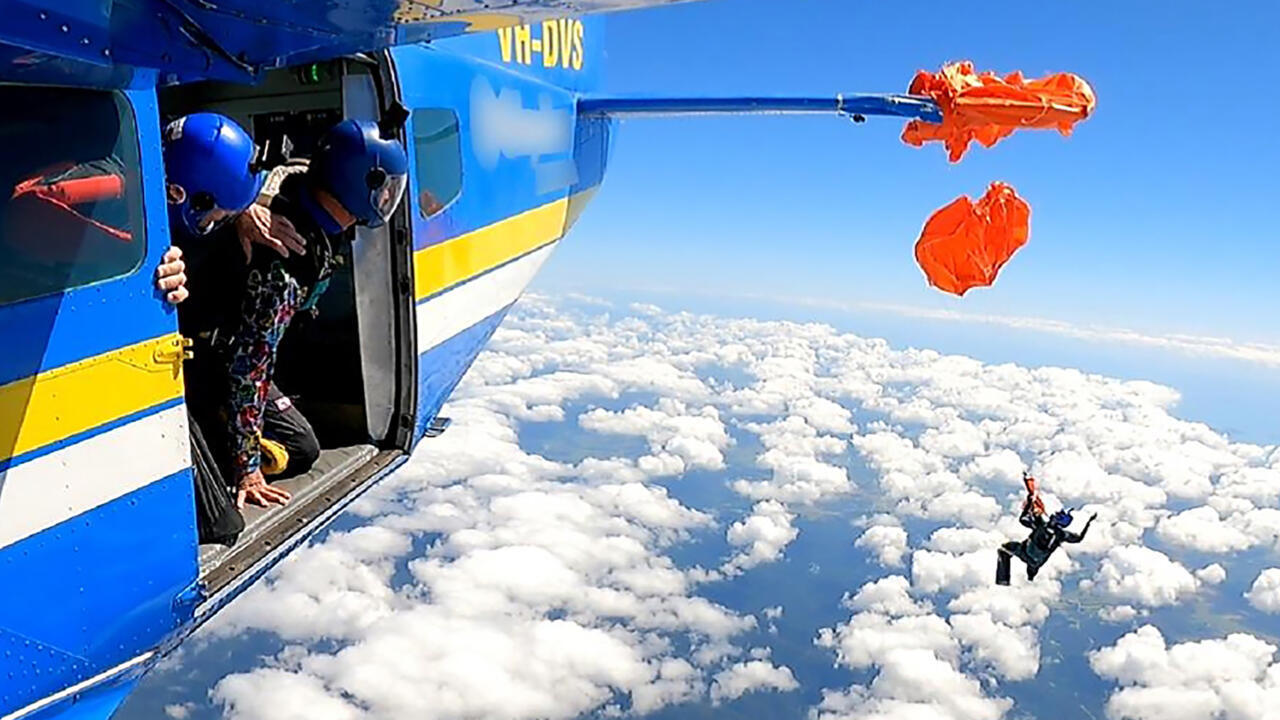
A dramatic mid-air emergency above Queensland, Australia, has drawn international attention after a skydiver survived an almost unimaginable ordeal at 15,000 feet. What was intended to be a routine group jump turned into a life-threatening emergency when the skydiver’s parachute unexpectedly deployed and became entangled on the aircraft’s wing, leaving him dangling beneath the plane as it continued flying.
The terrifying sequence, captured on video, offers a rare look into how quickly a controlled skydive can spiral into danger and how a combination of training, equipment, and sheer presence of mind saved a life. Investigators say the incident underscores long-standing safety principles that, when followed, can mean the difference between catastrophe and survival. With a damaged aircraft, a suspended skydiver cutting through tangled lines, and a pilot struggling to maintain control, the event serves as one of the most striking reminders in recent years of the risks inherent to high-altitude parachuting.
Unexpected Deployment and Sudden Danger
The incident unfolded on 20 September above Tully Airport in Queensland when a group of 17 experienced parachutists prepared for a complex 16-way formation jump from a Cessna Caravan aircraft. Conditions were normal and the jump sequence began as planned. However, tragedy nearly struck moments after the first skydiver exited the aircraft. As he moved out of the doorway, the grey handle of his reserve parachute accidentally caught on part of the plane and triggered an unintentional deployment. The abrupt force of the opening canopy flung him backwards, slamming his legs into the plane’s wing and sending him into a helpless suspension beneath the aircraft.
The deployed parachute rapidly wrapped itself around the stabiliser of the plane. With the canopy lines tightly constricting the tailplane, the skydiver found himself dangling in open air with only the tangled parachute attaching him to the aircraft. The Australian Transport Safety Bureau (ATSB) noted in its report that the parachute’s entanglement created an immediate aerodynamics problem for the pilot. The rear of the aircraft suddenly lifted, causing a pitch-up and a stark reduction in airspeed. Although the other parachutists continued exiting, two remained in the doorway, stunned at the unfolding emergency.
Initially, the pilot believed the aircraft had simply stalled. Reacting instinctively, they added power in an attempt to regain stability. Only after being alerted to the presence of a skydiver attached to the tailplane did the pilot reduce power again, recognising the gravity of the situation. Even at 15,000 feet, there was little time to respond and even less room for error. The plane’s performance was compromised, visibility from the cockpit was limited, and any aggressive manoeuvres could place the skydiver at greater risk.
NEW: Skydiver's parachute gets caught on the tail of a plane, leaving him dangling 15,000 feet in the air over North Queensland, Australia.
— Collin Rugg (@CollinRugg) December 11, 2025
As the parachutist climbed out of the plane, his reserve parachute handle got snagged on a wing flap.
The parachute then deployed and… pic.twitter.com/oVxiOl8bWN
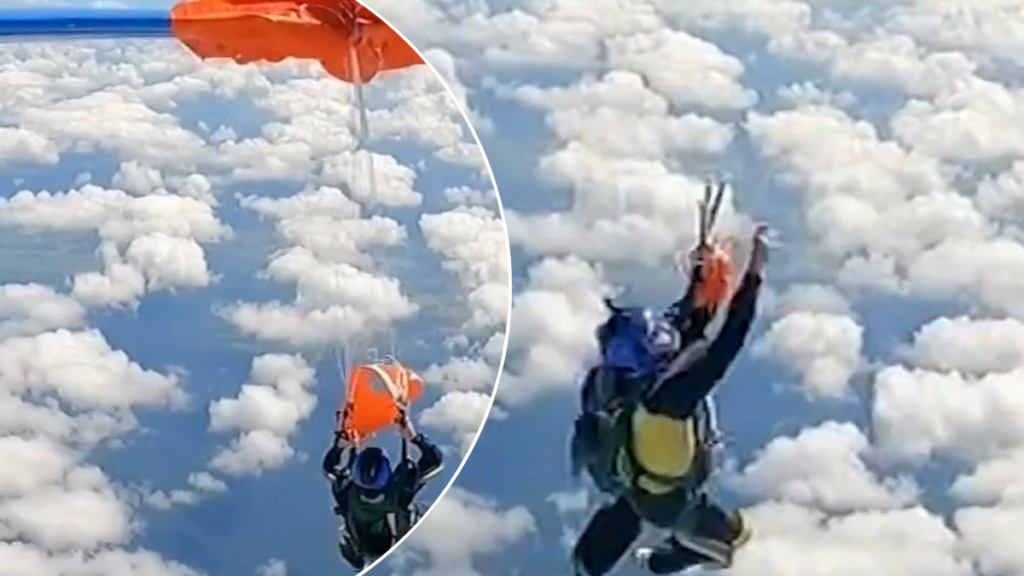
Meanwhile, suspended in mid-air, the skydiver attempted to act. Training dictates that whenever a premature deployment occurs, the priority is to regain independence from the aircraft. Equipped with a hook knife, he began slicing through the reserve parachute lines. This was no easy task—only 11 of the lines could be cut safely, leaving a portion still wrapped around the stabiliser. Yet cutting these lines was enough to free his body from the aircraft’s direct hold, allowing him to eventually release his main parachute.
This deployment occurred even as he remained tangled in some of the reserve lines, demonstrating both the complexity and the delicacy of the situation. Though battered and shaken, the skydiver descended under canopy and managed to land safely. According to the ATSB, he sustained only minor injuries, marking what investigators have called a truly miraculous outcome.
Pilot’s Struggle to Land a Damaged Aircraft
While the skydiver focused on survival thousands of feet below, the crisis in the cockpit was far from over. With the parachutists clear of the aircraft, the pilot faced the daunting challenge of controlling a plane with a severely compromised tailplane. Part of the reserve parachute remained wrapped around the stabiliser, restricting pitch control and altering the aircraft’s response to control inputs. In effect, the pilot had limited authority over ascent, descent, and general stability.
The situation was serious enough that the pilot declared a mayday to Brisbane Centre air traffic control. They reported minimal control of the aircraft and prepared for the possibility that they might need to abandon the plane mid-flight. The pilot was wearing an emergency parachute and mentally rehearsing the possibility of bailing out if the plane’s control deteriorated further. The prospect of a pilotless aircraft over inhabited areas is a nightmare scenario, yet remaining onboard carried its own grave risks.
Read : Skydiving Instructor Justin Robert Fuller Dies After Falling from Sky Without Parachute
As the aircraft descended through approximately 2,500 feet, the pilot reassessed the situation. They determined they still possessed enough pitch and throttle control to attempt a landing. The remaining parachute material on the tailplane created unpredictable handling, but the aircraft was responsive enough to maintain controlled flight. Carefully managing speed and descent rate, the pilot guided the damaged aircraft back toward the airfield.
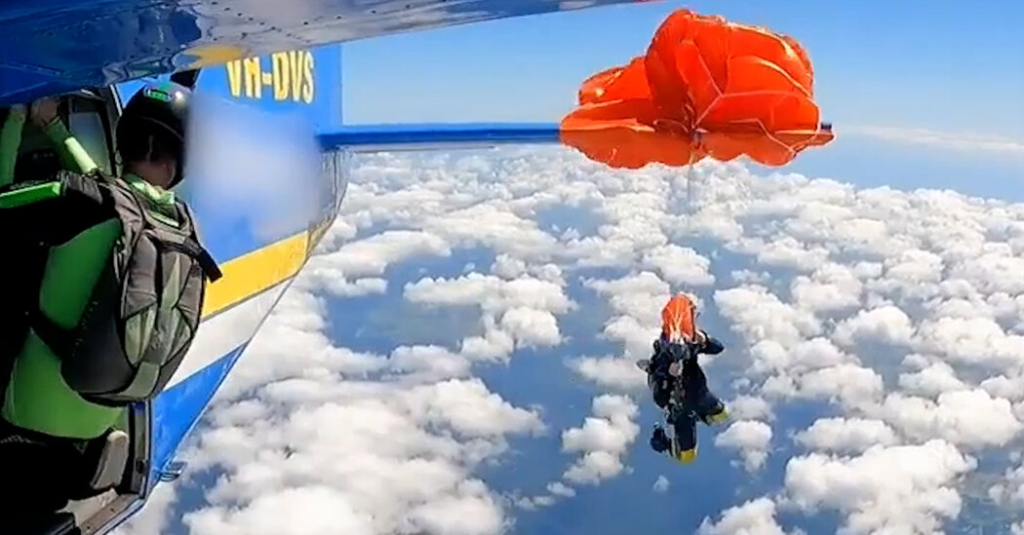
Against all odds, the landing was successful. The Cessna touched down safely, bringing an end to one of the most dramatic skydiving-related aviation emergencies documented in recent years. ATSB Chief Commissioner Angus Mitchell later noted that the pilot’s actions demonstrated remarkable composure and adherence to emergency protocols. Without steady judgement and precise inputs, the outcome could have been far worse.
Investigators also highlighted that the incident illustrated the compounding nature of aviation emergencies. A single equipment snag not only endangered the skydiver but also jeopardised the stability of the aircraft and the safety of everyone onboard. The chain of events required simultaneous decision-making by individuals facing entirely different sets of pressures—one hanging from a plane and cutting himself free, and another fighting to keep a damaged aircraft airborne.
The aircraft itself showed visible structural damage around the stabiliser, confirming how significant the drag and twisting force from the tangled parachute had been. Even with that damage, the successful landing underscored the robustness of the Cessna design and the importance of pilot training in handling abnormal situations.
Lessons and Safety Warnings Issued After the Incident
Following a full investigation, the ATSB issued important guidelines for parachutists, pilots, and operators to prevent similar incidents in the future. While premature deployments are rare, they remain one of the most dangerous events that can occur during skydiving operations. The agency emphasised that skydivers must be constantly mindful of the location of the handles on their rigs, especially when moving through tight aircraft exits. Even minor contact or brushing against the aircraft interior can lead to an accidental deployment, as seen in this case.
Read : 32-Year-Old Jade Damarell Deliberately Dies in Skydiving Accident Despite Experience
Another major recommendation revolved around equipment. The hook knife that the skydiver used to cut through his reserve lines was described by investigators as genuinely life-saving. Without it, he would likely have remained attached to the aircraft until it descended dangerously low or endured more severe injuries during his eventual separation. As such, the ATSB reaffirmed the importance of carrying a hook knife in accessible locations on skydiving rigs. This tool, often overlooked, has proven to be critical during line entanglements, premature deployments, and other unforeseen emergencies.
The ATSB statement also addressed aircraft loading and weight distribution. While not a factor in this particular incident, previous fatal accidents have occurred when skydiving aircraft were loaded outside their centre-of-gravity limits. Parachutists moving in the aircraft, particularly in larger groups, can shift weight distribution and create hazardous conditions if not managed carefully. Operators were urged to conduct precise weight and balance calculations for every flight, regardless of how routine the jump may seem.
The broader safety message from the ATSB focused on the unpredictable nature of skydiving operations. Even with experienced jumpers and pilots, well-maintained aircraft, and favourable weather, risks can emerge suddenly. The difference between survival and disaster often comes down to training, equipment, and calm responses under pressure. This incident demonstrated each of these factors in action: the skydiver remembered his emergency procedures, the pilot managed the aircraft with discipline, and both trusted in the equipment available to them.
While the video of the incident has been widely shared, experts caution that spectators may underestimate just how close the situation came to a fatal outcome. A parachute wrapped around a stabiliser can cause an aircraft to pitch uncontrollably, especially if power settings change abruptly. The skydiver’s body weight, suspended beneath the plane, also generated drag that the aircraft was not designed to accommodate. Any sudden shift could have torn the stabiliser or caused the aircraft to enter an unrecoverable stall.
The survival of both the skydiver and the pilot is therefore seen as a testament to the effectiveness of safety protocols that have been developed over decades. It also reinforces the need for continuous vigilance in adventure sports where even momentary lapses can lead to cascading dangers. The ATSB’s recommendations aim to ensure that parachutists and operators learn from this incident rather than dismiss it as a one-off anomaly.
In the end, the Queensland skydiver’s story stands as one of the rare instances in which a catastrophic chain of events was broken by quick thinking and the proper use of emergency tools. It will likely be studied in safety briefings and training sessions for years to come, serving as both a warning and an example of how preparedness can turn a near-tragedy into a story of survival.
Typhu88vips, alright! Let’s see if I can finally hit that jackpot. Been playing a while, due for a good win I reckon! Ready to roll! typhu88vips