
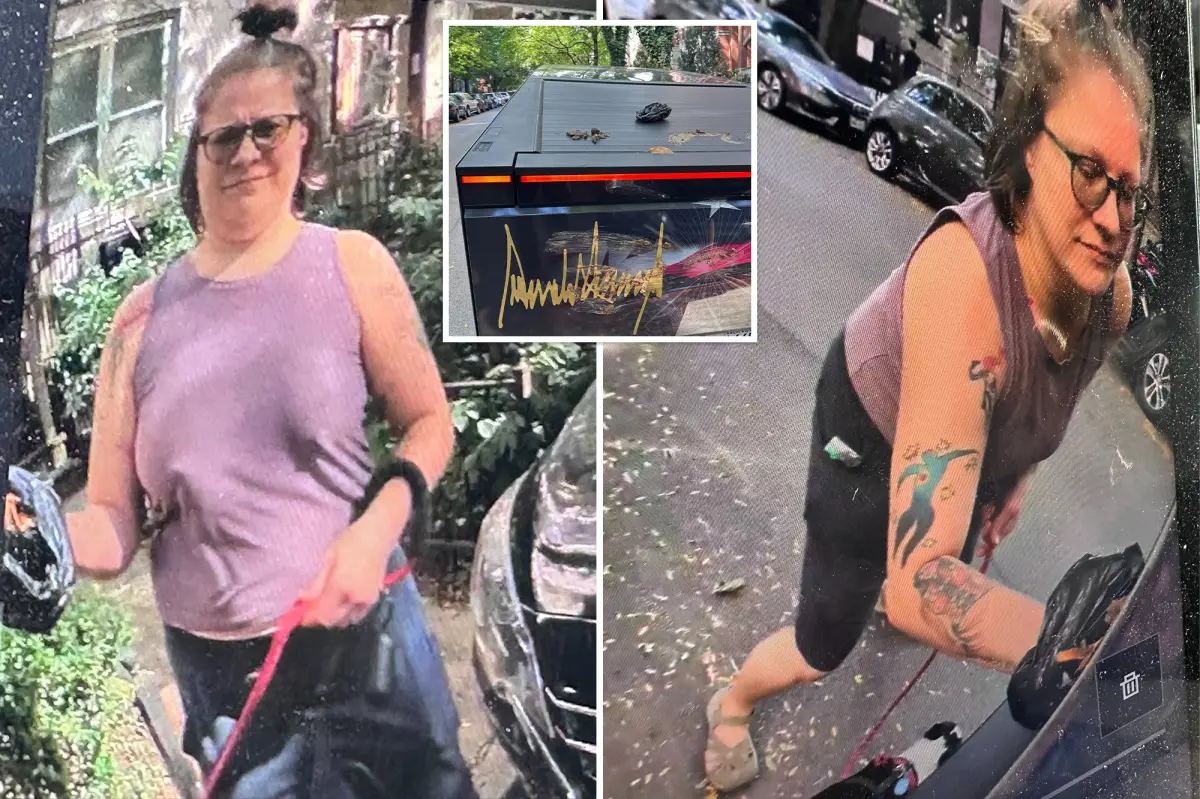
In a bizarre act of apparent political vandalism, a Chicago Woman Caught Smearing Dog Poop on Trump-Themed Tesla Cybertruck parked in the city’s Northalsted neighborhood. The incident, which unfolded on Wednesday, October 1, 2025, has ignited a firestorm of online outrage, swift identification by internet sleuths, and questions about the intersection of political fervor and public behavior.
The vehicle’s owner, John Evans, a visitor from Savannah, Georgia, shared footage from the Cybertruck’s built-in cameras, exposing the act in vivid detail. As of October 5, no charges have been filed, but the backlash has already reverberated through social media and local business circles. The event highlights escalating tensions in an already polarized election season, where symbols of support for former President Donald Trump have become flashpoints for confrontation.
Evans, attending a conference in Chicago, left his distinctive vehicle parked on a public street, only to discover the defacement upon his return. What began as a personal affront quickly escalated into a viral story, amassing tens of thousands of views and shares within hours. Authorities have been notified, but Evans has opted against pursuing a formal police report, citing the severity of other crimes demanding law enforcement’s attention.
The Shocking Act Captured on Camera
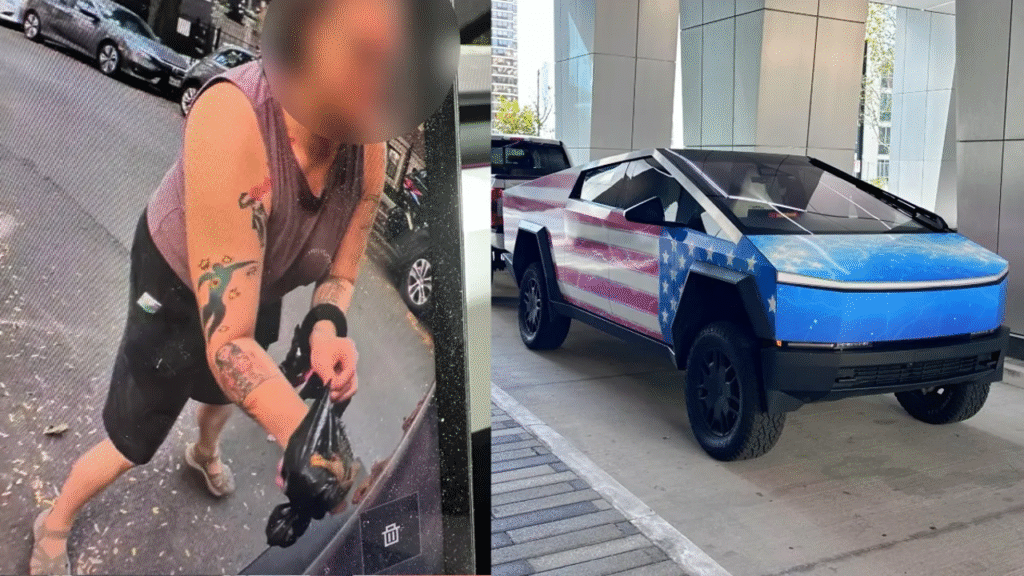
The Cybertruck in question stands out even among the angular, stainless-steel behemoths produced by Tesla. This particular model, owned by John Evans, features a custom wrap mimicking the American flag, with stars and stripes cascading across its polygonal body. The most prominent element—and likely the trigger for the vandalism—is a gold-leaf replica of Donald Trump’s signature emblazoned on the tailgate, a bold declaration of allegiance to the former president and current Republican frontrunner. Evans, a vocal Trump supporter, had the vehicle customized in Savannah to reflect his patriotic leanings, turning it into a rolling billboard for his political views.
On the afternoon of October 1, while Evans was inside a nearby conference center in Chicago’s vibrant Northalsted district—known for its LGBTQ+ community, bustling nightlife, and progressive leanings—the vehicle sat unattended on a side street. Northalsted, often called Boystown, is a hub of cultural diversity and activism, where political expressions are commonplace but rarely devolve into outright sabotage. Tesla’s Cybertruck, with its futuristic design and autonomous features, already draws stares; this one’s thematic flair amplified its visibility.
Surveillance footage from the Cybertruck’s multiple external cameras provided an unblinking record of the incident. At approximately 2:15 p.m., a woman in her mid-40s approached the rear of the vehicle. Dressed in casual athletic wear—a gray hoodie, black leggings, and sneakers—she carried a small plastic bag, the kind commonly used for pet waste. Without hesitation, she extracted a handful of dog feces from the bag and methodically smeared it across the tailgate, focusing intently on the Trump signature. The act lasted less than 30 seconds; she wiped her hands on her pants, glanced around briefly, and strolled away down the sidewalk as if nothing had occurred.
Caught on camera in Chicago: A woman wipes dog poop on a Tesla Cybertruck wrapped in an American flag with Trump’s signature. The owner, visiting from Savannah, says internet sleuths quickly identified her. MORE: https://t.co/lb3Vxn4jAj 📸 @jeeotus pic.twitter.com/4BQvbUYCKl
— FOX 32 News (@fox32news) October 2, 2025
Evans reviewed the footage later that evening, stunned by the deliberate nature of the vandalism. “It was so calm, so calculated,” he later recounted in a post on X, the platform formerly known as Twitter. “She didn’t run or look panicked—she just did it and kept walking.”
The video, shared as a series of still images and clips under his handle @jeeotus, revealed the woman’s face clearly, including distinctive tattoos on her arms and a noticeable posture that would soon aid in her identification. The defacement left a foul residue on the gold-leaf lettering, requiring professional detailing to restore the surface. Cleaning costs, while not publicly disclosed, are estimated in the hundreds of dollars, a minor expense compared to the emotional toll on the owner.
This wasn’t a random act of mischief. Evans believes the Trump branding was the clear motivator, pointing to the woman’s focused targeting of the signature. In a city like Chicago, where Democratic strongholds dominate and Trump memorabilia can provoke strong reactions, such incidents underscore a broader trend of symbolic attacks on political displays. Similar reports have surfaced nationwide, from defaced yard signs to slashed tires on vehicles bearing campaign stickers, but the use of animal waste adds a layer of visceral disgust to this case.
Swift Online Identification and Business Fallout
The power of social media turned a private grievance into a public reckoning almost overnight. By 8 p.m. on October 1, Evans’s initial X post had garnered over 10,000 views. Within hours, it exploded to more than 75,000 likes and 20,000 reposts, fueled by algorithms favoring controversial content. Users flooded the thread with tips, photos, and accusations, transforming the platform into a digital detective agency.
Prominent among the responders were self-proclaimed “sleuths” who cross-referenced the woman’s appearance with public profiles. By Thursday morning, October 2, a consensus emerged: the suspect was Dorothy Owen, a 46-year-old co-owner of Renegade Dog Services, a Chicago-based dog walking and daycare operation located in the Lake View area, just blocks from the incident site. Owen’s business specializes in pet care for urban dwellers, offering services like group walks and overnight boarding. Her professional photos on the company’s website and Instagram matched the video stills—tattoos, build, and even the sneakers aligned perfectly.
The identification snowballed into coordinated action. Negative reviews poured into Renegade Dog Services’ Google and Yelp pages, dropping its rating from a solid 4.8 stars to below 3.0 within 48 hours. Comments ranged from pointed critiques—”If this is how you handle ‘waste,’ how do you handle pets?”—to outright condemnations tying the alleged act to the business’s ethos. One reviewer wrote, “Boycotting until accountability is shown. Politics aside, this is unacceptable behavior.” The influx prompted temporary moderation of the review sections, but the damage was done; inquiries for services reportedly plummeted by 40%, according to anonymous staff sources.
Renegade Dog Services responded indirectly via its Instagram account, posting a cryptic meme on October 3 that appeared to lampoon the situation. The image depicted a disheveled figure with exaggerated features, captioned: “Let’s be honest, that could be anyone’s sh–ty tattoos and saggy t-ts. #f–kmontana #f–ktrump #f–kice.” The post, which garnered hundreds of angry replies before being deleted, only intensified the scrutiny. Owen has not publicly addressed the allegations, and attempts to reach her for comment through the business line went unanswered as of October 5. Chicago police confirmed they received a tip about the incident but classified it as a low-priority misdemeanor vandalism case, with no arrest warrant issued.
The episode exemplifies the double-edged sword of online vigilantism. While it delivered rapid accountability, it also raised concerns about doxxing and reputational harm without due process. Evans praised the community’s response, noting in a follow-up post: “America is happy to help other Americans with accountability for bad actors.” Yet, he stopped short of endorsing the review-bombing, emphasizing that the goal was awareness, not destruction.
Owner’s Perspective and Lessons in a Divided Nation
John Evans, a 52-year-old entrepreneur from Savannah, Georgia, embodies the Cybertruck’s target demographic: affluent, tech-savvy, and unapologetically conservative. His decision to theme the vehicle around Trump reflects a deeper commitment to the MAGA movement, which he credits with revitalizing American manufacturing—Tesla’s domestic production chief among them. “This truck isn’t just transportation; it’s a statement,” Evans told local reporters via phone on October 3. “Elon Musk built it in America, and Trump’s policies made that possible.”
The vandalism struck a personal chord for Evans, who described the discovery as “gut-wrenching.” Returning from his conference, he noticed the smeared tailgate immediately, the stench alerting him before the visuals did. Rather than rage, he channeled his energy into documentation, uploading the footage to X with a measured caption: “Caught this in Chicago today. Thoughts?” The response validated his restraint; supporters flooded his mentions with encouragement, while critics debated the merits of public political displays.

Evans’s refusal to file a police report underscores his pragmatic worldview. “Cops have real problems—shootings, thefts, not dog poop on a truck,” he explained. “The internet handled this better than any courtroom could.” He views the backlash as a form of communal justice, aligning with his belief in personal responsibility over institutional intervention. To the alleged perpetrator, he offered a pointed olive branch: “We are Americans. You have an obligation to do better. This doesn’t solve anything; it makes it worse.”
Broader implications ripple beyond this single truck. In the lead-up to the 2026 midterms, incidents like this fuel narratives of incivility, with Trump allies decrying “left-wing extremism” and opponents highlighting unchecked MAGA provocation. Northalsted’s community leaders, while condemning the act, have called for de-escalation, noting the neighborhood’s history of fostering dialogue amid diversity. Evans echoed this in his final X update on October 4: “Hoping folks on both sides can learn to get along. We’re all in this together.”
As the story fades from viral feeds, the Cybertruck gleams anew, its signature restored. For Evans, the ordeal reinforces resilience; for Owen’s business, it’s a stark reminder of visibility’s perils. In Chicago’s concrete jungle, where politics and pets collide, this peculiar clash serves as a microcosm of national fractures—messy, malodorous, and ultimately, a call for cleaner discourse.