

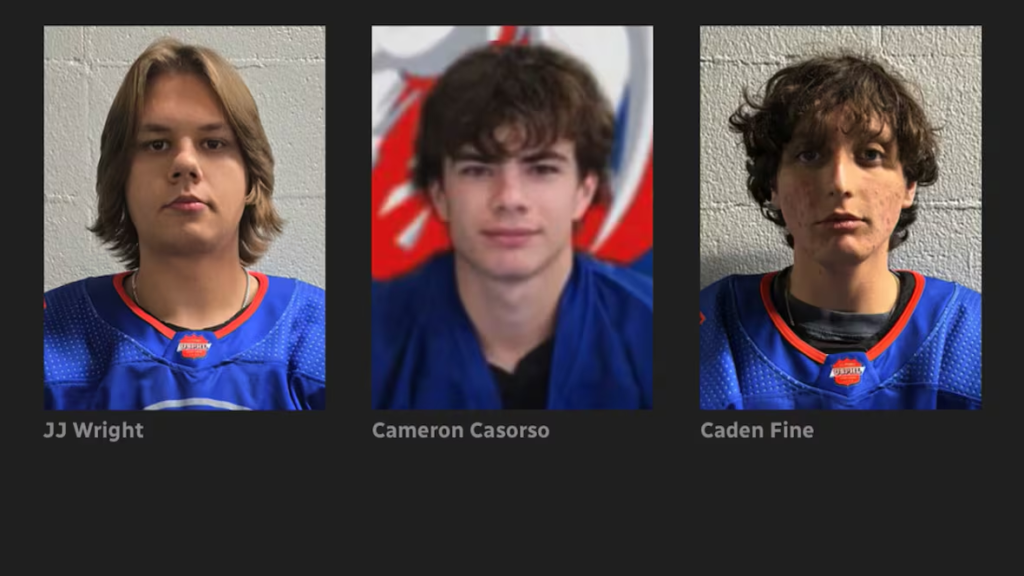
The Canadian junior hockey community is mourning the deaths of three Southern Alberta Mustangs players who were killed in a vehicle collision while travelling to practice early Monday morning. The tragedy occurred near Stavely, Alberta, and has sent shockwaves through local, national, and international hockey circles, uniting teams, families, and fans in collective grief. The loss of JJ Wright, Cameron Casorso, and Caden Fine has underscored both the close-knit nature of junior hockey and the profound impact such losses have beyond the rink, affecting multiple communities across Canada and the United States.
According to the Royal Canadian Mounted Police, the crash took place at an intersection along Highway 2, approximately an hour south of Calgary. The players were en route to a scheduled practice when their small passenger vehicle collided with a northbound semitruck hauling gravel. Wright and Casorso, both 18-year-olds from Kamloops, British Columbia, and 17-year-old Fine from Birmingham, Alabama, were pronounced dead at the scene. The driver of the semi, a 40-year-old man from Stavely, sustained minor injuries. Authorities have stated that the investigation remains ongoing.
As news of the crash spread, tributes and condolences poured in from across the hockey world, including statements from political leaders, professional hockey organizations, and grassroots associations. For many, the tragedy has drawn painful parallels to previous incidents involving junior hockey teams, reinforcing the emotional weight carried by such events within the sport.
Details of the Crash and Immediate Response
The RCMP confirmed that emergency responders were dispatched to the scene shortly after the collision was reported Monday morning. The crash occurred at a rural intersection, a type of roadway setting that has historically been associated with serious accidents involving commercial vehicles. Investigators reported that the semi was travelling northbound while the passenger vehicle was heading east when the collision occurred. No further details regarding fault or contributing factors have been released, pending the completion of the investigation.
The Southern Alberta Mustangs, a team competing in the United States Premier Hockey League, acknowledged the incident in a statement posted to Facebook. The organization said it was working closely with law enforcement and requested privacy for the families of the players as they navigate the aftermath of the loss. The statement emphasized that the three teenagers were more than athletes, describing them as deeply loved members of the Mustangs family and the communities they represented.
In Stavely, the impact of the tragedy was immediately visible. At the town’s arena, three white and red Mustangs jerseys bearing the players’ surnames were laid out on a table, accompanied by three upright hockey sticks arranged in a traditional memorial display. The scene became a focal point for community members seeking a space to grieve and reflect.
🚨 BREAKING: Three junior hockey players killed in Alberta crash ages 17, 18, and 18.
— Chet Rune (@ChetRune) February 3, 2026
The Southern Alberta Mustangs, a U.S. Premier Hockey League team based in Stavely, Alta., were travelling to a team practice when their vehicle collided with a semi-truck.
HEARTBREAKING. pic.twitter.com/BkVUmCkKGX
Alberta Premier Danielle Smith addressed the tragedy in a social media post, offering condolences to the families, teammates, and friends of the players. She described the loss as one felt by the entire provincial hockey community and expressed confidence that Albertans would rally around those affected in the days ahead. Her remarks echoed a broader sentiment expressed by many leaders: that junior hockey teams often function as extended families, making such losses particularly devastating.
Remembering JJ Wright, Cameron Casorso, and Caden Fine
JJ Wright and Cameron Casorso both hailed from Kamloops, British Columbia, a city with a strong hockey tradition and a history of developing young talent. The Kamloops Minor Hockey Association confirmed that both players spent the majority of their formative years within its system. Casorso began playing in the organization in 2012, while Wright joined in 2011. Each continued their development there through 2025 before advancing to junior hockey opportunities elsewhere.
In a public statement, the association noted that although Wright and Casorso began their journeys in Kamloops, they found a second hockey family with the Southern Alberta Mustangs. The organization described the players as teammates and friends to many, emphasizing the collective grief felt by the broader hockey community in Kamloops and beyond. The statement reflected the sense that player development in junior hockey is not only about athletic progression, but also about building lasting personal relationships.
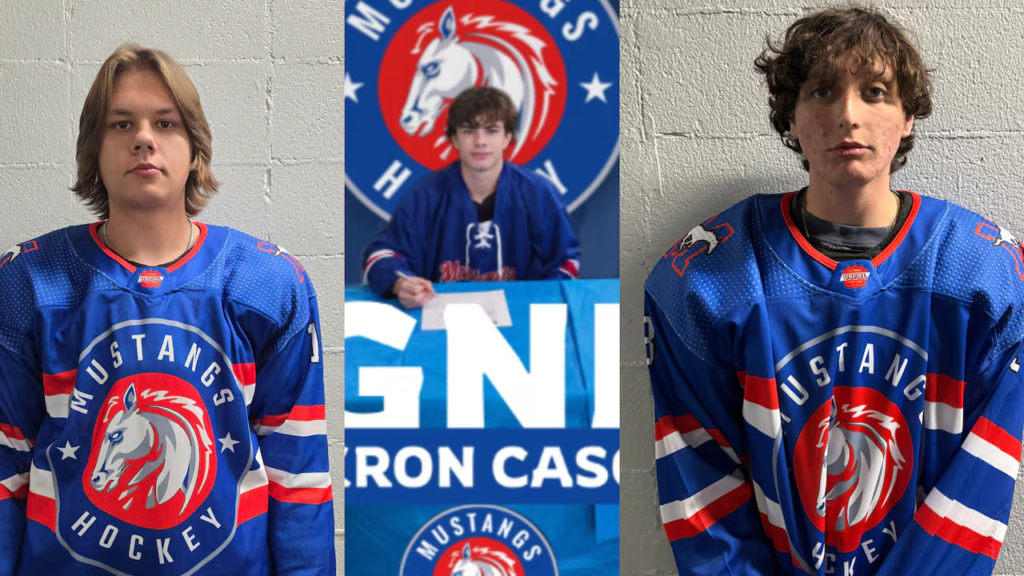
Caden Fine, the youngest of the three, was from Birmingham, Alabama, representing the increasingly international nature of junior hockey in North America. His presence on a Canadian-based team highlighted the sport’s reach beyond traditional hockey markets. Teammates and supporters described him as dedicated and passionate, traits that had helped him earn a place on the Mustangs roster despite coming from a region less commonly associated with elite hockey development.
The Calgary Flames, a National Hockey League team, also issued a message of support on social media, stating that its thoughts and prayers were with everyone who knew the players. Such gestures from professional organizations are common in the wake of junior hockey tragedies, reflecting the interconnectedness of the sport at all levels.
Across social media platforms, former teammates, coaches, and fans shared memories and messages of condolence. Many posts focused on the players’ character and work ethic, underscoring how junior hockey athletes often balance demanding travel schedules, training commitments, and personal development at a young age.
Impact on the Hockey Community and Historical Context
The deaths of the three Mustangs players have revived memories of one of the darkest moments in Canadian sports history: the 2018 Humboldt Broncos bus crash. In April of that year, 16 people were killed and 13 others injured when a bus carrying the Saskatchewan Junior Hockey League team was struck by a semitruck at a rural intersection near Tisdale, Saskatchewan. The Broncos were travelling to a playoff game at the time, and the incident prompted nationwide mourning, policy discussions on road safety, and a long-term outpouring of support for those affected.
Read : Turkmenistan Ice Hockey Players Punch Hong Kong Team After Match Loss At Asian Winter Games
Following the recent crash in Alberta, the mayor of Humboldt, Rob Muench, expressed condolences to the Mustangs and their community. In a Facebook post, he said Humboldt stood with the Alberta team as it mourned the loss, acknowledging the shared understanding that comes from having experienced a similar tragedy. His message reflected the enduring bond formed among hockey communities touched by loss.
Junior hockey occupies a unique place in Canadian culture, often serving as both a competitive stepping stone and a central social institution in smaller towns and cities. Teams frequently rely on long-distance travel to attend practices and games, increasing exposure to roadway risks. While such travel is an accepted part of the sport, incidents like this one bring renewed attention to the vulnerabilities faced by young athletes.
In the immediate aftermath of the crash, many organizations focused on supporting mental health resources for players, staff, and families. Hockey associations at various levels have historically emphasized the importance of counseling and peer support following traumatic events, recognizing that the emotional impact extends well beyond those directly involved.
The Southern Alberta Mustangs have not announced details regarding memorials or changes to their schedule, indicating that decisions will be made in consultation with families and league officials. In similar cases, teams have postponed games or dedicated seasons to honoring fallen teammates, though no such plans have yet been confirmed.
As the investigation continues, the focus for many remains on remembering JJ Wright, Cameron Casorso, and Caden Fine for who they were both on and off the ice. Their deaths have left a lasting void within their team and the broader hockey community, serving as a somber reminder of the fragility of life and the deep connections forged through sport.
Enjoyed studying this, very good stuff, thankyou. “If it was an overnight success, it was one long, hard, sleepless night.” by Dicky Barrett.