
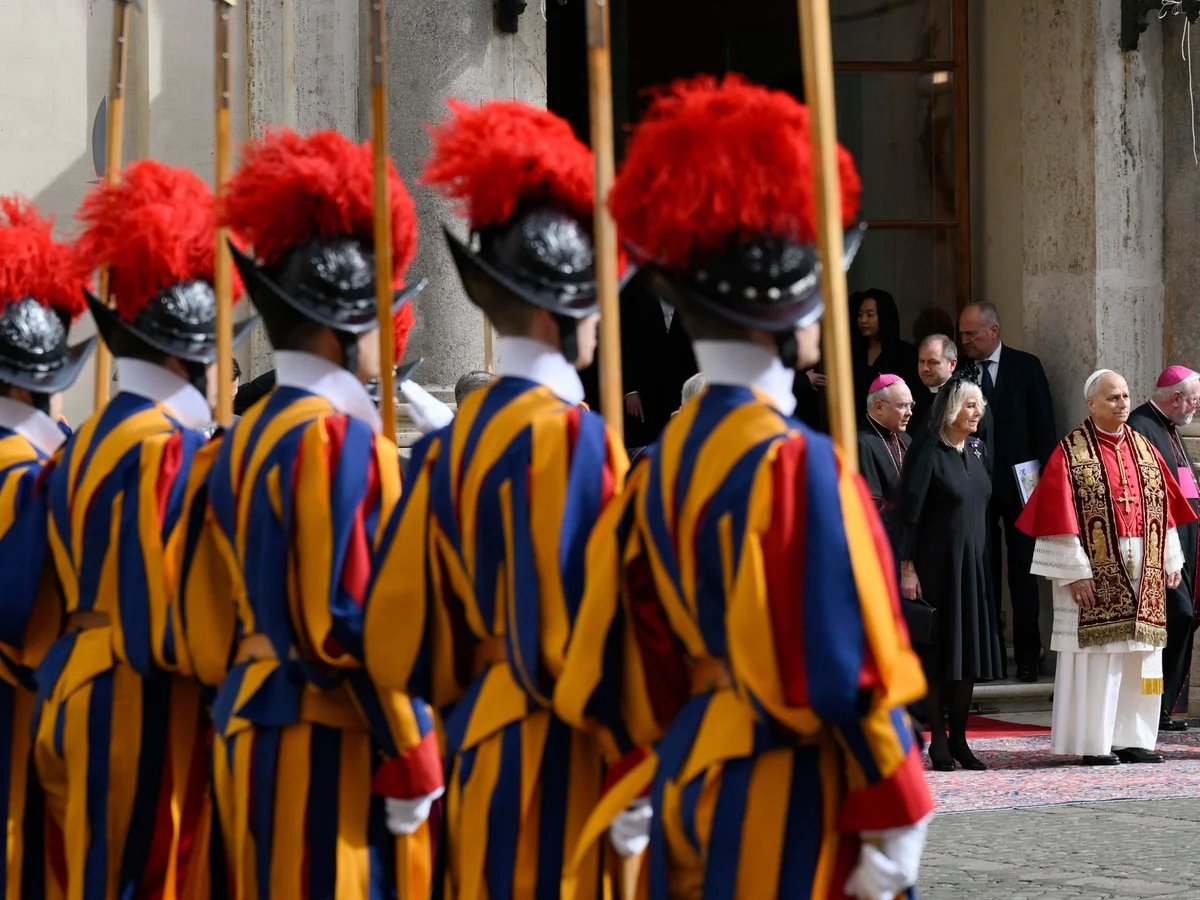
The Vatican has opened an internal investigation after a member of its elite Swiss Guard was accused of making an antisemitic remark and gesture toward two Jewish women attending a Papal audience marking the 60th anniversary of Nostra Aetate, a landmark Catholic document promoting interfaith dialogue.
The allegations have drawn attention not only because of their setting—the heart of the Catholic world—but also because they contrast sharply with the very message of mutual respect and tolerance being celebrated that day. The Vatican and the Swiss Guard have both confirmed that a procedural review is underway, as Jewish representatives express concern over what they describe as a deeply distressing encounter within the walls of the Holy See.
Allegations of Antisemitic Behavior in St Peter’s Square
According to accounts from the two women involved, Vivian Liska and Michal Govrin, the incident occurred on October 29 in St Peter’s Square, shortly before Pope Leo XIV’s address commemorating Nostra Aetate, the Second Vatican Council declaration that reshaped the Church’s relationship with Judaism and other faiths. Professor Liska, director of the Institute of Jewish Studies at the University of Antwerp, and Ms Govrin, an Israeli novelist and scholar, were part of an official Jewish delegation attending the event.
The women alleged that as they approached a guard post near the entrance from Rome into Vatican territory, the Swiss Guard on duty told them, “No photographs,” in response to their request to take a picture. Liska said the guard then muttered, “les Juifs” — French for “the Jews” — under his breath. When she confronted him about the comment, the guard denied having said it, responding, “No, I didn’t,” and, “You are lying.” Ms Govrin recalled that he then made a hissing sound “with deep contempt,” followed by what she described as a small spitting gesture in their direction.
Both women said they were stunned by what had taken place, especially given the occasion and setting. In a statement shared with Kathpress, a Catholic news agency, Govrin wrote, “We were totally shocked. Such an incident of Jewish hatred inside the Vatican?! In contrast to the Pope’s important words strongly condemning antisemitism and calling for collaboration and peace?!”
Read : Taiwan Urges China to Release Fishing Boat Detained by China’s Coast Guard
Following the incident, the women lodged a formal complaint with Vatican officials, who reportedly apologized and assured them that the matter would be investigated. Liska later told Italian daily La Repubblica that she received a call from a Swiss Guard officer who informed her that CCTV footage had been reviewed but did not conclusively show what the guard had said or done. The officer emphasized that the review aimed to ensure the professionalism of the guards on duty and that disciplinary measures would depend on the outcome of the inquiry.
Vatican and Swiss Guard Response to the Incident
The Swiss Guard, a centuries-old unit tasked with protecting the Pope and the Apostolic Palace, quickly acknowledged that one of its members was under investigation. Corporal Eliah Cinotti, spokesperson for the Guard, confirmed that a “procedural internal investigation” was underway “to be sure of the professionalism of the guards in service.” The Vatican, for its part, echoed this statement, adding that a preliminary reconstruction suggested the episode may have begun with a disagreement over taking photographs near a security checkpoint.
While the Vatican did not identify the guard involved, officials emphasized that the inquiry would be handled seriously and that the Holy See maintains a firm commitment to combating antisemitism. The Holy See has faced growing scrutiny over the past decade to ensure that its institutions fully reflect the Church’s stated doctrine of interfaith respect and inclusivity.
Read : Beloved Security Guard Nicola Tanzi Beaten to Death by 25-Year-Old David Mazariegos
Pope Leo XIV, who delivered a speech that same day marking Nostra Aetate’s anniversary, stressed that the Church “does not tolerate antisemitism and fights against it.” His address emphasized that the declaration, first promulgated in 1965 under Pope Paul VI, “opened up a new horizon of encounter, respect and spiritual hospitality” and “teaches us to meet the followers of other religions not as outsiders, but as travelling companions on the path of truth.”
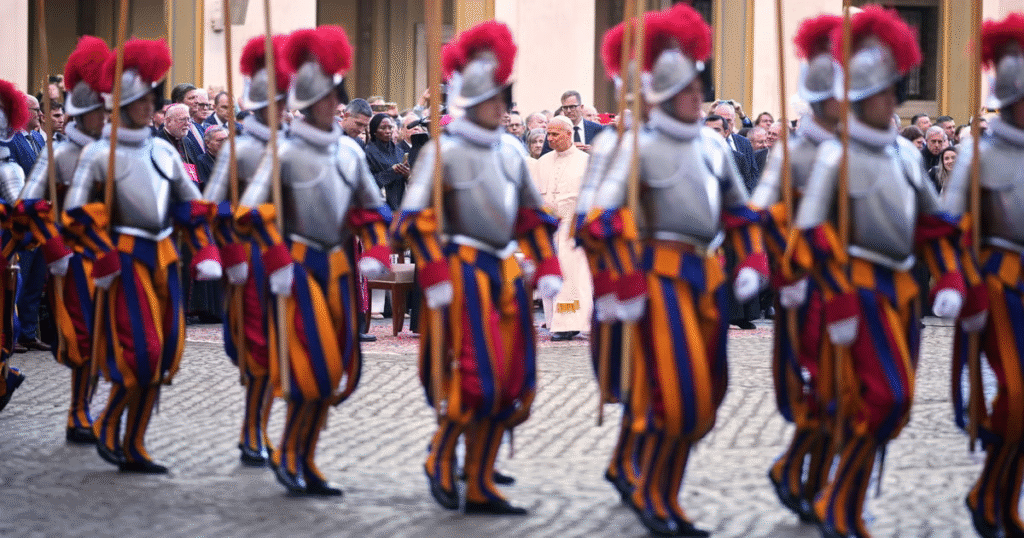
These remarks, meant to reaffirm Catholic–Jewish friendship, now carry an added resonance given the alleged conduct of one of the Vatican’s own guards during the same occasion. Although the Vatican has characterized the case as an isolated incident, Jewish organizations and interfaith observers have called for transparency and for measures ensuring that such behavior is not tolerated within the Holy See’s ranks.
Prof Liska, while condemning the incident, also noted that the wider experience of the anniversary events had been mixed. “It was a small thing on the part of a single individual,” she said in her remarks to La Repubblica, “and I don’t think it’s right for it to translate into a negative feeling about all those days. There were beautiful things that happened, as well as disappointing, irritating, and even worrying things.” Her statement reflected an effort to balance disappointment with recognition of the event’s broader significance.
Historical Context and Broader Implications for Interfaith Relations
The timing and symbolism of the incident have amplified its impact. Nostra Aetate, issued on October 28, 1965, represented one of the most profound shifts in modern Catholic teaching. It rejected the notion of collective Jewish guilt for the death of Jesus, acknowledged the shared heritage between Christianity and Judaism, and urged Catholics to engage with followers of other religions through dialogue and understanding. The document marked the beginning of a new era of cooperation and reconciliation between the Catholic Church and Jewish communities worldwide.
In the six decades since its release, Nostra Aetate has underpinned a growing partnership between the Vatican and Jewish institutions. Regular interfaith conferences, academic collaborations, and papal visits to synagogues have reinforced a mutual commitment to remembrance and peace, especially in the shadow of the Holocaust. However, incidents such as this one, however isolated, risk undermining those efforts by reminding observers that prejudices can persist even in places devoted to reconciliation.
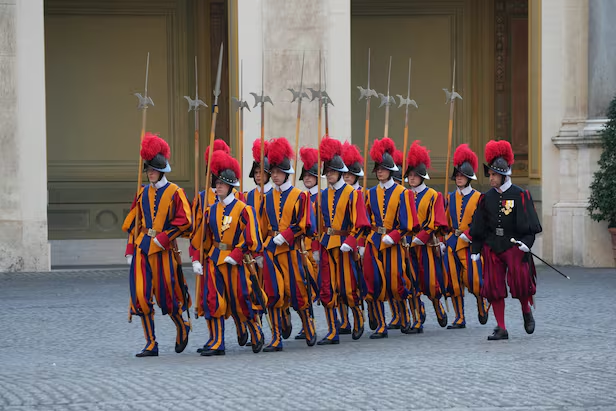
The Swiss Guard, an institution renowned for its ceremonial precision and strict discipline, is seldom associated with controversy. Established in 1506, the corps is composed primarily of young Swiss Catholics who swear loyalty to the Pope and serve both symbolic and security functions. Members undergo rigorous training and are expected to exemplify the moral and ethical values of the Vatican. For this reason, the current allegations have come as a shock to many within the Church, prompting reflection on internal conduct standards and cultural awareness among Vatican personnel.
Read : 22-Year-Old Channay Augustus Charged with Assaulting Security Guard at Britannia International Hotel
Jewish leaders and interfaith advocates have expressed hope that the Vatican’s swift response will reinforce its commitment to Nostra Aetate’s principles rather than detract from them. They have urged transparency in the investigation and encouraged continued dialogue to prevent similar misunderstandings or acts of hostility. Some observers have also noted that the guard’s alleged use of the term “les Juifs” — in French, the language historically associated with both Catholic diplomacy and European antisemitism — added a particularly sensitive dimension to the case.
Within the Vatican, awareness of antisemitism and interreligious relations has evolved considerably over the decades. Popes John Paul II, Benedict XVI, Francis, and now Leo XIV have all emphasized that antisemitism is incompatible with Christian teaching. John Paul II’s visit to the Rome synagogue in 1986, where he referred to Jews as the Church’s “elder brothers,” remains a milestone in this relationship. More recently, Pope Francis has repeatedly denounced antisemitism as “a virus that must be eliminated from society.”
Against that backdrop, any incident perceived as antisemitic within Vatican walls inevitably attracts intense scrutiny. Analysts suggest that the Vatican’s handling of the current case will be viewed as a test of its internal accountability and its commitment to upholding the values it publicly promotes. For many within both the Catholic and Jewish communities, the key issue is not whether one guard behaved improperly, but how the institution responds to allegations that contradict its moral teachings.
The event also comes amid rising reports of antisemitic behavior across Europe, linked in part to growing political polarization and global conflicts. Religious leaders have increasingly called for solidarity against hate speech and discrimination of all kinds. In this context, the Vatican’s ability to demonstrate zero tolerance for prejudice within its own ranks could serve as a broader moral example.
Pope Leo XIV’s commemoration of Nostra Aetate was intended to highlight the Church’s enduring commitment to respect and dialogue among faiths. “We are called to honor our differences while affirming our common humanity,” he told the assembled crowd. For attendees like Liska and Govrin, those words took on personal significance after their confrontation, underscoring the ongoing challenge of ensuring that ideals proclaimed from the pulpit are consistently reflected in daily interactions.
The investigation into the Swiss Guard’s behavior continues, with no public indication yet of disciplinary outcomes. Vatican officials have reiterated that they will “act according to the truth of the facts established,” and that the Holy See remains firmly opposed to any expression of intolerance or discrimination. As inquiries proceed, observers within the Vatican and beyond will watch closely to see whether this moment becomes an uncomfortable footnote—or an opportunity for renewed reflection on the Church’s pursuit of understanding and unity among all people.
Somebody necessarily assist to make severely posts I might state.
That is the first time I frequented your website page and to this point?
I surprised with the analysis you made to create this actual put up incredible.
Magnificent activity!