
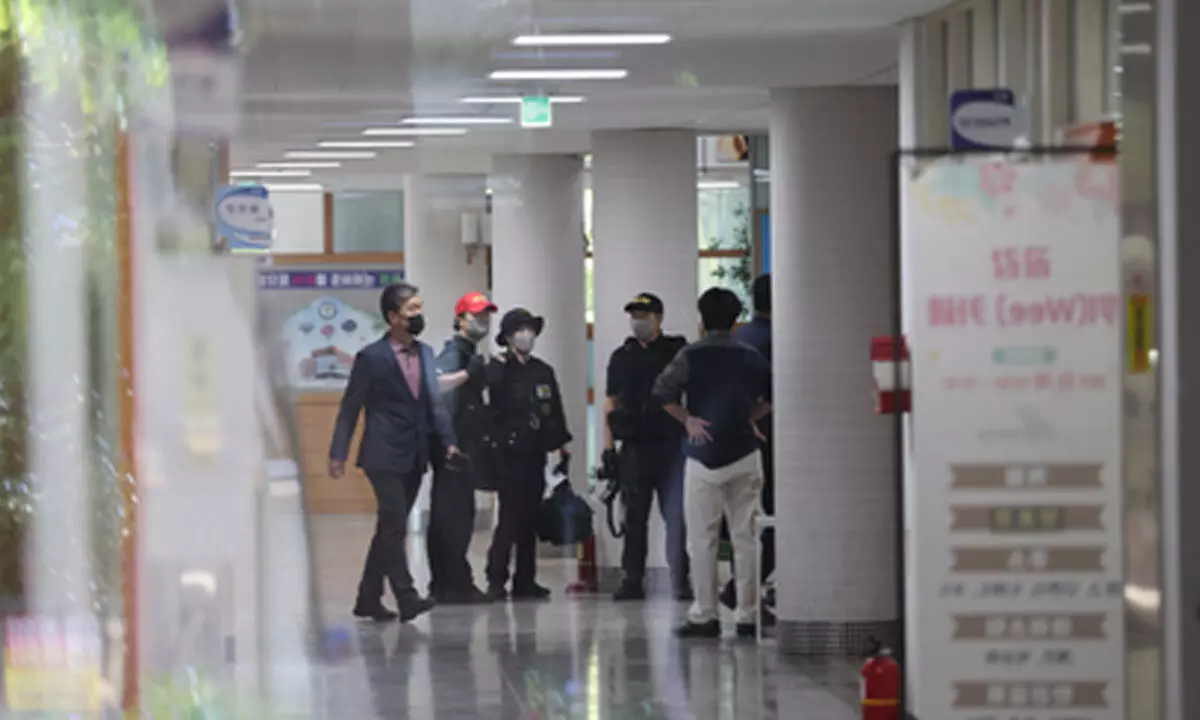
In a shocking act of violence that has gripped South Korea, an 18-year-old student enrolled in a special education program attacked six staff members at a high school in Cheongju, located 110 kilometers south of Seoul.
The tragic incident, which unfolded on Monday morning, has renewed concerns about the growing number of violent crimes in a country historically known for its low crime rate. Though no students were injured, the event left deep emotional scars within the school community and beyond.
Stabbing at High School in Cheongju
At approximately 8:40 am local time, as the school day was beginning, chaos erupted within the walls of the special education building. The student, whose identity has been withheld due to privacy laws, reportedly wielded a knife and began attacking teachers and staff members seemingly at random.
According to state news agency Yonhap, the victims included the principal and several faculty members who sustained injuries to the face, abdomen, and other body parts.
Emergency responders quickly arrived at the scene, transporting the injured to nearby hospitals. Although the injuries ranged from minor to serious, none of the victims were reported to be in critical condition. Authorities confirmed that no students were harmed during the rampage, a fact that brought a small measure of relief amidst the unfolding tragedy.
Witnesses at the school described scenes of fear and confusion. Some staff members attempted to shield others, while students, alerted by alarms and shouting, were evacuated or locked down in classrooms. “It was terrifying,” said one teacher who managed to avoid injury. “We are trained for emergencies, but you never truly expect something like this to happen.”
Early reports suggest that the suspect had a documented intellectual disability and was participating in a specialized program tailored for students requiring additional support.
Read : South Korea: Land of the Morning Calm
However, it remains unclear what may have triggered such a violent outburst. Authorities have stated that the investigation will include a thorough psychological assessment to better understand the student’s motives and state of mind leading up to the attack.
The Chase and Rescue:
Following the attack, the student fled the school premises, heading toward a nearby lakeside park. In an apparent attempt to evade capture or perhaps out of panic, the suspect jumped into a reservoir within the park. Local media reported that a passerby, surnamed Kim, encountered the student during the escape and sustained a head injury in the encounter.
Police and emergency teams responded rapidly to the unfolding situation. Within 12 minutes of the stabbing attack, authorities had located the student in the reservoir. Rescue teams managed to pull the individual from the water and immediately transferred them to a hospital for medical evaluation.

The rescue operation, though successful, added another layer of tension to an already harrowing morning. Concerns initially swirled about the student’s physical condition following the jump into the reservoir, but subsequent reports indicated that the suspect survived and is currently under medical and police supervision.
Investigators are now piecing together the timeline of events, examining surveillance footage from the school and nearby areas, and interviewing witnesses. The police emphasized that understanding the student’s motive is a priority, particularly given the vulnerable context of special education students. They are also investigating whether there were any warning signs or previous behavioral issues that may have gone unaddressed.
The Cheongju stabbing incident has reignited debates in South Korea about how to better support individuals with intellectual disabilities and mental health challenges within the educational system, ensuring both their well-being and the safety of the broader community.
A Pattern of Violence Amidst Low Crime Rates
While South Korea continues to boast a low murder rate of 1.3 per 100,000 people—well below the global average—the country has experienced a series of high-profile violent crimes in recent years. These incidents, often shocking in their brutality, have raised alarms about societal pressures, mental health awareness, and gaps in preventive care.
Just three months prior to the Cheongju incident, another tragedy struck when a teacher fatally attacked an eight-year-old student at an elementary school in Daejeon. That heartbreaking case had already spurred calls for greater vigilance and support systems within schools. Yet the Cheongju stabbing serves as a grim reminder that the threat of violence has not abated.
Only last week, a 33-year-old man was arrested for fatally stabbing a woman and injuring another shopper inside a supermarket, reportedly after consuming soju. One victim, a woman in her 60s, suffered a heart attack following the attack and died at the hospital, while a store employee was also injured.
Other recent violent episodes include a subway station stabbing that resulted in one death and three injuries, an attack on another high school teacher, and a terrifying rampage in the Bundang area, where an assailant drove into pedestrians before attacking shoppers with a knife.

Experts point to a complex mix of factors behind this worrying trend. South Korea’s competitive societal culture, long working hours, social isolation, and insufficient mental health resources have been cited as contributing to a rise in stress-related and violent behaviors. Moreover, there remains a strong stigma surrounding mental health issues, making it harder for individuals to seek help before their conditions worsen.
The Cheongju case has highlighted the delicate balance required in supporting students with special needs. While inclusion programs are essential for fostering equal opportunities, there is now renewed scrutiny on the level of monitoring and intervention available for students showing signs of severe emotional or behavioral disturbances.
Schools across the country are expected to review and possibly strengthen their emergency response protocols following this incident. Discussions are also underway about increasing funding for school counselors, improving teacher training in dealing with crises, and enhancing collaboration with mental health professionals.
Parents and educators alike are calling for a national conversation about violence prevention, the treatment of intellectual disabilities within mainstream settings, and the urgent need to destigmatize seeking psychological help.
Meanwhile, in Cheongju, the community is grappling with the aftermath of the attack. Messages of support for the injured staff members have poured in from across South Korea, and counseling services have been made available for students and faculty traumatized by the event.
The road to recovery will be a long one, not only for those physically harmed but also for an education system and a society seeking to understand how such violence can be prevented in the future. As the investigation continues, many hope that meaningful change will emerge from this painful chapter.