
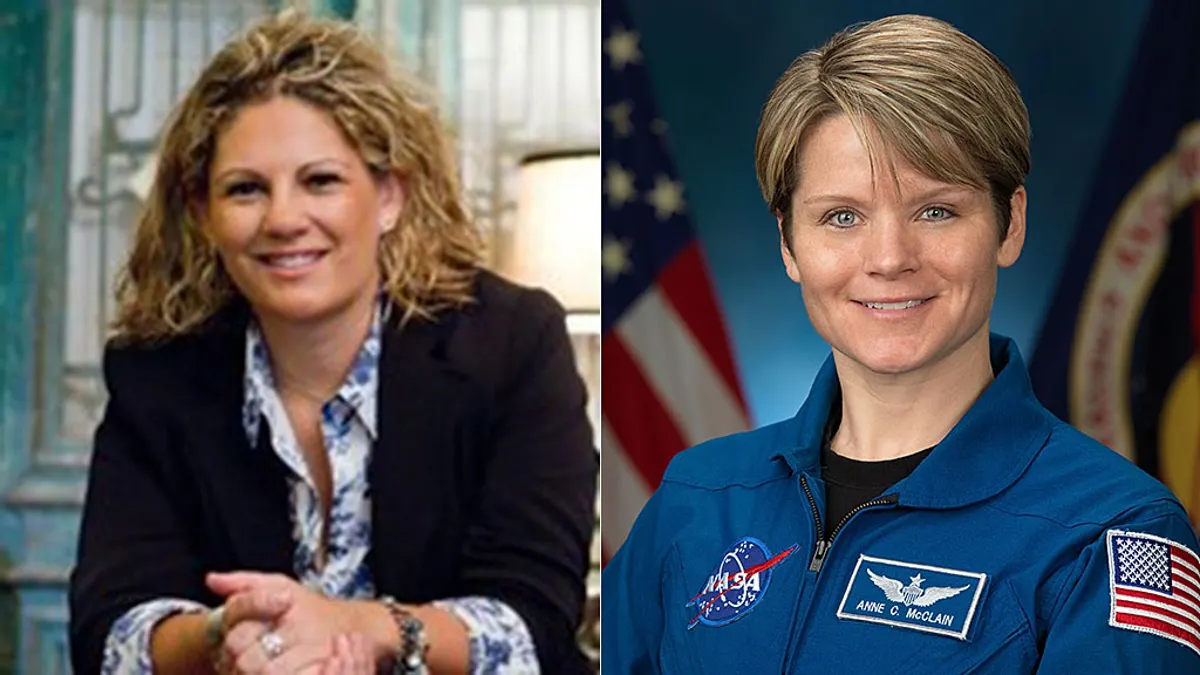
The sentencing of a Kansas woman for making false criminal allegations against her estranged spouse,Anne McClain, a high-profile astronaut, has drawn renewed attention to the serious legal consequences of misleading law enforcement—particularly when claims intersect with sensitive national institutions and the extraordinary environment of human spaceflight. Summer Heather Worden, a former U.S. Air Force intelligence officer, has been sentenced to three months in federal prison followed by two years of supervised release after admitting she lied to investigators about her former partner’s actions while aboard the International Space Station.
The case attracted widespread public interest not only because of the individuals involved but also because of the unusual nature of the allegation itself—one that placed criminal suspicion on conduct supposedly occurring hundreds of kilometers above Earth. Federal prosecutors stated that Worden falsely accused her estranged spouse Anne McClain of illegally accessing her personal bank account from orbit during a contentious divorce.
The claim captured significant attention when it first surfaced in 2019, partly because it raised unprecedented legal and jurisdictional questions about alleged wrongdoing in space. However, investigators later determined that the accusation lacked evidentiary support and that the account access in question had been authorized long before the dispute escalated. Worden ultimately pleaded guilty to making false statements to law enforcement authorities, bringing a years-long legal saga to a formal conclusion.
Her sentencing includes not only incarceration and supervised release but also a substantial financial penalty. She has been ordered to pay $210,000 in restitution, reflecting the broader legal and investigative costs associated with pursuing the matter. The case underscores how false allegations—particularly those directed at public servants in sensitive roles—can carry lasting professional, financial, and reputational consequences for all parties involved.
Legal Proceedings and the False Allegations
The origins of the case date back to July 2019, when Summer Heather Worden accused Anne McClain of unlawfully accessing her bank account while stationed aboard the orbital laboratory. At the time, the couple was undergoing divorce proceedings, and tensions were already high. Worden claimed that unauthorized financial surveillance had occurred during the mission, an allegation that generated intense media coverage due to the novelty of the claim and the involvement of a serving astronaut.
Federal investigators soon examined the timeline and digital access history associated with the account. Evidence presented in court demonstrated that Worden had opened the bank account in April 2018 and that both parties had legitimate access to it until January 2019, when she changed the account credentials. Investigators further determined that she had provided access to financial records and login information years earlier, with documentation indicating shared access as far back as 2015.
These findings contradicted the central premise of the criminal allegation. According to prosecutors, there was no evidence of unauthorized intrusion or misconduct. Instead, the access that occurred aligned with permissions previously granted. Authorities concluded that Worden’s statements to law enforcement were knowingly false, and that the claims she made did not reflect the actual history of the account’s use.
The legal consequences of those statements became the central focus of the prosecution. Making false claims to federal investigators is a criminal offense, particularly when such claims prompt significant investigative activity. Worden eventually pleaded guilty to lying to law enforcement, acknowledging that the allegations she advanced were not supported by fact and that her statements had misled authorities.
Woman who falsely accused NASA astronaut ex-wife of first crime in space sentenced to prisonhttps://t.co/2WJSSzcKzs pic.twitter.com/hS8lwzmUt4
— The Washington Times (@WashTimes) February 13, 2026
Court records also indicated that the situation did not end with the initial complaint. Even after an internal investigation cleared Anne McClain of wrongdoing, Worden continued promoting the accusation publicly. Prosecutors stated that she shared personal information and worked with a media consultant to amplify the claim, actions that further complicated the dispute and increased its public visibility. These developments contributed to the seriousness with which the court viewed the matter, as they prolonged the impact of the false allegation and intensified scrutiny surrounding the case.
The sentencing order reflects the cumulative weight of those actions. Federal authorities emphasized that misleading investigators, especially in a case involving national institutions and significant public attention, required accountability. Worden has been instructed to voluntarily surrender to a Federal Bureau of Prisons facility once designated, marking the final stage of a legal process that began with extraordinary claims but concluded with a conventional criminal conviction.
Impact on the Astronaut’s Career and Public Standing
The individual targeted by the false accusation maintained throughout the investigation that the account access had been authorized and lawful. From the beginning, she asserted that there was no evidence of misconduct and that her actions were consistent with previously granted permissions. Her position aligned with investigative findings that ultimately cleared her of any wrongdoing.
The public nature of the allegation, however, placed her under intense scrutiny. As a serving astronaut, she operates in an environment where trust, credibility, and professional integrity are fundamental requirements. Astronauts undergo extensive evaluation, continuous monitoring, and rigorous training, and they represent not only their agencies but also national scientific leadership and international cooperation. Allegations of criminal behavior—particularly those involving personal conduct during space missions—carry the potential to affect both individual careers and institutional reputation.
Read : Pakistani Astronauts to be First Foreign Guests at Tiangong Space Station
Despite the controversy, her professional trajectory continued. She had joined the astronaut corps in 2013 and quickly built a distinguished record of service. During her first spaceflight, she spent more than 200 days in orbit as a flight engineer and completed two spacewalks, demonstrating both technical skill and operational reliability in one of the most demanding professional environments imaginable.
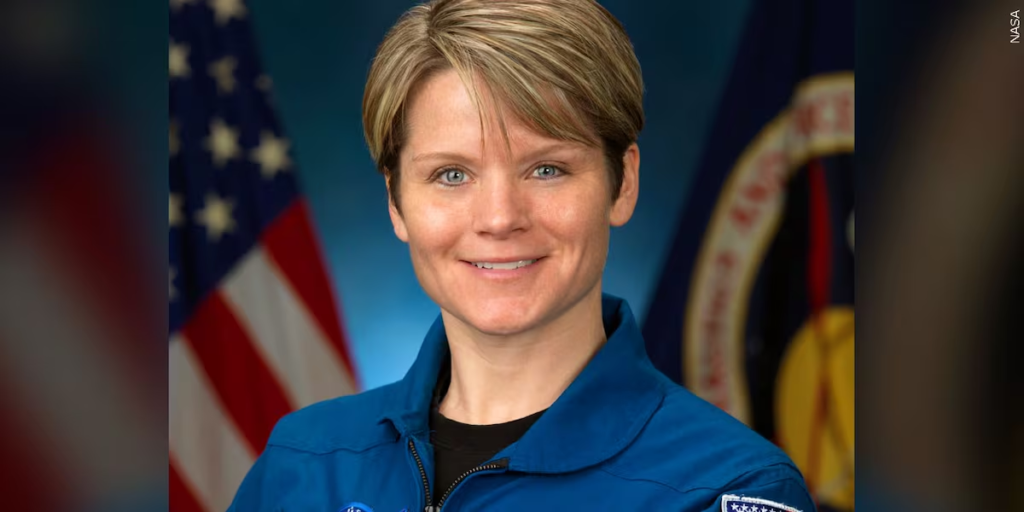
Her more recent assignment involved commanding a major crewed mission that launched in March 2025. During that mission, she again served as a flight engineer for an extended period and carried out another complex spacewalk lasting nearly six hours. These accomplishments reflected continued confidence from agency leadership and confirmed that the investigation’s findings did not impede her standing within the astronaut corps.
In public remarks following the legal proceedings, she stated that the false allegations were presented to investigators and the media with the intention of causing harm. She emphasized that from the outset there had been no evidence supporting the claims and that overwhelming evidence had disproved them. Her statements highlighted a broader commitment to professional values and public service, suggesting that the scrutiny ultimately reinforced rather than diminished her dedication to her work.
The case demonstrates how even unfounded accusations can produce lasting public scrutiny, particularly when directed at individuals in highly visible and demanding professions. For astronauts, whose responsibilities extend beyond technical operations to public representation and international collaboration, reputational risk can have implications that extend well beyond personal matters. The resolution of the case therefore carried significance not only for the individuals directly involved but also for the broader institutional environment in which they serve.
Broader Legal and Institutional Implications
Beyond the personal and professional dimensions of the dispute, the case carries wider significance for legal accountability and public trust. False allegations involving highly specialized operational environments—such as space missions—can strain investigative resources and create confusion about jurisdiction, authority, and oversight. When the alleged misconduct is said to occur in orbit, the matter becomes even more complex, potentially involving multiple legal frameworks and international agreements.
Read : Priceless Piece of Moon Donated to Ireland by Apollo Astronauts Destroyed by Fire
The investigation demonstrated how carefully such claims must be examined. Access records, authorization histories, and digital forensic evidence all played central roles in establishing the factual timeline. The outcome illustrates that even unprecedented or unusual allegations are subject to the same evidentiary standards that govern any criminal investigation, regardless of where the alleged activity is said to have taken place.

The financial component of the sentence also reflects institutional costs. Restitution orders often correspond to the expenses associated with investigations, legal proceedings, and related administrative processes. In this case, the $210,000 restitution requirement signals the scale of resources devoted to addressing the false claim and resolving the matter through formal legal channels.
The case also underscores the importance of internal review mechanisms within major institutions. Investigations that begin externally may intersect with internal oversight procedures designed to protect both operational integrity and employee rights. The prompt internal review that cleared the astronaut played a critical role in establishing factual clarity early in the process, helping prevent the spread of unsupported conclusions within official structures.
Public communication formed another significant dimension of the case. Allegations involving government agencies and high-profile personnel often generate extensive media attention. Once claims enter the public sphere, correcting misinformation can be difficult even after official findings are released. The persistence of the false narrative in this case—despite investigative conclusions—illustrates how reputational harm can continue long after factual disputes are resolved, particularly when claims are widely circulated.
Ultimately, the sentencing represents a formal acknowledgment that false statements to law enforcement carry tangible consequences, regardless of the circumstances in which they arise. The legal system’s response reflects a commitment to protecting investigative integrity and ensuring that accusations are supported by evidence before they trigger extensive official action.
The case remains notable for its unusual setting, its public visibility, and its intersection of personal conflict with national institutions. Its resolution brings closure to a dispute that began with extraordinary claims about conduct in space but ended with a clear legal determination that knowingly providing false information to investigators is a serious criminal offense subject to meaningful penalty.