
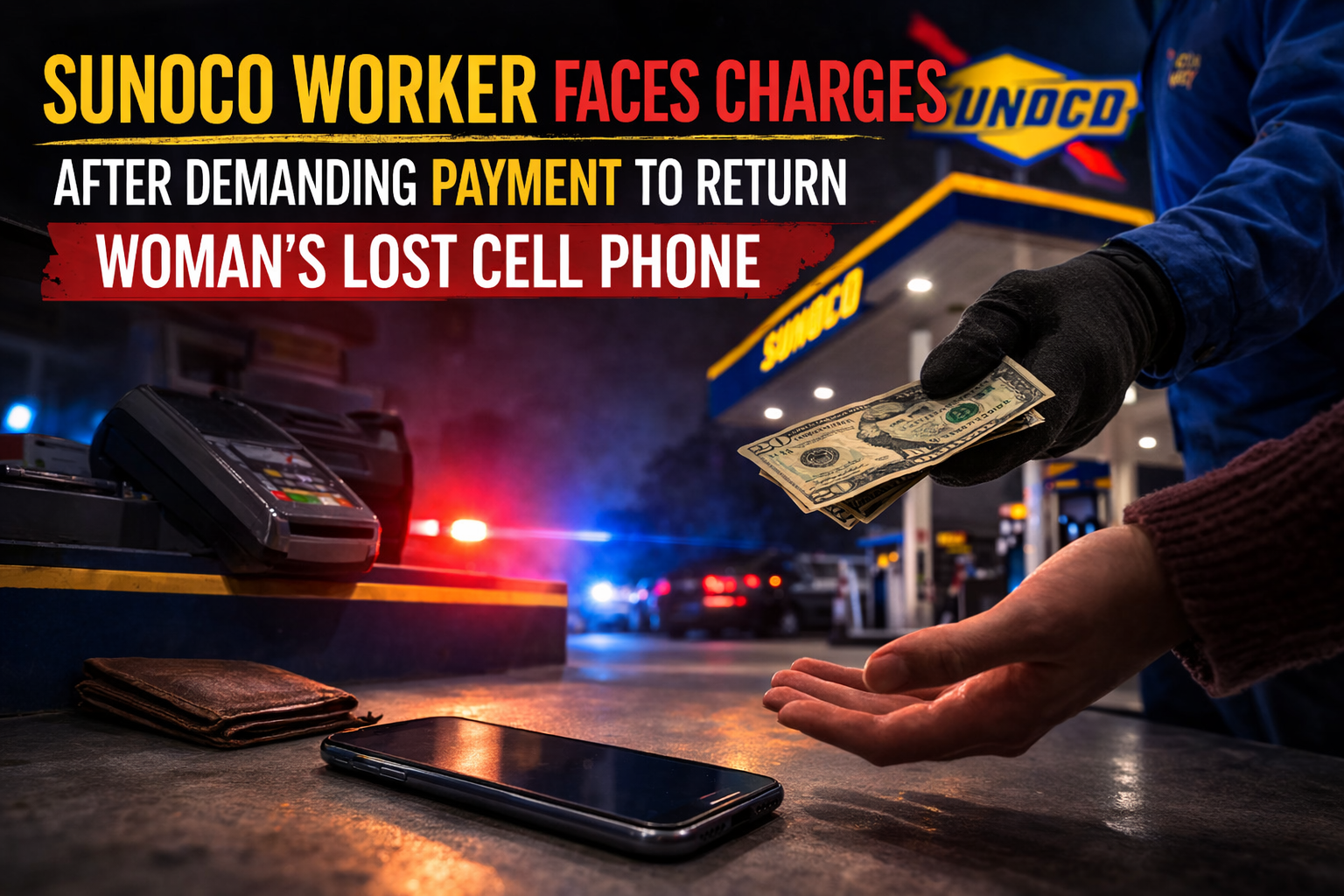
A routine stop at a gas station in Brook Park, Ohio, turned into a troubling experience for a local woman after she realized she had accidentally left her cell phone behind at the checkout counter. What began as a simple attempt to recover a misplaced device soon escalated into a situation that led to police involvement and criminal charges against a gas station employee.
According to reports, the worker allegedly demanded money in exchange for returning the phone, raising questions about ethics, responsibility, and accountability in everyday interactions between businesses and their customers. The incident highlights how a seemingly minor mistake can quickly spiral into a dispute when trust is undermined and personal property becomes the subject of negotiation.
The situation unfolded during the morning hours of February 20 at a Sunoco station located on Engle Road. The woman had stopped at the station and inadvertently left her phone on the checkout counter while completing her purchase. Realizing the mistake shortly after returning home, she attempted to track down the missing device by calling it with the help of her mother. What followed during that phone call set off a chain of events that ultimately drew the attention of local police and led to accusations that the worker attempted to profit from the situation.
The Lost Phone and the Alleged Demand for Payment
After the woman discovered that her phone was missing, she and her mother decided to call the device in hopes that someone nearby might answer and help them locate it. To their surprise, the call was answered by a man whom the woman recognized as the employee working at the Sunoco station where she had just been. This initially seemed promising, as it suggested that the phone had not been permanently lost and might still be at the location where she had left it.
However, the conversation quickly took an unexpected turn. According to the woman’s account, the employee told her that she would need to meet him somewhere other than the gas station if she wanted her phone back. He allegedly went on to say that she would also have to pay him $50 in order to retrieve it. The demand immediately raised concerns for the woman, who expected that her lost property would simply be returned if it had been found.
Rather than agreeing to the conditions laid out by the worker, the woman insisted that she would only meet him at the gas station itself. She was unwilling to arrange a meeting elsewhere or provide payment for the return of her own phone. According to the report, the employee responded by increasing the amount he demanded from $50 to $100 after she declined his initial request.
Read : Gassy Cows and Pigs Will Face Carbon Tax in Denmark from 2030
The escalating demand further alarmed the woman. Instead of continuing to negotiate with the employee, she chose to take the matter directly to law enforcement. She drove to the local police station and reported what had happened, explaining that the person who had answered her phone was allegedly asking for money to return it. Her decision to involve the police shifted the situation from a private dispute into a potential criminal matter. What might have otherwise remained a disagreement over a lost item quickly became a case requiring investigation.
Police Intervention and the Return of the Phone
After receiving the woman’s report, police officers went to the Sunoco station on Engle Road to investigate the situation. Their objective was straightforward: determine whether the employee had the phone and whether the claims about the payment demand were accurate. When officers arrived at the station and spoke with the worker, they asked him directly about the missing phone. According to police reports, the man immediately handed the device over to the officers without hesitation. This action confirmed that the phone was indeed in his possession at the time authorities arrived.
Read : Postal Worker Natasha Morisseau Suspended After Allegedly Throwing Mail in Dumpster
The worker then provided his own explanation for how he came to have the phone. He told officers that another customer had discovered the device at the gas station and turned it in. According to his account, he had simply been holding onto it after it was found. While this explanation addressed how the phone ended up with him, it did not fully resolve the questions raised by the woman’s complaint.

The central issue was whether the employee had demanded payment to return the phone during their earlier conversation. Police returned the phone to its rightful owner after recovering it from the employee. Although the device was safely returned, the incident did not end there. Officers continued their inquiry into the claims surrounding the alleged demand for money.
Situations involving lost property often depend heavily on trust and cooperation between the person who finds the item and the person who lost it. When that trust breaks down, law enforcement can become involved to determine whether a crime may have occurred. In this case, the allegations suggested that the return of the property may have been conditioned on payment, which raised serious concerns.
Conflicting Accounts and the Worker’s Explanation
When questioned further by police, the employee acknowledged that the woman had indeed called the phone and spoken with him. However, he denied that he had demanded money from her in exchange for returning the device. Instead, he offered a different explanation for what had happened during the call. According to the worker, he had been joking with the woman when she contacted him. He told police that he pretended to be a homeless person and asked her for food as part of what he described as a prank.
Read : Daycare Worker Savannah Alexander Accused of Assaulting Two Children
In his account, the request for assistance was not meant to be taken seriously but was simply an attempt at humor. The worker stated that the situation changed once the woman became upset during the conversation. At that point, he said, he ended the call and stopped the prank. From his perspective, the interaction had been misunderstood and was not intended as a genuine demand for payment.

This explanation stands in contrast to the woman’s account, in which she said the employee demanded specific amounts of money and suggested meeting at another location in order to return the phone. The difference between the two accounts became a central point in the case. Authorities ultimately moved forward with charges against the worker following the investigation. The incident underscores how actions that may be intended as jokes or pranks can be interpreted very differently by the person on the receiving end, especially when personal property is involved.
Beyond the immediate legal questions, the case highlights the broader expectations placed on employees who interact with customers. Workers at retail locations are often entrusted with handling situations involving lost items, customer inquiries, and other everyday concerns. When a customer leaves something behind, the general expectation is that staff members will safeguard the item and help facilitate its return without creating additional obstacles.
In many businesses, lost-and-found procedures are in place precisely to prevent misunderstandings and ensure that property is returned promptly and fairly. Deviating from those practices can create confusion, damage trust, and lead to disputes that might otherwise have been avoided. The incident at the Sunoco station illustrates how quickly a routine situation can escalate when communication breaks down. A misplaced phone is a common and usually minor problem, but the events that followed transformed it into a matter involving police, conflicting statements, and criminal charges.
For the woman who lost her phone, the experience likely began with the simple frustration of realizing that she had left an important personal item behind. By the time the situation concluded, it had evolved into an unexpected confrontation involving alleged demands for money and a police investigation. For the employee involved, the case serves as a reminder that interactions with customers carry responsibilities that extend beyond the immediate transaction at the register.
Even casual remarks or attempts at humor can have consequences when they occur in the context of a dispute over someone’s belongings. As authorities proceed with the case, the facts presented by both sides will continue to be examined. What remains clear is that a brief moment of carelessness at a checkout counter ultimately led to a far more serious situation than anyone involved might have anticipated.