

In a deeply tragic yet eerily ironic incident, a man in Thailand met his end in a way that many have called a textbook example of “instant karma.” Surapong Thongnak, a 36-year-old man, died on May 25 after attempting to attack his ex-girlfriend with an M26 fragmentation grenade. What he didn’t anticipate was that the grenade would bounce off a concrete pillar, land near him, and explode in his hands, killing him instantly and injuring four others, including his intended target.
The story made headlines not only for the shocking violence but also for the bizarre twist of fate that turned Surapong’s aggression back upon him. This incident brings into sharp focus the escalating problem of domestic violence, the psychological impact of rejection on unstable individuals, and the need for broader societal awareness about abusive relationships and their aftermath.
A Love Turned Toxic: The Events Leading to the Explosion
The series of events began when Surapong Thongnak, driven by unresolved emotions and perhaps a deeply bruised ego, stormed into the house of his ex-girlfriend, Kanonraphat Saowakhon, 28, in Surat Thani province. It had been only two months since the relationship had ended, but the rejection seemed to have ignited something dangerous in him.
According to witnesses and police reports, Surapong entered her home and demanded reconciliation. When Kanonraphat refused, he allegedly attempted to stab her with a pair of scissors. Thankfully, she managed to escape physical harm at that moment and fled inside the house.
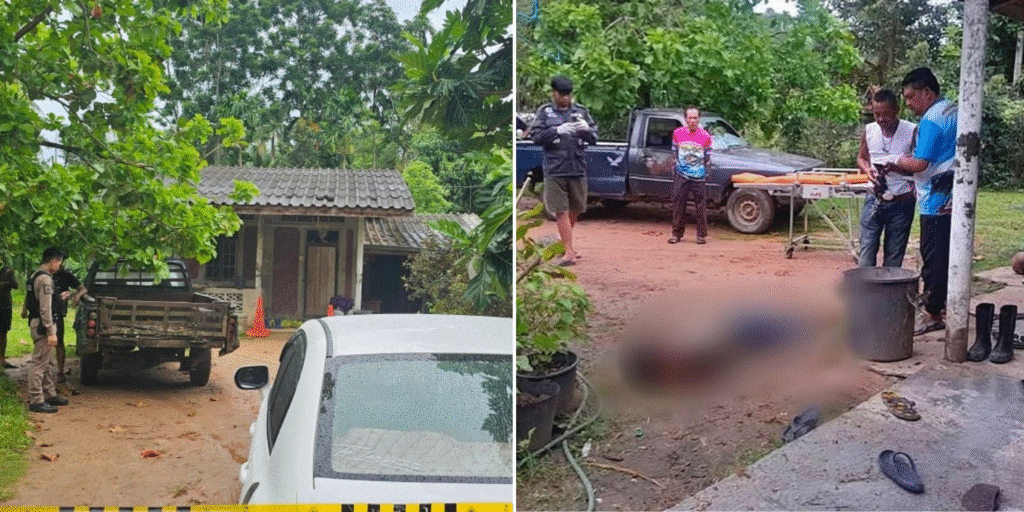
This would have already been a terrifying ordeal, but what came next escalated the situation into a horrifying act of violence. Surapong rushed to his vehicle and retrieved a military-grade M26 grenade. He returned to the property and hurled the explosive device toward the house. However, fate intervened in the form of a concrete pillar, which caused the grenade to bounce back toward him.
In a frantic and perhaps panicked moment, Surapong bent down to pick up the grenade—likely intending to throw it again—but it was too late. The device exploded in his hands, killing him instantly. His ex-girlfriend and three others were injured by the blast, though their injuries were relatively minor. One elderly man, 68-year-old Samart Janyang, suffered more severe injuries and was transferred to a larger hospital for further treatment.
Debris, shrapnel, and blood stained the yard. Police arrived to find Surapong’s lifeless body lying face down in a pool of blood. The surreal scene left residents and even seasoned police officers shocked.
Behind the Tragedy: A Pattern of Violence and Instability
The nature of the attack and the choice of weapon—a military-grade grenade—suggest more than just a crime of passion. It paints a picture of a man deeply unstable and potentially involved in more than just a failed romance. During their investigation, police discovered half a kilogram of methamphetamine in Surapong’s car. This discovery adds another layer to the story: drug use, mental instability, and an impulsive act of violence culminating in self-destruction.
His mother, Ranjuan Timdee, spoke to reporters in disbelief. She admitted that her son had only been dating Kanonraphat for two months before the breakup. She expressed shock that he had become so violent, unable to comprehend how he had spiraled to this point. Her words echo the sentiments of many parents who are blindsided by the dangerous behavior of their adult children.

While Surapong’s specific motivations may never be fully known, experts in domestic violence often cite power and control as the underlying reasons abusers lash out after a relationship ends. For individuals who perceive their partner’s departure as a personal attack or rejection, the loss of control can trigger a dangerous psychological response. Combined with substance abuse, this mental volatility can lead to extreme acts of violence—sometimes with deadly consequences.
Violence After Separation: A Global Pattern
Though this particular incident occurred in Thailand, it is part of a much larger and disturbing global pattern. Studies consistently show that individuals—particularly women—are at the greatest risk of violence immediately after leaving an abusive relationship. According to Battered Women’s statistics, 77% of domestic violence-related homicides occur post-separation. Violence can increase by up to 75% for as long as two years after the end of a relationship.
This spike in aggression following separation underscores the dangerous dynamic of control that exists in many abusive relationships. When a victim leaves, it often triggers a crisis in the abuser. The abuser may perceive the loss of control as a personal affront and retaliate in an attempt to reassert dominance. This can take many forms, from stalking and harassment to full-scale physical assault.
In Surapong’s case, this manifested not only as a physical attack but as an attempted act of mass violence. The fact that he used a grenade—a weapon designed for warzones—suggests a level of premeditation and intent that goes far beyond a spontaneous emotional reaction. He wasn’t just trying to intimidate or scare Kanonraphat; he was trying to destroy.
Adding to the tragedy is the fact that so many people underestimate the danger posed by former partners. According to research by Women’s Aid, 72% of people underestimate how common domestic abuse is. This underestimation leads to a lack of appropriate support, both legally and socially, for victims trying to leave dangerous relationships.
In many places, laws designed to protect victims are reactive rather than proactive. Victims often need to demonstrate a clear pattern of danger before they can receive protective orders or legal support. By the time authorities step in, it’s sometimes too late.
The story of Surapong Thongnak is one that shocks, disturbs, and forces reflection. On one level, it’s a grotesque example of instant karma—an attacker brought down by his own violence. But on a deeper level, it serves as a reminder of the dangers many people face when trying to escape abusive relationships. It shows how deeply entrenched anger, instability, and possessiveness can culminate in fatal consequences.
There is also a chilling lesson in how quickly personal turmoil can spiral into public tragedy when mental health, drug abuse, and violent tendencies intersect. It raises questions about how individuals like Surapong obtain military-grade weapons, and what more can be done to prevent such acts before they occur.
For Kanonraphat and the other survivors, the emotional scars of this incident will likely last far longer than the physical injuries. And for the community, it is a wake-up call to take all signs of domestic violence seriously—no matter how brief the relationship or how sudden the threat may seem.
In the end, the tragic irony of Surapong’s death will be remembered as both a cautionary tale and a symbol of unintended consequences. The very weapon he intended to use to harm others became the instrument of his own destruction. It is a haunting example of how violence, when wielded in anger, rarely follows the script we imagine—and sometimes, fate has its own form of justice.
This is the right website for anybody who wants to understand this topic.
You realize so much its almost tough to argue with you (not that I actually
will need to…HaHa). You definitely put a brand new spin on a subject that’s been written about for decades.
Wonderful stuff, just great!