

The Sydney Driverless Metro witnessed a terrifying and unprecedented incident when a driverless train sped through a tunnel at 100 km/h with one of its doors wide open. The event, which took place during peak hours, left passengers shocked and concerned about the safety of the city’s modern transit system.
The incident has sparked an outcry from the Rail, Tram and Bus Union (RBTU), with officials questioning how such a major safety failure was allowed to occur. The situation, which could have ended in catastrophe, has raised alarms about Sydney Metro’s safety protocols and operational efficiency.
A Terrifying Ride for Commuters
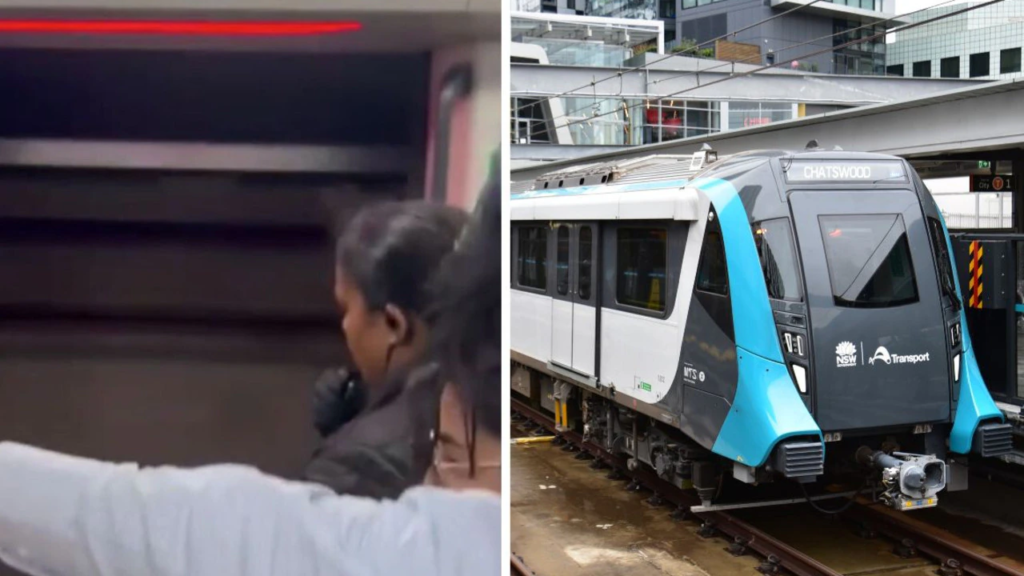
Passengers on board the Sydney Driverless Metro experienced a harrowing journey when they noticed that one of the doors had not closed properly. The train had just left Chatswood Station, heading toward Crows Nest, at approximately 8:00 am when the issue was discovered.
A video taken by passengers shows commuters standing away from the open door as the train continued at high speed through an underground tunnel. The sight of an open door at such speeds was enough to induce fear and panic among those on board.
Two metro employees were present inside the carriage, actively trying to manage the situation. One of them could be seen using a two-way radio to report the incident to the control centre. Despite their efforts, the train did not come to an immediate halt but continued at full speed for nearly two minutes before stopping.
Passengers on board a packed driverless metro train were left gripping handrails during peak hour on Wednesday morning when a door was left open while it was travelling at high speed along the underground line on Sydney’s north shore. pic.twitter.com/5lNhcogFO8
— Evan S (@fictillius) April 2, 2025
The fact that the train had already reached 100 km/h before the issue was addressed has led many to question the reliability of Sydney Metro’s safety measures and response mechanisms.
Investigation Underway, But Safety Concerns Linger
Following the incident, Metro Train Sydney released a statement reassuring passengers that their trains are safe to ride. Daniel Williams, the head of Metro Train Sydney, attributed the malfunction to a “door fault” and confirmed that an investigation was already underway.
He stated that their Operational Control Centre (OCC) had been alerted as soon as the issue was identified and that attempts were made to remotely fix the problem. However, when these attempts failed, the metro personnel on board had to manually close the door using a special key.
While no injuries were reported, the incident has raised questions about the effectiveness of Sydney Metro’s emergency response systems. The train in question was immediately removed from service, but commuters and transport unions are demanding answers.
The Rail, Tram and Bus Union (RBTU) has labeled the situation one of the most serious rail safety incidents in a decade. The union is calling for urgent safety checks on all metro trains, emphasizing that such an incident should never have happened in the first place.
Read : 3-Year-Old Girl Dies in Van and Metrolink Tram Collision in Manchester
According to the RBTU, the most alarming aspect of the incident is that the train was allowed to depart from Chatswood Station with a known door fault. If the issue had been detected earlier, the train should have been pulled from service immediately rather than being allowed to continue its journey with passengers on board.
The fact that such a malfunction occurred on a driverless train further intensifies concerns about automated rail transport and its reliability in critical situations.
Sydney Metro’s Reputation at Stake
Sydney Metro has long prided itself on being one of the most advanced public transportation systems in Australia. With its driverless trains, it represents a step forward in automation and efficiency.
However, this recent incident has cast doubt on the safety protocols that govern the metro’s operations. Automated systems are meant to reduce human error, but they also come with their own set of challenges, particularly when technical malfunctions arise.
The incident has also ignited debate over whether driverless trains are truly safe for public transport. While proponents argue that automation minimizes the risk of human mistakes, critics point out that technical failures, such as the one witnessed on Sydney Metro, can be equally dangerous.
The inability to quickly resolve the open door issue remotely and the delayed response time highlight potential weaknesses in the metro’s operational framework.
Rail safety experts have warned that this incident should serve as a wake-up call for Sydney Metro to conduct a thorough review of its safety procedures. While automation can offer increased efficiency, it should never come at the cost of passenger safety.
Implementing more rigorous pre-departure checks, enhancing monitoring systems, and ensuring that emergency response teams are better equipped to handle such situations must be a top priority moving forward.
The Rail, Tram and Bus Union is now pushing for a comprehensive safety audit of the metro network. It is also calling for greater transparency regarding how safety faults are handled and what measures are in place to prevent such incidents from occurring again. The union’s concerns are shared by many passengers who, after witnessing the incident, are now questioning whether they can truly trust Sydney Metro’s reliability.
Additionally, this incident may have repercussions beyond Sydney Metro itself. Cities around the world that are considering implementing similar driverless train systems may take note of this safety lapse.
It serves as a stark reminder that while technological advancements can improve public transport, they must be accompanied by foolproof safety measures to protect passengers at all times.
As Sydney Metro continues its investigation into the malfunction, one thing is clear: this incident must not be taken lightly. The potential consequences of a high-speed train running with an open door are too grave to ignore.
Commuters deserve a transportation system that prioritizes their safety above all else. It remains to be seen whether Sydney Metro will take the necessary steps to prevent a similar event from happening again, but for now, the confidence of passengers has been shaken.