

When Texas businessman Daniel Keene posted a short comment on X (formerly Twitter) about immigration policy, he could not have anticipated the storm that would follow. What began as a one-line statement attached to a neighborhood celebration video spiraled into a viral controversy, leaving Keene facing public outrage, professional repercussions, and alleged expulsion from his church. His case has become an emblem of how rapidly social media disputes can escalate into real-world consequences, raising broader questions about free speech, community standards, and the cost of public opinion in the digital age.
The Tweet That Sparked the Controversy
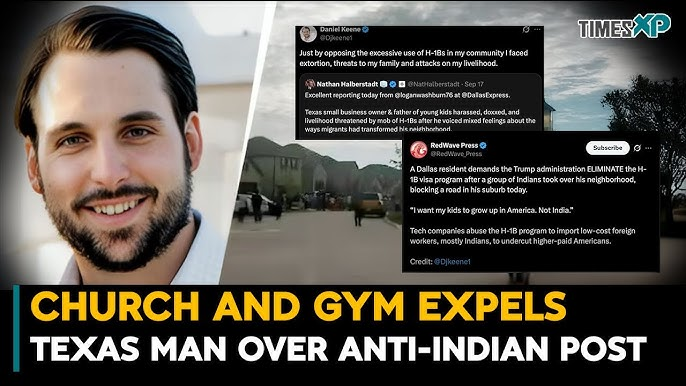
On September 6, Daniel Keene shared a video on X showing a lively street celebration taking place in his neighborhood. Alongside the clip, he wrote, “We have to cancel the H-1Bs. I want my kids to grow up in America. Not India.” The statement, interpreted by many as an anti-immigrant or racially charged remark, quickly drew widespread criticism. The H-1B visa program, which allows U.S. employers to hire foreign workers in specialty occupations, has long been a subject of debate, especially in technology and engineering sectors.
Daniel Keene’s phrasing struck a particularly sensitive chord, as it appeared to target Indian immigrants specifically, a group that forms a substantial portion of H-1B visa holders in the United States. Within hours, Keene’s post went viral, accumulating thousands of responses that ranged from calls for him to be reported to demands for boycotts of his business. Many social media users accused him of xenophobia, while others defended his right to express his views on immigration policy.
Facing mounting backlash, Daniel Keene deleted the post, but screenshots of the comment continued to circulate widely. He later stated that he had not intended to incite hostility, but to “bring awareness to the policy effect on the ground.” Speaking to Newsweek, Keene clarified that his comment reflected his perspective on labor and demographic trends, not personal animosity toward any group. Nevertheless, the incident had already triggered a wave of online condemnation and real-world repercussions.
Allegations of Expulsion from Church
The fallout from Daniel Keene’s post extended far beyond the digital realm. In a series of subsequent X posts, he claimed that his church leadership had confronted him over the controversy and ultimately asked him to leave the congregation. According to Keene, he was summoned to a two-hour meeting on September 24 with seven church elders, during which he was “interrogated” over his social media post. He alleged that the elders refused to consider his “character witnesses from Indian friends” and declined to review his history of anti-racism posts that he said demonstrated his respect for all communities.
“The elders told me to leave the church on the evening of the 24th of September in many different ways over a two-hour meeting with seven elders,” Daniel Keene wrote online. He added that, despite being told to leave, his name remained in the church’s “member/donation management system,” suggesting an incomplete or unofficial removal. His claims portrayed a deeply personal experience, framing his treatment as an example of social ostracization resulting from online controversy.
In response, a spokesperson for the church offered a markedly different account in comments to Newsweek. The representative emphasized that Daniel Keene’s political opinions were never a point of contention during the meetings. Instead, the discussions reportedly centered on the Christian duty to love one’s neighbors regardless of origin. “At no time during our recent meetings with the Keenes were their political opinions ever a point of focus or topic of disagreement,” the spokesperson said.
“Instead, our discussions centered on the gospel mandate to love our neighbors as Christ has loved his church — however or wherever or whenever those neighbors arrive.” The church concluded by saying that Keene and his family had been asked to consider whether they could “joyfully continue as members of the church,” rather than being formally expelled.
This church's actions against Daniel Keene are so insane that I can't even begin to express how self-destructive these elders are being right now. If you think your elders might be anything like Daniel's elders, get away from that congregation as soon as possible! #DanielKeene… https://t.co/AFH0FXOe4z pic.twitter.com/se9XJ2jkAj
— Glenn Jones (@idotf) October 8, 2025
The conflicting narratives between Keene and the church underscored how moral and political divides can infiltrate even close-knit communities. For Daniel Keene, the encounter appeared to symbolize an erosion of belonging; for the church, it was a matter of spiritual reflection and community cohesion. The tension between individual conviction and collective ethos, magnified by the digital dissemination of personal beliefs, became the central thread of this unfolding story.
Business and Social Fallout
The controversy’s impact on Daniel Keene’s professional and social life has been significant. In addition to facing online harassment and what he described as “death threats,” Keene said his business suffered financial losses in the wake of the viral post. Potential clients reportedly withdrew from engagements, and the reputational damage extended into local circles. The situation deepened when his gym membership was canceled—a development that drew further attention to the cascading consequences of social media backlash.
According to Daniel Keene, the termination of his gym membership was another example of punitive action taken against him for his online statement. However, the gym’s management disputed this characterization, maintaining that the decision was not politically motivated. The owner stated that Keene had “negatively singled out a cultural group,” which violated the gym’s community standards and inclusivity principles. While no formal record of misconduct was disclosed, the message was clear: public commentary perceived as discriminatory can have tangible social costs, even in seemingly unrelated areas of daily life.
Daniel Keene’s experience also reignited debates over whether personal expression on social media should affect professional or community standing. Supporters of Keene framed the situation as an overreach of “cancel culture,” arguing that individuals should not lose jobs, memberships, or church participation for expressing policy opinions. Critics countered that the phrasing of his post reflected exclusionary rhetoric incompatible with values of equality and respect. This divide reflects a broader American struggle to balance free expression with the social responsibility of digital citizenship.
From a broader perspective, Keene’s story illustrates how online discourse increasingly blurs the lines between private opinion and public consequence. A single sentence on a social platform, amplified by the speed and scope of viral sharing, can influence one’s livelihood, relationships, and reputation. In Keene’s case, his initial intent—to question immigration policy—was quickly overshadowed by the perceived tone and target of his comment. Whether viewed as a cautionary tale about public expression or as an example of collective overreaction, the incident has become a touchpoint in ongoing discussions about speech, identity, and accountability in modern America.
In the weeks following the controversy, Keene continued to post on X, attempting to clarify his position and defend his character. He reiterated that his remarks were policy-focused rather than racially motivated and expressed regret that his wording had caused offense. Yet his public defense did little to stem the tide of criticism. The persistence of the backlash highlights the enduring nature of digital memory, where deleted posts and retractions often fail to erase initial impressions.
As the furor around Daniel Keene’s comment subsides, his story remains a vivid example of the complexities surrounding speech and identity in the social media era. The episode reveals how cultural and political sensitivities, magnified by instantaneous online engagement, can redefine personal lives within days. It underscores that in today’s interconnected world, every word shared publicly carries potential repercussions—both moral and material—far beyond the moment it is written.
**mitolyn official**
Mitolyn is a carefully developed, plant-based formula created to help support metabolic efficiency and encourage healthy, lasting weight management.