
Forests are essential to sustaining life on Earth, acting as crucial regulators of our climate, sources of biodiversity, and providers of resources that support millions of livelihoods. Covering about 31% of the world’s land area, forests offer a balance between human needs and environmental sustainability.
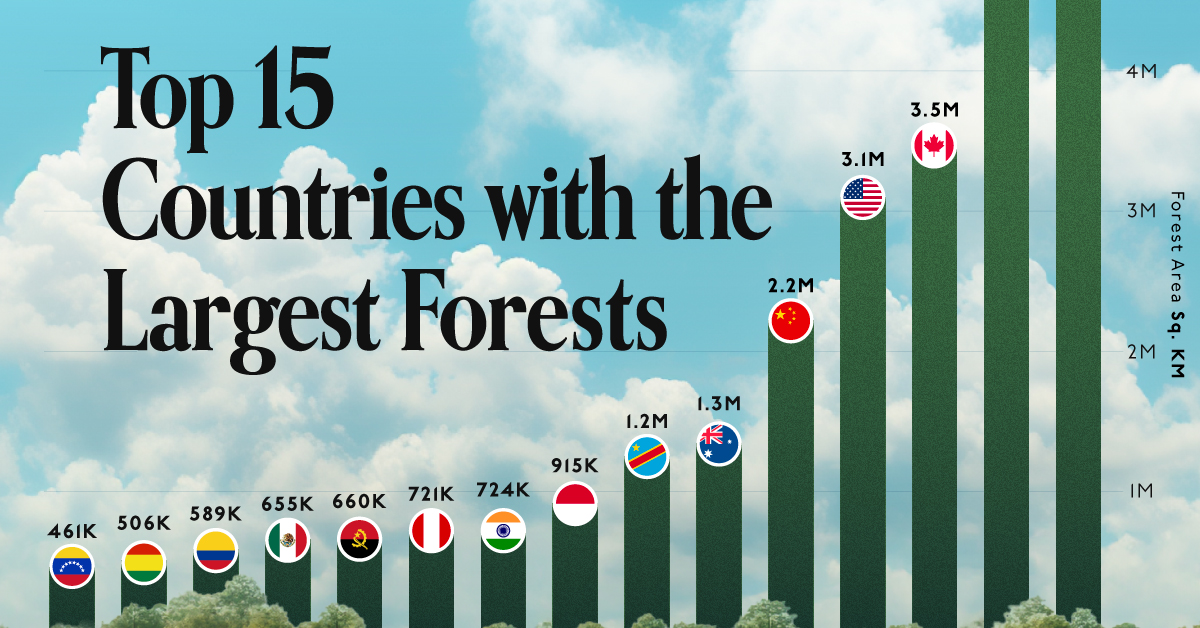
Countries with vast forest resources play a significant role in maintaining this balance. Here, we explore the ten countries with the highest forest area, examining their contributions to global ecology and how they manage this valuable resource.
1. Russia: 814,848,460 Hectares
Russia tops the list with a staggering 814.8 million hectares of forest, which represents nearly 20% of the world’s total forested land. This immense forest area is largely found in the vast Siberian region, home to the famous taiga or boreal forests. These forests are crucial carbon sinks, absorbing large amounts of carbon dioxide, thus playing a vital role in mitigating global warming.
Read : Mawphlang: The Sacred Forest in Meghalaya Where You Can’t Take Even a Leaf
However, Russian forests face challenges from logging, forest fires, and climate change, with fires becoming increasingly frequent and severe in Siberia. The Russian government has implemented stricter regulations to combat illegal logging and protect these valuable ecosystems, emphasizing the country’s role in preserving its immense natural resources.
2. Brazil: 491,570,000 Hectares
Brazil is home to the Amazon Rainforest, often called the “lungs of the Earth.” Covering 491.6 million hectares, Brazil’s forests represent the largest portion of tropical forests worldwide. The Amazon’s biodiversity is unparalleled, providing habitat to millions of plant, animal, and insect species, many of which are still undiscovered.
Read ; Ghost Forests: Nature’s Eerie Warning of Climate Change
However, Brazil’s forests are under significant threat from deforestation for agriculture, primarily cattle ranching and soy cultivation. In recent years, Brazil has faced international scrutiny for deforestation practices that threaten the global climate. Efforts to curb deforestation have led to stricter environmental policies and increased reforestation programs, though the challenge of balancing economic growth and conservation remains ongoing.
3. Canada: 346,975,800 Hectares
With nearly 347 million hectares of forest, Canada ranks third in the world in terms of forest area. The country’s forests are predominantly boreal, covering vast areas across northern provinces. Canadian forests are carefully managed to ensure sustainable harvesting, with policies in place to replant areas that are logged. The forests are crucial for Canada’s economy, supporting industries like lumber, paper, and tourism.
Moreover, Canada’s forests play a vital role in supporting indigenous communities who rely on them for food, medicine, and cultural practices. Climate change, however, poses a significant threat to these forests, with increasing instances of wildfires and pest infestations.
4. United States: 310,645,000 Hectares
The United States ranks fourth globally with over 310 million hectares of forest, covering a wide range of ecosystems from tropical rainforests in Hawaii to temperate rainforests in the Pacific Northwest. The U.S. manages its forests through various federal, state, and local agencies that focus on conservation, recreation, and sustainable timber harvesting.
The United States has also implemented policies for forest fire management, recognizing the importance of controlled burns in preventing catastrophic wildfires. American forests are vital for biodiversity, hosting numerous plant and animal species, including endangered ones, and serve as a major economic resource, especially for the timber and paper industries.
5. China: 211,405,700 Hectares
China’s forest area covers over 211 million hectares, ranking it fifth globally. The Chinese government has made significant efforts in recent decades to increase forest cover, launching initiatives like the “Great Green Wall,” a massive tree-planting project aimed at combating desertification. China’s forests are diverse, with temperate forests in the north, subtropical forests in the south, and boreal forests in the mountainous regions.
These forests are vital for preventing soil erosion, particularly in areas prone to desertification. China’s rapid industrialization has put pressure on its natural resources, but its afforestation programs demonstrate a commitment to reversing deforestation trends and protecting biodiversity.
6. Democratic Republic of Congo (DR Congo): 151,955,200 Hectares
The DR Congo boasts 151.9 million hectares of forest, primarily consisting of the Congo Rainforest, the second-largest tropical rainforest in the world. These forests are incredibly biodiverse, home to unique wildlife such as gorillas, elephants, and numerous bird species. The forests of the DR Congo are essential for carbon storage and play a critical role in the global climate.
However, the DR Congo’s forests are under threat from logging, agriculture, and mining activities. Efforts are underway, supported by international organizations, to improve sustainable forestry practices and protect the forest from exploitation. These initiatives are crucial not only for preserving biodiversity but also for ensuring the survival of indigenous communities who depend on the forest.
7. Australia: 125,367,000 Hectares
Australia has approximately 125.4 million hectares of forest, covering a range of ecosystems from tropical rainforests in Queensland to eucalyptus woodlands in New South Wales. Australia’s forests are uniquely adapted to its climate, with many species like eucalyptus trees that have evolved to thrive in fire-prone environments.
Unfortunately, these forests are increasingly threatened by climate change, with devastating wildfires occurring more frequently. The 2019–2020 bushfire season, often referred to as “Black Summer,” highlighted the vulnerability of Australian forests to extreme weather events. Despite these challenges, Australia has robust conservation policies and numerous national parks that protect its unique ecosystems.
8. Indonesia: 89,641,200 Hectares
Indonesia’s forests cover about 89.6 million hectares and are primarily tropical rainforests located across thousands of islands. These forests are incredibly rich in biodiversity, home to iconic species like orangutans, tigers, and rhinos. However, Indonesia’s forests face significant threats from palm oil plantations, illegal logging, and forest fires, which are often intentionally set to clear land.
Indonesia has been working to reduce deforestation rates, though balancing economic demands with environmental protection remains a challenge. Efforts such as moratoriums on new logging permits and sustainable palm oil certification programs aim to address these issues while preserving the country’s rich biodiversity.
9. Peru: 73,637,800 Hectares
Peru’s forests cover 73.6 million hectares, mostly in the Amazon basin, making it one of the most biodiverse countries in the world. The Peruvian Amazon is home to countless species, including jaguars, macaws, and a wide variety of plant life. These forests are crucial for indigenous communities and play a vital role in global carbon storage.
Peru faces challenges in managing its forests, with illegal logging and land encroachment being significant issues. However, conservation efforts, supported by both local and international organizations, are working to preserve these forests and protect indigenous rights.
10. India: 71,038,800 Hectares
India’s forests cover 71 million hectares, representing a mix of tropical, subtropical, and temperate forests. India has made significant strides in forest conservation through afforestation programs and community-based forest management initiatives. The country’s forests are home to diverse wildlife, including tigers, elephants, and leopards, and are essential for preventing soil erosion and maintaining water cycles.
However, India’s forests are under pressure from agricultural expansion, urbanization, and industrialization. Government initiatives such as the Joint Forest Management program have helped improve forest cover, and ongoing efforts aim to balance conservation with India’s development needs.
Forests are vital for maintaining ecological balance, supporting biodiversity, and mitigating climate change. The countries listed here, with their vast forested areas, are crucial to global environmental health. However, these forests are increasingly under threat from human activity and climate change.
Protecting these areas requires a combination of local conservation efforts, international cooperation, and sustainable development policies. As stewards of these natural resources, these countries have a significant responsibility to safeguard their forests for future generations.