

The story of deep-sea explorer Tommy Thompson blends scientific achievement, historic discovery, legal battles, and one of the most unusual imprisonment cases in modern American history. Once celebrated for uncovering one of the most valuable shipwrecks ever found, Thompson later became known for a prolonged legal standoff that kept him behind bars for years. After refusing to reveal the location of 500 missing gold coins tied to a legendary shipwreck, he spent more than a decade in prison under contempt of court orders.
Now 73 years old, Thompson has been released, bringing a long and complicated saga closer to its conclusion. Thompson’s journey from celebrated innovator to imprisoned defendant illustrates the complex intersection of maritime exploration, financial disputes, and the legal system. His discovery of a famous 19th-century shipwreck in the Atlantic Ocean once captivated historians, investors, and treasure hunters alike.
However, disagreements over profits, missing assets, and unanswered questions eventually overshadowed the triumph of the discovery itself. For many observers, the case highlights the risks and controversies that often accompany high-value treasure recovery projects. His release comes after years of legal proceedings and imprisonment related not to a traditional criminal conviction, but to contempt of court.
The unusual nature of the case meant that Thompson remained jailed long after typical legal limits would have applied, largely because authorities believed he still possessed information about the missing treasure. With his release now confirmed, the decades-long dispute surrounding the treasure of a famous shipwreck continues to provoke debate about accountability, evidence, and the limits of judicial pressure.
The Discovery of the Legendary “Ship of Gold”
Tommy Thompson first rose to prominence in the late 1980s when he led the team responsible for locating the wreck of the S.S. Central America, a ship that sank during a hurricane in 1857. The vessel had been carrying a massive cargo of gold from the California Gold Rush when disaster struck off the coast of South Carolina. The tragedy claimed the lives of hundreds of passengers and crew members, and the loss of the gold contributed to a financial panic that shook the United States economy during the 19th century.
For more than a century, the wreck remained hidden in the depths of the Atlantic Ocean. Locating it posed enormous technical challenges due to the extreme depth and the limitations of available exploration technology. Thompson, who was trained as a research scientist, helped develop innovative underwater robotic systems capable of operating in deep-sea conditions. His team eventually succeeded in identifying and exploring the wreck site in 1988, a discovery that quickly gained international attention.
The find was extraordinary not only because of its historical importance but also because of the sheer value of the treasure recovered. Thousands of gold coins and hundreds of gold bars were retrieved from the wreckage, along with artifacts that offered insights into life during the Gold Rush era. The discovery was widely described as one of the greatest shipwreck finds in American history.
Thompson’s work was initially celebrated as a remarkable combination of scientific ingenuity and adventurous exploration. The recovered treasure was eventually sold through collectors and coin dealers, with a significant portion of the gold entering the rare coin market. At the time, the value of the recovered assets was estimated in the tens of millions of dollars, sparking widespread fascination among historians, investors, and collectors.
Read : China Creates First AI Commander That Can Operate in War-like Events Without Human Intervention
However, the financial structure behind the expedition involved numerous investors who had funded the search in exchange for a share of the eventual profits. As time passed, many of those investors claimed they never received the returns they had expected. What began as a celebrated discovery gradually evolved into a complex financial dispute that would follow Thompson for decades.
Legal Battles, Missing Coins, and Years on the Run
By the early 2000s, tensions between Thompson and the investors who financed the treasure recovery effort had escalated significantly. In 2005, several investors filed lawsuits accusing him of failing to distribute profits from the sale of recovered gold. According to the legal claims, more than $50 million had been generated from the sale of gold bars and coins recovered from the shipwreck, yet investors alleged they had received little or no compensation.
Thompson disputed the accusations, maintaining that the funds from the sales had largely been consumed by legal costs, bank loans, and other expenses related to the complex recovery operation. The situation grew increasingly contentious as the lawsuits progressed through federal courts. One of the central mysteries involved approximately 500 gold coins that had been minted from gold recovered from the shipwreck. Authorities believed Thompson had information about the location or control of these coins, which were valued at roughly $2.5 million at the time.
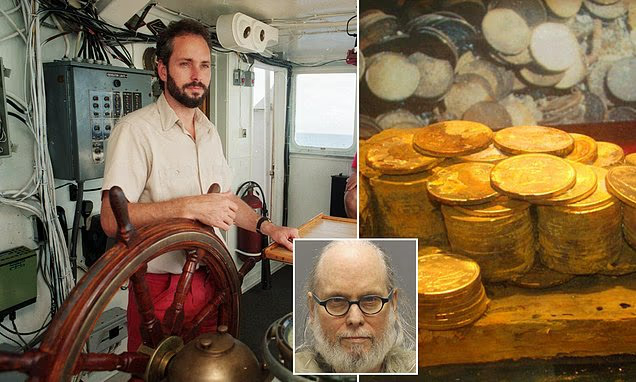
The court sought to compel him to reveal where the coins were stored or who controlled them. Instead of cooperating with the court process, Thompson withdrew from public view. While living in Florida, he went into seclusion and failed to appear for a scheduled court hearing in 2012. His absence prompted a federal judge in Ohio to issue a warrant for his arrest. For several years, Thompson managed to evade authorities, effectively becoming a fugitive. His disappearance added another layer of intrigue to a case that had already attracted national attention.
Eventually, law enforcement officials located him in a Florida hotel in 2015. He was arrested and returned to Ohio to face the court orders he had previously ignored. During subsequent hearings, Thompson was repeatedly asked to disclose the location of the missing gold coins. The judge held him in contempt of court when he refused to answer questions about the treasure. Contempt charges are typically used when someone defies a court order, and they can result in imprisonment until the individual complies.
In Thompson’s case, the court believed that continued detention might eventually compel him to reveal the information being sought. However, Thompson consistently maintained that he did not know the location of the coins. He claimed they had been transferred to a trust in Belize and that he no longer had control over them. His refusal to provide answers meant he remained imprisoned year after year, creating an unusual legal situation that attracted attention from legal experts and the media alike.
A Decade Behind Bars and an Unusual Release
One of the most controversial aspects of Thompson’s imprisonment involved the length of time he remained behind bars for contempt of court. Under federal law, incarceration for civil contempt is generally limited to 18 months. However, Thompson’s case was complicated by the terms of a plea agreement and the court’s belief that he continued to withhold information about the missing coins.
In 2019, a federal appeals court ruled that the typical 18-month limitation did not apply to Thompson under the specific circumstances of his case. Judges concluded that his refusal to answer questions violated the conditions of his earlier plea agreement, allowing the contempt order to continue. Throughout the legal proceedings, Thompson maintained that he could not provide the answers the court demanded.
During a video hearing in 2020, he told the judge that he did not know the whereabouts of the coins and suggested that he lacked the ability to secure his own release because he had no information to give. His statement reflected the central dilemma in the case. Authorities believed Thompson held the key to recovering millions of dollars in missing treasure, while Thompson insisted that he had already lost control of the assets in question. As the years passed, it became increasingly unclear whether continued imprisonment would ever produce new information.

In February of the year prior to his release, the presiding judge reconsidered the situation. After reviewing the lengthy period Thompson had already spent in custody, the judge determined that continued detention was unlikely to compel him to reveal the location of the coins. As a result, the civil contempt sentence was brought to an end. However, Thompson was not immediately released. Instead, the court ordered him to begin serving a separate two-year sentence related to his failure to appear in court back in 2012.
That sentence extended his incarceration further before he was finally released from federal custody. His release marks the end of one of the longest contempt-related imprisonments in recent memory. Even so, many questions surrounding the missing coins remain unanswered. The case has also sparked debate about the fairness and effectiveness of extended contempt imprisonment. Supporters of Thompson argue that the dispute ultimately involved business disagreements between investors and a treasure recovery company.
Critics, on the other hand, maintain that he withheld crucial information that could have helped resolve the financial claims tied to the treasure. Some observers have noted that Thompson paid an extraordinary personal price for the conflict. Spending more than a decade behind bars for refusing to provide information is highly unusual, particularly in cases that originate from commercial disputes rather than violent crimes. Despite his release, the broader story surrounding the treasure of the S.S. Central America remains unresolved.
The missing gold coins have never been recovered publicly, and their current location continues to be a subject of speculation. For historians and treasure enthusiasts, the shipwreck itself remains one of the most fascinating maritime discoveries ever made. Yet the legacy of that discovery is now intertwined with years of courtroom battles, unanswered questions, and a prolonged legal standoff that transformed a celebrated explorer into a figure at the center of one of the most unusual legal sagas connected to treasure hunting.