

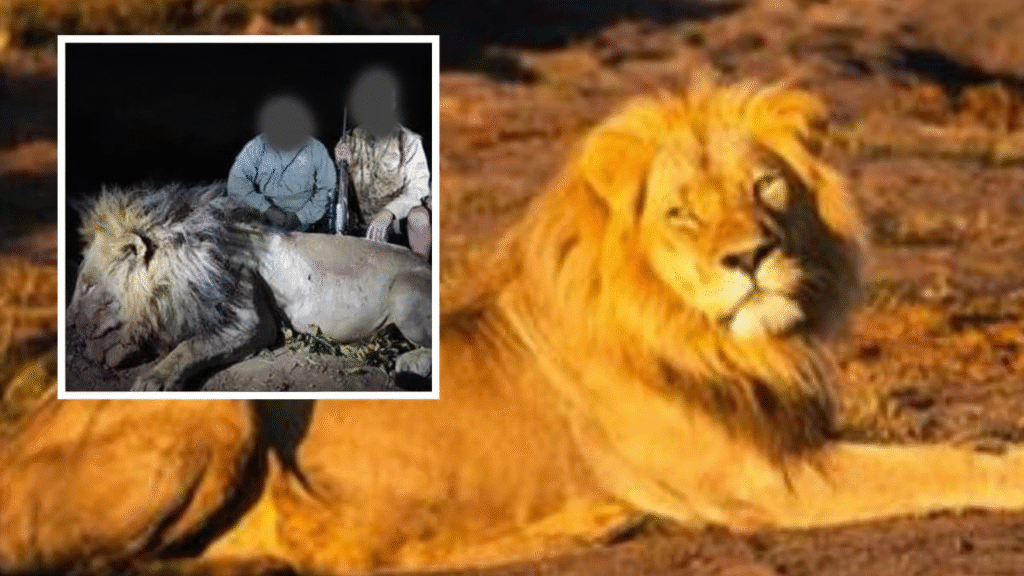
The killing of a collared lion in Zimbabwe by a trophy hunter has once again ignited global outrage, recalling the infamous death of Cecil the lion in 2015. The slain lion, known as Blondie, was part of an Oxford University research project and wore a tracking collar as part of a study meant to aid conservation efforts. His death, allegedly caused by being lured out of the protected Hwange National Park using bait, has become the latest rallying cry for critics of trophy hunting.
While the Zimbabwean government insists the killing was legal and appropriately sanctioned, conservationists and animal welfare groups argue that it represents a fundamental breach of ethical hunting principles. The death of Blondie has not only reopened old wounds but has also raised urgent questions about the sustainability of wildlife conservation policies that continue to accommodate trophy hunting.
The Story of Blondie: Lured from Protection to Death
Blondie was no ordinary lion. As a dominant male in his prime and an active part of a scientific study conducted by Oxford University, he was easily recognizable due to the conspicuous tracking collar around his neck. This collar, sponsored by Africa Geographic, was intended to provide invaluable data on lion behavior and movements to assist in long-term conservation planning.
Yet in June 2025, Blondie’s life was cut short near Hwange National Park after he was reportedly baited out of the park and into a designated hunting zone. According to Africa Geographic, the bait used to lure Blondie was likely a dead animal, a common tactic in lion hunts. Despite the visibility of Blondie’s research collar, the hunter proceeded to kill him, raising serious ethical questions about the selection criteria used by trophy hunters.
Read : Truth Behind Viral Claim That JD Vance Broke Football Championship Trophy at White House
Simon Espley, CEO of Africa Geographic, strongly criticized the killing, saying it “made a mockery of the ethics trophy hunters claim to subscribe to.” He pointed out that hunters often claim to target only older, non-breeding males. Blondie, however, was a healthy, prime-aged breeding male with a prominent research collar — clearly not the kind of lion ethical hunters claim to pursue.
Read : Top Ten Most Beautiful Australian Villages You Must Visit Once in a Lifetime
The Zimbabwe Parks and Wildlife Management Authority (ZimParks) defended the killing, with spokesperson Tinashe Farawo stating that all permits were in order and rangers were present during the hunt. He also mentioned that hunts are usually conducted at night, implying that the collar may not have been visible at the time. Still, critics argue that the visibility of the collar is irrelevant; the very existence of the collar should have automatically disqualified the lion from being hunted.
The Economics and Ethics of Trophy Hunting
Trophy hunting is a deeply polarizing subject in conservation. On one hand, countries like Zimbabwe argue that hunting generates essential revenue — nearly $20 million annually — to support conservation programs, employ local trackers, and fund national parks. A single lion hunt can bring in around $100,000 when accounting for hunting fees, accommodation, and other expenses paid by the client.
Farawo emphasized that Zimbabwe’s wildlife conservation efforts depend heavily on such funding, especially in the face of chronic budgetary shortfalls. With approximately 1,500 lions in Zimbabwe and about a third residing in Hwange National Park, the country allows for the hunting of up to 100 lions each year under strict regulations.
However, these economic justifications do little to assuage conservationists and animal welfare activists, many of whom argue that the killing of research animals undermines scientific efforts and jeopardizes broader conservation goals. When collared animals like Blondie are targeted, it disrupts long-term research, compromises data collection, and removes key individuals from the ecosystem.
Moreover, ethical concerns abound. The idea of luring lions out of protected zones — legally or not — seems to many as a betrayal of conservation efforts. While legal loopholes might exist, critics argue that the spirit of wildlife protection is being violated. If animals under study are not protected from hunters, how can meaningful conservation be ensured?
The broader debate centers on whether conservation should be funded through practices that involve killing the very animals we aim to protect. Proponents of sustainable hunting argue that it can be a tool for managing populations and generating funds. Opponents, however, see it as a relic of colonialism and exploitation — a practice where wealthy foreign tourists, mostly from the West, pay enormous sums to kill Africa’s most iconic animals for sport and prestige.
Echoes of Cecil and the Fragility of Wildlife Protections
Blondie’s death bears a chilling resemblance to the 2015 killing of Cecil the lion, also a research subject with Oxford University, who was lured out of Hwange and shot by American dentist Walter Palmer. Cecil’s death caused global uproar, particularly because of the cruelty involved — Cecil was first wounded by an arrow and suffered for hours before being finished off. His head and skin were removed for trophies.
Much like Blondie, Cecil wore a GPS collar and was central to ongoing research. The public backlash was swift and immense. There were calls for policy reforms, changes in hunting laws, and even for the extradition of the hunter, although that never materialized. One local hunting guide was arrested, but the charges were ultimately dropped.
Ten years later, the lessons from Cecil’s death appear to have been ignored or forgotten. Despite the global attention and condemnation it received, trophy hunting persists — not just in Zimbabwe, but also in other countries like South Africa and Botswana, which recently lifted its own ban. Conversely, Kenya remains one of the few African countries to ban commercial trophy hunting outright.
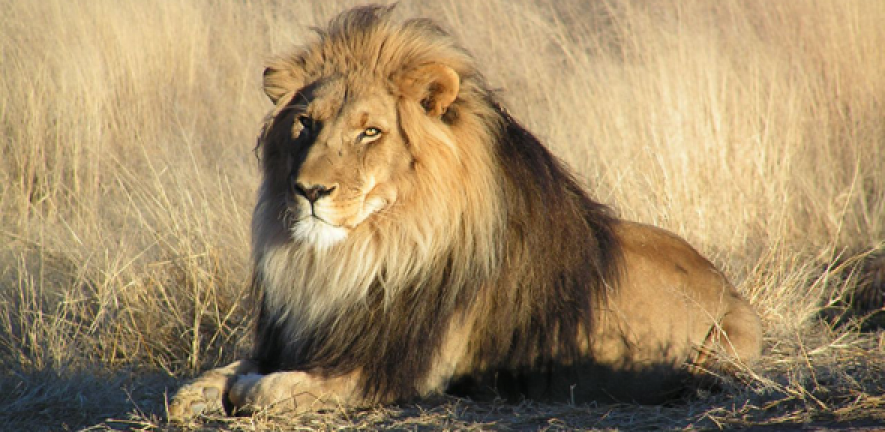
This recurring pattern — of research lions being legally hunted through technicalities — suggests systemic problems with how protected areas are managed and monitored. Collared lions, integral to conservation science, should not be treated as fair game. Their role in understanding ecosystem health, migration patterns, disease spread, and behavior is too critical to be sacrificed for short-term financial gain.
Conservationists are calling for international regulations to protect research animals and improve oversight of trophy hunting. Proposals include buffer zones around national parks, stricter enforcement of hunting quotas, bans on hunting collared animals, and enhanced public transparency about the permitting process.
At the heart of the issue is a question that goes beyond legality — it is about moral responsibility. Should nations continue to profit from activities that destroy the very wildlife they aim to conserve? Can conservation coexist with commodification, or is it time to find new, non-lethal ways to fund Africa’s fragile ecosystems?
Until a more humane and forward-looking conservation model is adopted, the specter of Cecil and now Blondie will continue to haunt the landscape of African wildlife protection. The death of yet another iconic lion, despite the international uproar a decade ago, shows just how precarious the situation remains. Without stronger safeguards, other collared lions in the wild may be doomed to suffer the same fate — and the world will once again be left mourning a loss that could have been prevented.