
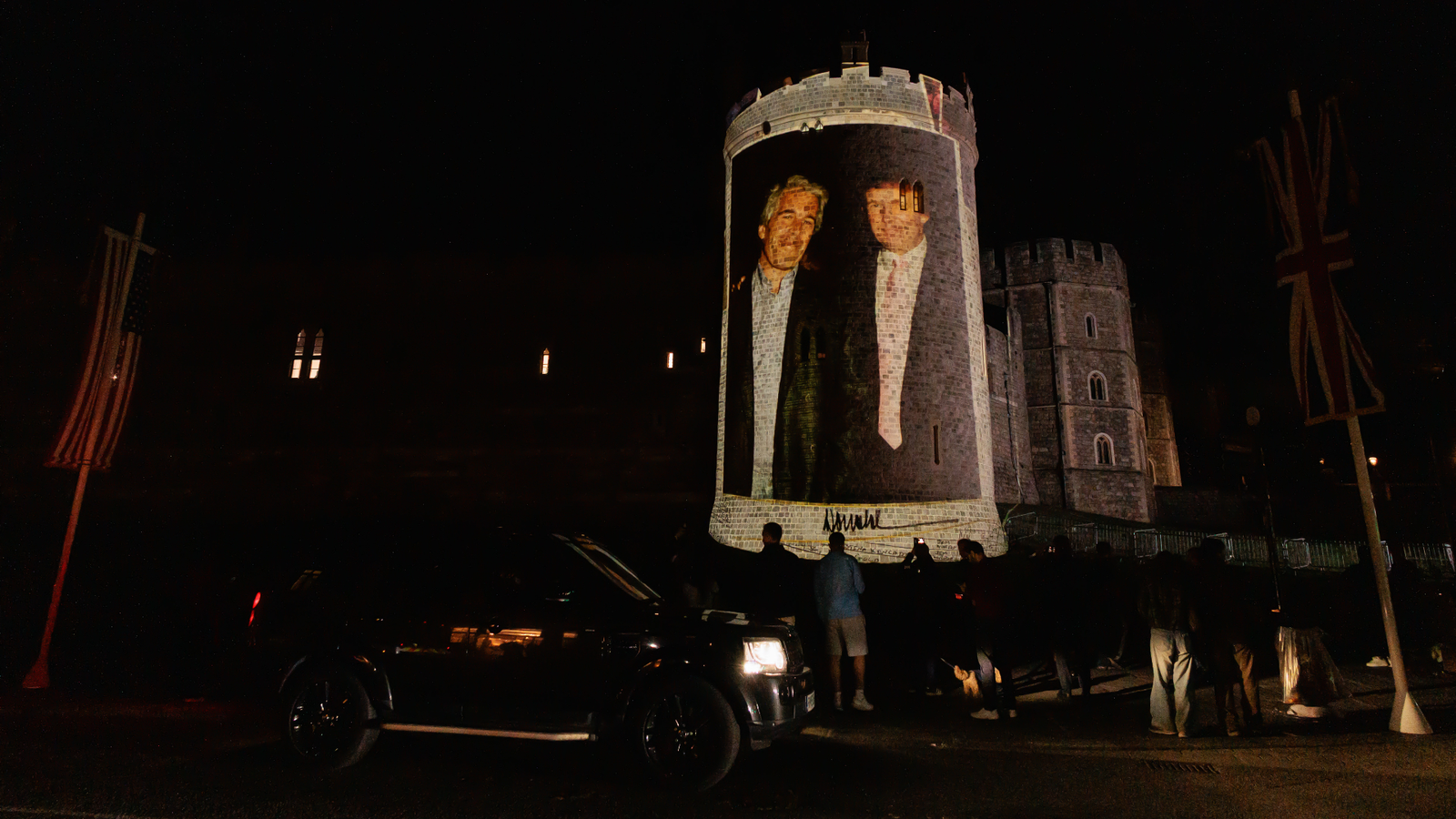
In a bold and controversial act of protest, four individuals were arrested after projecting provocative images of US President Donald Trump alongside convicted sex offender Jeffrey Epstein onto the historic walls of Windsor Castle. The incident unfolded on September 16, 2025, just hours before Trump’s arrival in the United Kingdom for his unprecedented second state visit. As the royal residence prepared to host the American leader and the British monarch, the unauthorized display lit up the night sky, drawing immediate condemnation from authorities and sparking debates over free speech, international diplomacy, and the lingering shadows of Epstein’s scandals.
Thames Valley Police swiftly intervened, detaining the suspects on suspicion of malicious communications, in what they described as a “public stunt” that disrupted the pomp and circumstance of the high-profile visit. This event not only overshadowed the early stages of Trump’s itinerary but also reignited global scrutiny on the president’s past associations, blending street-level activism with the grandeur of transatlantic relations. The projections, which lasted several minutes, featured a montage of photographs, news clippings, and textual excerpts highlighting Trump’s documented ties to Epstein during the 1990s and early 2000s.
Among the visuals was a well-known image of Trump and Epstein at a social event, accompanied by portraits of Epstein’s victims and headlines from major outlets detailing the financier’s crimes. A particularly inflammatory element was the display of an alleged 2003 birthday letter from Trump to Epstein, purportedly containing a lewd doodle and affectionate notes referring to Epstein as a “pal” and wishing him “another wonderful secret.”
Trump has repeatedly denied the authenticity of the letter, which surfaced in congressional investigations earlier this month, and the White House has dismissed it as a fabrication by political opponents. Additional projections included Trump’s mugshot from his 2023 Georgia election interference indictment and footage of the two men socializing, underscoring the protesters’ intent to confront the president with his historical connections amid renewed Epstein-related inquiries.
The stunt was the work of Led By Donkeys, a British activist collective renowned for its guerrilla-style campaigns against political figures through large-scale public art and projections. Founded in the wake of the 2016 Brexit referendum, the group has a track record of targeting high-profile targets with satirical banners and visuals, often unfurling massive displays at landmarks like the Cliffs of Dover or during political conferences. In this instance, Led By Donkeys claimed responsibility via social media, posting an image of the projection with the caption “Hey Donald, welcome to Windsor Castle.”
🇬🇧🇺🇸 Four people arrested after projecting images onto Windsor Castle ahead of President Trump’s visit to the UK. The images included his 2023 mugshot and photos with Jeffrey Epstein. pic.twitter.com/IO3Fr0EBIr
— Hasta la vista, EU (@KrsteKrstevski2) September 16, 2025
The organization framed the action as a necessary reminder of accountability, especially given the timing—mere days after US Democrats in Congress subpoenaed Epstein’s estate and ordered testimony from figures like former Attorney General Merrick Garland and ex-Secretary of State Hillary Clinton as part of a broader probe into Epstein’s network. Led By Donkeys emphasized that their work has historically elicited chuckles from police rather than arrests, calling the detentions “Orwellian” and “ridiculous,” suggesting an overreach influenced by the event’s diplomatic sensitivity.
The Arrests and Immediate Aftermath
Thames Valley Police responded with remarkable speed to reports of the unauthorized projection on one of Windsor Castle’s towers, halting the display and apprehending four adult males at the scene. The suspects, identified by authorities as a 60-year-old man from East Sussex, a 36-year-old and a 50-year-old from London, and a 37-year-old from Kent, were taken into custody on suspicion of malicious communications—a charge that encompasses sending or displaying material intended to cause distress or anxiety.
Chief Superintendent Felicity Parker, speaking on behalf of the force, underscored the gravity of the situation: “We take any unauthorised activity around Windsor Castle extremely seriously.” The arrests occurred shortly after Trump’s Air Force One touched down at Stansted Airport, ensuring the incident did not directly interrupt his motorcade but certainly amplified media coverage as he settled into his itinerary. By the following day, September 17, the four men remained in custody as an investigation unfolded, with police vowing a thorough probe into the technical aspects of the projection—likely involving high-powered lasers or projectors positioned nearby.
Read : Home of The British Royal Family – Windsor Castle Raided by Two Thieves
In a related development, two additional men, both aged 37 and from the London area, were arrested separately for breaching temporary airspace restrictions by operating drones over Windsor, though these incidents were not directly linked to the projections. Led By Donkeys expressed dismay over the detentions, noting in statements to the press that their activists had faced no such repercussions in past operations, even when engaging with law enforcement on-site. “Often the police come along and we have a chat, and they even have a laugh with us,” a group spokesperson remarked, highlighting a perceived escalation in response to the target’s status.
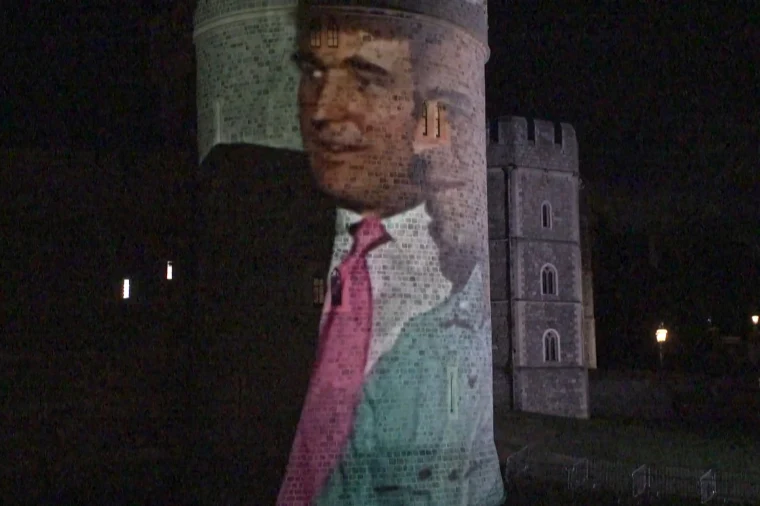
The immediate fallout rippled through security protocols for the state visit. Windsor Castle, a symbol of British monarchy since the 11th century, was placed under heightened alert, with additional patrols and surveillance to prevent copycat actions. Protesters, undeterred, had already unfurled a massive banner featuring Trump and Epstein along a path leading to the castle earlier that day, accompanied by the message “Welcome to the UK, Donald.”
This prelude to the projection underscored the organized nature of the opposition, coordinated by the Stop Trump Coalition, which mobilized thousands for demonstrations in central London on September 17. While the arrests quelled the nighttime spectacle, they fueled accusations of heavy-handed policing, with human rights advocates questioning whether the charges truly constituted malice or merely pointed political critique.
Broader Context: Trump’s UK Visit and Epstein’s Shadow
President Trump’s second state visit to the United Kingdom, spanning just 48 hours, was billed as a triumphant return to strengthen the “special relationship” between Washington and London. Arriving on the evening of September 16, Trump and First Lady Melania were whisked to a private residence before the centerpiece of the trip: a full day at Windsor Castle on September 17. There, King Charles III extended a ceremonial welcome in the castle’s quadrangle, complete with a guard of honor from the Coldstream Guards.
The agenda included a private lunch with the royal family, a viewing of a special Royal Collection exhibition, and a poignant wreath-laying at the tomb of the late Queen Elizabeth II in St. George’s Chapel—a gesture of respect echoing their 2019 visit. The day culminated in a state banquet hosted by Charles and Queen Camilla, followed by a spectacular flypast featuring the Red Arrows aerobatic team alongside US and UK F-35 jets, and a Beating Retreat ceremony on the east lawn.
Notably, the visit featured no public-facing engagements for Trump, a departure from his first trip in 2019, which had drawn massive protests. This seclusion at Windsor allowed the pageantry to proceed insulated from the streets, though the projection stunt pierced that veil dramatically. Trump, in brief remarks upon arrival, praised Charles and Camilla as “friends of mine for a long time,” downplaying any tensions.
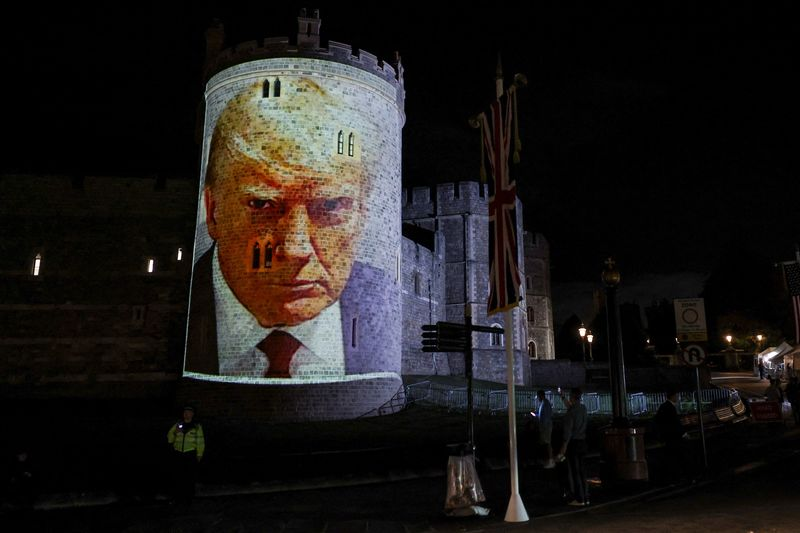
Yet the Epstein projections cast a pall, coming amid fresh revelations: just a week prior, UK Prime Minister Keir Starmer had dismissed Lord Peter Mandelson as ambassador to the US over his own Epstein connections, a move that strained bilateral ties. Epstein, who died by suicide in a New York jail in 2019 while awaiting trial on sex trafficking charges, had long haunted Trump’s orbit. Flight logs show the president flew on Epstein’s plane multiple times, and survivors have recounted Epstein boasting of their friendship, including keeping a framed photo of Trump on his desk.
The incident also intersected with domestic US politics. Congressional Democrats’ recent release of the alleged birthday letter—denied by Trump as a hoax—has intensified calls for transparency, with subpoenas targeting Epstein’s associates. In the UK, the projections amplified anti-Trump sentiment, with Led By Donkeys positioning their action as a defense of victims’ voices against elite impunity. Critics, including conservative commentators, decried the stunt as tasteless and un-British, arguing it undermined the monarchy’s neutrality. Supporters, however, hailed it as a masterstroke of dissent, reminiscent of historical protests like the Suffragettes’ castle disruptions.
Implications for Protest, Diplomacy, and Accountability
The Windsor Castle projections transcend a mere prank, encapsulating the fraught dynamics of protest in an era of digital activism and strained international optics. For Led By Donkeys, the arrests represent a rare setback in a career of viral triumphs, prompting soul-searching about the risks of targeting figures of Trump’s caliber during state-sanctioned events. The group’s “Orwellian” label evokes fears of chilling effects on satire, especially as UK laws on malicious communications evolve to address online harassment.
Legally, the suspects now face bail conditions and potential court dates, with outcomes that could set precedents for artistic expression near royal sites. By September 18, the four men had been released on bail, pending further inquiries, allowing them to reflect on a stunt that garnered millions of views but at personal cost. Diplomatically, the episode underscores vulnerabilities in hosting controversial leaders. Trump’s visit, meant to reset US-UK relations post-Brexit and amid trade negotiations, was marred not just by the projections but by concurrent London rallies drawing tens of thousands under slogans like “Dump Trump.”
Buckingham Palace maintained stoic silence, focusing on the “warmth and hospitality” extended to guests, yet whispers of embarrassment circulated among aides. For Trump, the incident provided fodder for his narrative of a “witch hunt,” with allies decrying it as foreign meddling in American affairs. It also spotlighted Epstein’s enduring toxicity: despite years of distance—Trump banned Epstein from Mar-a-Lago in 2007 after misconduct allegations—their shared past refuses to fade, amplified by victims’ testimonies and Ghislaine Maxwell’s ongoing imprisonment.
Ultimately, this clash at Windsor’s ancient stones highlights the collision of history and headline. As the castle’s lights dimmed on the projections, they illuminated deeper questions: How far can protest pierce the armor of power? In an age where images travel faster than diplomacy, such stunts remind us that accountability often arrives not through quiet negotiations, but in flashes of defiant light. With Trump’s term winding down and Epstein’s secrets still unraveling, the world watches to see if Windsor marks a footnote or a flashpoint in the saga of influence, scandal, and sovereignty.