

The recent detention of Tufts University doctoral student Rümeysa Öztürk by Immigration and Customs Enforcement (ICE) has sparked widespread outrage and concerns over constitutional rights and academic freedom in the United States.
On Friday, a U.S. district judge ruled that Öztürk cannot be deported without a court order, putting a temporary hold on her removal from the country. This decision has brought national attention to the case, which many believe exemplifies the government’s overreach in targeting students based on political views.
A Controversial Detention
Rümeysa Öztürk, a Fulbright scholar and doctoral student at Tufts University, was arrested on Tuesday in a Boston-area suburb by masked, plainclothes ICE officers. Surveillance footage of the incident has since gone viral, fueling public anger and demands for accountability.
According to the Department of Homeland Security (DHS), her visa was terminated due to alleged ties to Hamas, an accusation made without any presented evidence.
Her lawyers argue that the arrest was politically motivated, pointing to an opinion piece she co-authored in a student newspaper that called for Tufts University to acknowledge what it termed the “Palestinian genocide” and to divest from companies linked to Israel.
Read : Turkish Student at Tufts University Arrested While Going for Iftar
Despite the DHS claims, Öztürk has not been formally charged with any crime. Her legal team, which includes attorneys from the American Civil Liberties Union (ACLU), describes her detention as unconstitutional and an act of retaliation against her free speech rights.
Tufts student Rumeysa Ozturk was detained by ICE.
— Tori Bedford (@Tori_Bedford) March 26, 2025
A video shared with GBH News shows a man in a hoodie approach her, then grab her wrists. Ozturk screams, then asks “Can I call the police?” before being told “We’re the police.”https://t.co/6dwvEmqjVr@sweetadelinevt @GBHNews pic.twitter.com/NAAgGVpp9G
The ACLU has further alleged that the government disregarded a prior court order by secretly transferring Öztürk to Louisiana without notifying her legal counsel.
Legal Battles and Judicial Intervention
Following her attorneys’ urgent legal filings, U.S. District Judge Denise Casper ruled that Öztürk could not be deported without further orders from the court. The ruling serves as a temporary safeguard against her immediate removal while the legal process unfolds.
Additionally, the judge ordered the U.S. government to respond to Öztürk’s latest legal claims by Tuesday evening, indicating that the case is far from over.
The judicial intervention has provided some relief for Öztürk’s supporters, but concerns persist over her treatment in ICE custody. According to her lawyers, she suffered an asthma attack while being transported to Louisiana and was unreachable for nearly a full day following her arrest.
Critics argue that this lack of transparency and communication highlights systemic issues within U.S. immigration enforcement, particularly in cases involving politically active individuals.
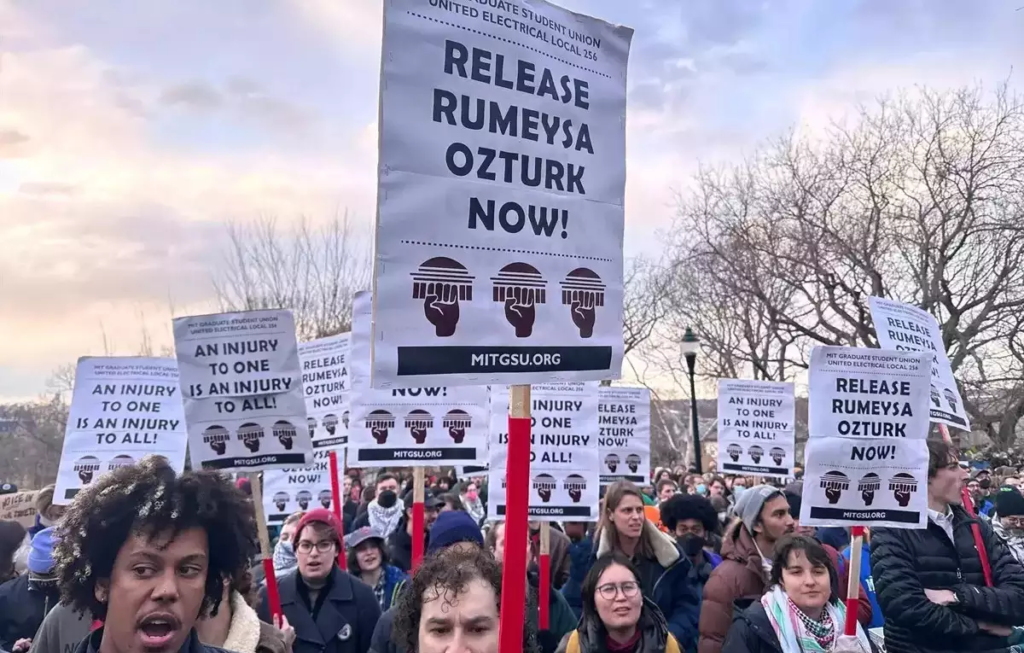
Her legal team maintains that the U.S. government’s actions violate fundamental rights. “Criticizing U.S. foreign policy and human rights violations is neither illegal nor grounds for detention,” said attorney Mahsa Khanbabai. The ACLU has vowed to continue fighting for Öztürk’s release and to ensure that immigration laws are not used as a tool for political suppression.
Broader Implications for Academic Freedom and Free Speech
The case of Rümeysa Öztürk has ignited debates on academic freedom and the extent to which the U.S. government can take punitive action against students for their political views. Advocacy groups and academic institutions have expressed concerns over what they see as an emerging pattern of targeting students involved in pro-Palestinian activism.
Reports indicate that the Trump administration ramped up efforts to deport students and academics connected to such activism, even in cases where individuals held permanent residency or valid visas.
This crackdown raises serious questions about the limits of free speech, particularly for international students. Many fear that the government is using immigration status as a means to silence political dissent, setting a dangerous precedent that could extend beyond this case.

“Grabbing someone off the streets, stripping them of their student visa, and detaining them solely based on political viewpoint is an affront to all of our constitutional rights,” said Jessie Rossman, legal director of the ACLU of Massachusetts.
Even beyond the legal dimensions, the case has implications for how international scholars perceive the U.S. as a destination for academic pursuits.
Many universities actively recruit international students with promises of intellectual freedom and safety. However, cases like Öztürk’s could deter future scholars from choosing American institutions, fearing potential political persecution.
As the legal battle continues, Öztürk’s supporters remain steadfast in their calls for her release and an end to what they see as politically motivated immigration enforcement. The case serves as a litmus test for the U.S. commitment to protecting free speech, academic expression, and the rights of non-citizens residing in the country.
The upcoming responses from the government and the judicial proceedings will determine whether this case marks a temporary overreach or a dangerous shift in how political dissent is handled within the immigration system.