

Tulare Lake, once the largest freshwater body west of the Mississippi River, has astonishingly reemerged in California’s San Joaquin Valley after more than 130 years. This revival is the result of extraordinary snowmelt from the Sierra Nevada mountains, driven by a series of atmospheric rivers that struck California in 2023.
The lake, long thought lost to history and human development, now spreads once again across a vast stretch of fertile farmland, forcing the region to reckon with both its environmental past and its agricultural future.
Before vanishing in the late 19th century, Tulare Lake was an immense freshwater lake, spanning over 100 miles in length and up to 30 miles wide during peak periods. Fed primarily by snowmelt from the Kings, Kaweah, Tule, and Kern Rivers, the lake served as a thriving ecological and cultural hub.
The Indigenous Tachi Yokut tribe, who called the lake “Pa’ashi,” lived along its shores, fishing, hunting, and gathering its natural bounty. The lake was a central part of their identity and livelihood, intricately tied to their cultural and spiritual practices.
As settlers moved into California during the colonial era and expanded agricultural operations in the fertile Central Valley, Tulare Lake began to vanish. By the early 20th century, aggressive irrigation projects and the construction of canals and levees diverted the lake’s inflow to feed fields of cotton, almonds, and vegetables.
What remained of Tulare Lake turned into farmland—land that would become some of the most productive agricultural soil in the United States, but at the cost of a vast natural ecosystem.
A Lake Buried by Progress
The disappearance of Tulare Lake marked a major shift in California’s relationship with its natural water systems. The desire to maximize arable land and boost agricultural output led to the redirection of rivers and the draining of wetlands. Tulare Lake’s basin, once teeming with waterfowl, fish, and aquatic plants, was gradually converted into dry, cultivable soil.
Steamships that once traversed its waters between Bakersfield and San Francisco became relics of a bygone era. Entire communities and industries were built on land that had once been submerged, with little expectation that the lake might ever return.
Yet, nature is persistent. In 2023, a combination of meteorological and climatic events disrupted this carefully engineered transformation. A series of atmospheric rivers—a meteorological phenomenon that brings intense, moisture-laden air from the Pacific Ocean—brought record-breaking snowfall to the Sierra Nevada mountains.
Read : Nine-Year-Old Boy Died After Getting Trapped Between Rocks in New South Wales
As temperatures rose in the spring, that snow rapidly melted, overwhelming the existing water infrastructure in the San Joaquin Valley. The rivers that had once fed Tulare Lake flowed once again into its ancient basin, resurrecting the ghost lake that had been dormant for over a century.
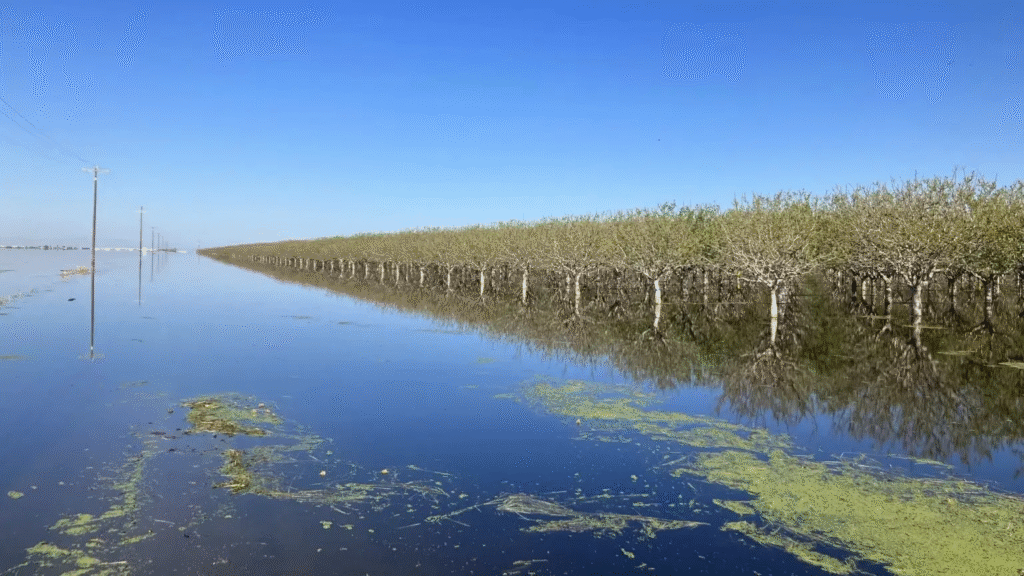
The reappearance of Tulare Lake is more than just a geographical curiosity. It serves as a poignant reminder of the impermanence of human attempts to dominate nature. Thousands of acres of farmland were flooded, roads were washed out, and entire communities were forced to evacuate or adapt to rising waters.
Crops that had been carefully planted and nurtured were submerged beneath feet of water. Farmers who had long depended on the predictability of irrigation schedules were suddenly grappling with nature’s volatility.
Indigenous Voices and Environmental Memory
For the Tachi Yokut people, the lake’s return is deeply symbolic. For generations, they have preserved oral histories and cultural knowledge of Pa’ashi, even as it disappeared from the map. The lake was not forgotten—it was merely dormant.
Now, its revival has stirred emotions within the tribe, blending a sense of loss with a renewed connection to their ancestral homeland. Some members view the lake’s return as a spiritual event, a sign that the land remembers and is capable of healing, even after decades of disruption.

Vivian Underhill, a researcher who studied the lake while affiliated with Northeastern University’s Social Science and Environmental Health Research Institute, has documented how Tulare Lake’s reappearance has impacted both Indigenous communities and broader environmental discourses.
She noted that the lake’s historical significance and its recent return challenge modern conceptions of land use, water rights, and ecological resilience.
The Tachi Yokut are also taking a renewed interest in land stewardship, emphasizing the importance of integrating Indigenous ecological knowledge with contemporary environmental planning. The flooding has brought their concerns to the forefront, highlighting the need for sustainable water management that considers not only agricultural productivity but also historical justice and environmental restoration.
A Future of Reflection and Reckoning
Tulare Lake’s reemergence has sparked broader discussions about California’s long-term water strategy and the sustainability of its agriculture-heavy economy. For decades, the Central Valley has functioned as the breadbasket of the United States, relying heavily on irrigation in a region with minimal rainfall. But the rebirth of Tulare Lake challenges assumptions about water security and land use in an era of climate unpredictability.
Flooded farmlands and displaced communities have prompted emergency responses and raised difficult questions about compensation, infrastructure, and resilience. Should certain areas that lie within the ancient lakebed be permanently set aside as floodplains or restored wetlands? Is it wise to rebuild irrigation networks in regions prone to such dramatic hydrological reversals?
Environmental scientists and policymakers are now reexamining California’s relationship with its rivers and lakes. The resurrection of Tulare Lake is not just a fluke event—it could become a recurring pattern if climate change continues to bring erratic precipitation and snowmelt. That possibility demands a fundamental rethink of how the state allocates water, prepares for floods, and balances the demands of agriculture with ecological preservation.
For some, the return of Tulare Lake is an opportunity to restore parts of California’s original landscape. Environmental advocates see the potential for reintroducing wetlands, creating wildlife habitats, and reducing groundwater depletion by allowing nature to reclaim its space. Such initiatives could reduce flood risks in the future while improving biodiversity and honoring Indigenous stewardship principles.
The challenge, of course, lies in the conflict between economic interests and ecological integrity. The San Joaquin Valley is home to a multibillion-dollar agricultural industry that feeds millions and employs thousands. The tension between short-term economic necessity and long-term environmental responsibility is stark. Balancing these competing priorities will require cooperation between government agencies, farmers, Indigenous communities, and scientists.
As California looks ahead, the story of Tulare Lake stands as a cautionary tale and a source of inspiration. It reminds us that nature is never truly conquered, that landscapes have memory, and that our interventions—however well-intentioned—can be undone by forces greater than ourselves. The lake’s reappearance is not just a return of water to land; it is a return of history, of cultural identity, and of environmental consciousness.
In many ways, Tulare Lake is more than a geographic feature. It is a symbol of resilience, of forgotten heritage, and of the need to coexist with, rather than dominate, the natural world. Whether it remains or disappears again, its presence in 2023 has already reshaped the narrative of California’s Central Valley and may yet shape its future for generations to come.