
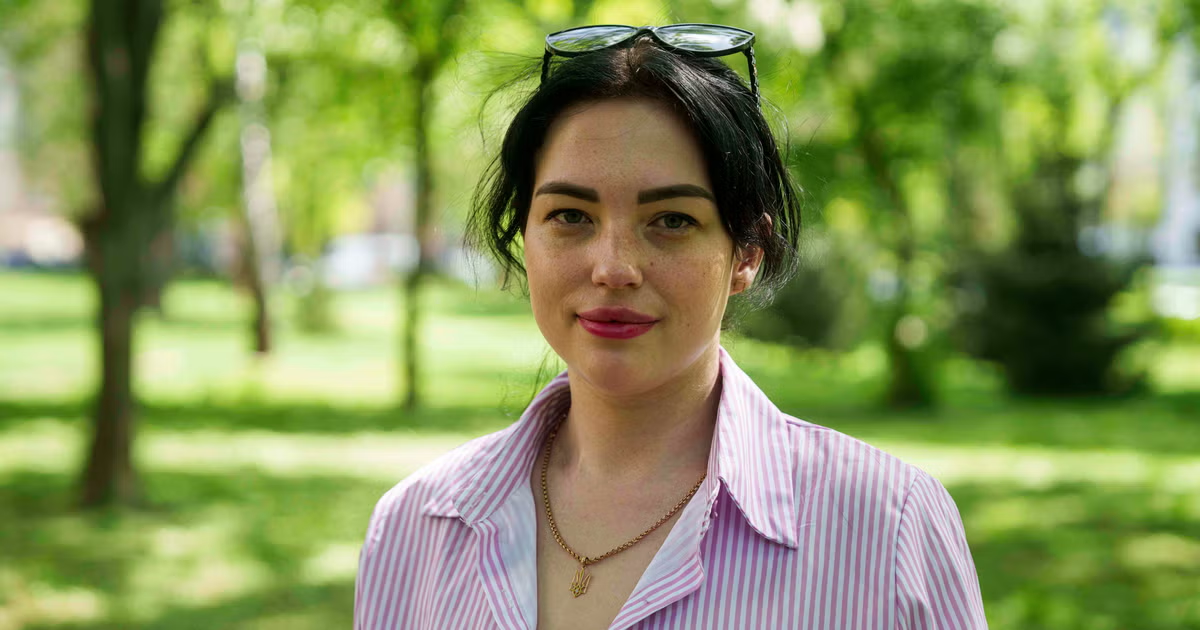
In the war-torn landscapes of Ukraine, where pain and perseverance coexist in every corner, the story of a Ukrainian woman with Stage 4 cancer stands out not just for her fight against a terminal disease, but for her unrelenting quest to bring back the man she loves.
Olha Kurtmalaieva, diagnosed with Hodgkin’s lymphoma, faced not only the collapse of her body but the silence of captivity that swallowed her husband, a Ukrainian marine held by Russian forces. Lying in intensive care, her body failing, she whispered to herself, “You have no moral right to die.” It wasn’t just a will to live. It was a mission—to survive for the man who had no one else waiting for him in Ukraine.
Against all medical odds, Olha achieved remission in 2024. But her story doesn’t end with survival. Her true struggle continues outside the hospital walls, where she stands at nearly every prisoner exchange, holds placards, rallies other women, and relentlessly advocates for the release of Ukrainian prisoners of war. Every breath she takes, every step she makes, is guided by one question: “What did I do today to bring him home?”
A Love Forged in War, and Tested by It
Olha Kurtmalaieva’s journey began long before cancer or captivity. At 15, she met Ruslan Kurtmalaiev in Berdiansk, a town that would later fall under Russian occupation. He was 21, a professional soldier, already marked by the war that began with Russia’s 2014 annexation of Crimea. Their bond was not instant but grew slowly during the summer of 2015. At 18, Olha married him, knowing that life with a soldier would demand strength, sacrifice, and separation.
By 21, she was diagnosed with Stage 2 Hodgkin’s lymphoma. Ruslan stayed by her side through the first grueling rounds of chemotherapy. He supported her as her hair fell, offering affection, comfort, and even humor. He once confessed that he would collect the fallen strands from her pillow before she woke up—an act of tenderness that defined their relationship.
Then came the full-scale Russian invasion of Ukraine in 2022. Medical treatments halted. Hospitals disappeared. Russian troops occupied Berdiansk, isolating Olha and thousands of others from critical care. But the worst news arrived when she learned that Ruslan had been captured. The image of his suffering quickly replaced her own fears. “He’s alive. That’s what matters,” she told herself. Yet the reality of captivity would later prove far more brutal than she could have imagined.
Still inside occupied territory, Olha Kurtmalaieva began to help the Ukrainian resistance in quiet, dangerous ways. Eventually, she escaped Berdiansk, describing the horror of walking through her hometown cloaked in foreign flags and fearing her Ukrainian music might betray her. She reached Kyiv, but the trauma of the journey and years of untreated cancer took its toll. Her condition deteriorated rapidly, and she was rushed to intensive care. Morphine could barely dull her pain. A nurse told her plainly, “You may not wake up tomorrow.”
Read : North Korea Helping Russia Carry Out Mass Murder of Civilians: Ukraine
But Olha wasn’t ready to give up. The thought of Ruslan—tortured, starving, alone—burned stronger than the disease ravaging her body. It gave her something to live for. She survived. And then, she began to fight not for herself, but for him.
Captivity, Cruelty, and the Quiet Strength of Hope
While Olha Kurtmalaieva battled her cancer, Ruslan faced inhuman conditions in Russian captivity. Though the two have shared just one phone call in three years, Olha has built a detailed understanding of his situation from interviews with returned prisoners. She learned that he had suffered broken ribs and a crushed arm from repeated beatings.
He was struck on the head eight times with a hammer, left with bruises more severe than any his cellmates had ever seen. He endured solitary confinement and was psychologically tormented with repetitive Russian anthems and religious texts that ignored his identity as a Muslim and a Crimean Tatar.
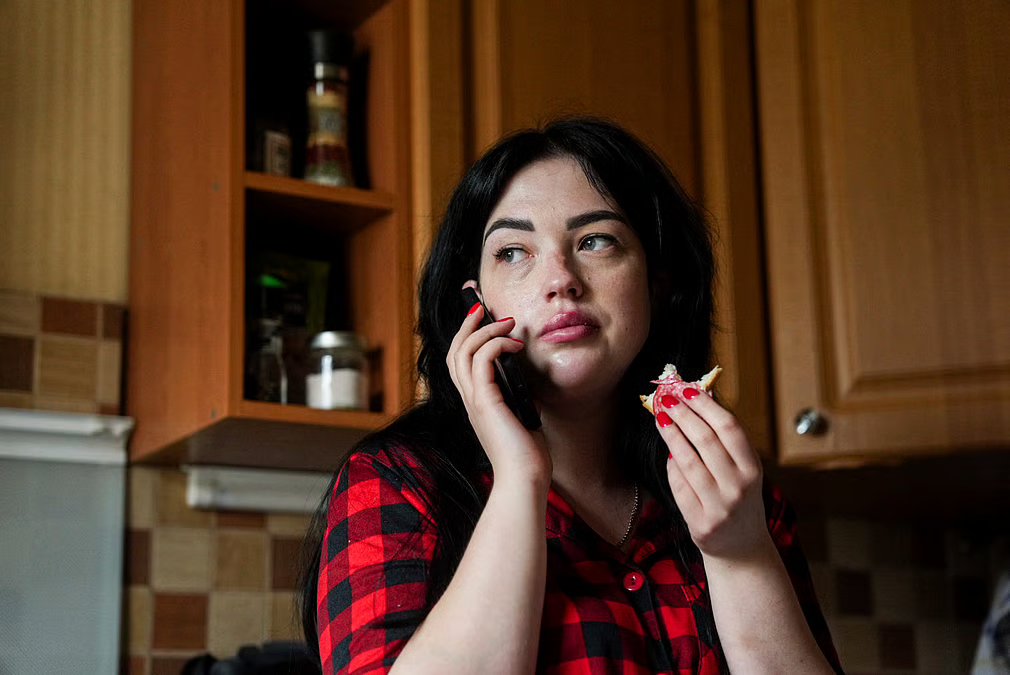
Yet even in this darkness, Ruslan spoke of Olha Kurtmalaieva. “She’s your age, but she’s got a business, she’s strong, she’s fighting for us. She’ll get us out,” he told a fellow prisoner who later recounted the story to her. Those words stay with Olha like a lifeline. They validate her pain, her sacrifice, and her mission.
In remission now, Olha continues her fight beyond the hospital walls. She co-founded the Marine Corps Strength Association, an organization representing over 1,000 Ukrainian prisoners of war. Through this platform, she advocates for international attention, facilitates peaceful rallies, and speaks with media outlets, ensuring that the plight of her husband and others like him is never forgotten.
She writes letters to Ruslan, but they never reach him. Her words vanish into the silent machinery of war. Still, she writes. She holds his image in her wallet, on her phone, on every wall of her home. Every decision, every heartbeat, is connected to him. “He’s everywhere in my life,” she says. And yet he is nowhere within her reach.
From Survival to Purpose: A Mission Beyond the Personal
Olha Kurtmalaieva’s personal victory over cancer was not an end, but a beginning. Her body, once frail and failing, now marches tirelessly in protest, advocacy, and organization. She juggles activism with running an online cosmetics store—a practical necessity, and a symbol of resilience. She continues to collect testimony from returned prisoners, piecing together clues about Ruslan’s condition like a detective driven by love.
Through the Marine Corps Strength Association, she gives voice to hundreds of women—wives, sisters, daughters—who wait in agony for the return of their loved ones. In each prisoner exchange, she stands in anticipation, her eyes scanning the released faces. Time and again, her hopes are dashed. Yet she returns, every time.
The war has taken nearly everything from Olha Kurtmalaieva—her health, her home in Berdiansk, her sense of safety. But it could not take her determination. Her journey is not one of helpless grief, but fierce resolve. “I can’t afford to be weak,” she says. “How can a marine’s wife be weak?”
As the war continues and negotiations drag on, Olha Kurtmalaieva’s fight serves as both a personal mission and a national symbol. She reminds the world that behind every soldier lost in battle or captivity, there is someone waiting, hoping, surviving just one more day. Her life, now lived for two people, is a rare blend of love, endurance, and unshakeable faith.
In a world shattered by war, she has stitched together her purpose with pain, refusing to surrender. Because she knows that someone, somewhere, is still counting on her.
And she will not stop until he comes home.